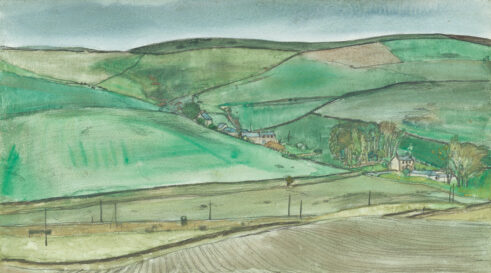
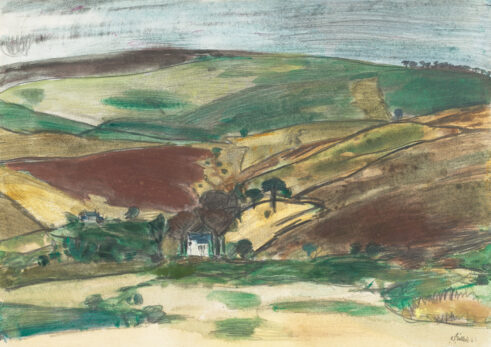
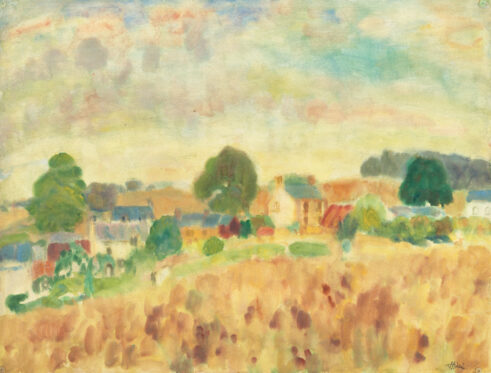
Gillies made a rare foray south of the border in 1958 to the Cumbrian village of Cartmel. The Priory has a long colourful history surviving Scottish raids in the 14th Century, and Henry VIII and Cromwell in those succeeding. The Scottish National Gallery of Modern Art has a pencil drawing inherited from the Lillie Collection of the same subject, but from a different angle and there are at least two paintings including this splendid example. Gillies has placed himself, respectfully, outside the grounds, looking in over a low stone wall running the full length of his composition. The buildings and bare winter trees are brightly lit by a winter sun, under a dark sky.
About Sir William Gillies

Sir William Gillies was the dominant figure of the Edinburgh School over which both his personality and his work had a quiet authority. He led by example at the College of Art, encouraging his students to experiment but from a firm grounding in looking, and of course practice, drawing in particular. He also selected his staff to reflect this ethos: men and women who had a similar independence but respected hard work, what William MacTaggart called the good habit. The duties of teaching for Gillies and many of his colleagues in the School of Drawing and Painting were combined with their own practice without conflict; being a professional painter: working and exhibiting, was understood as integral to the reputation and health of the School. Robin Philipson, Elizabeth Blackadder, John Houston, David Michie and James Cumming were the beneficiaries of this attitude, along with their students, quietly instilled by Gillies over his fifty years of influence.