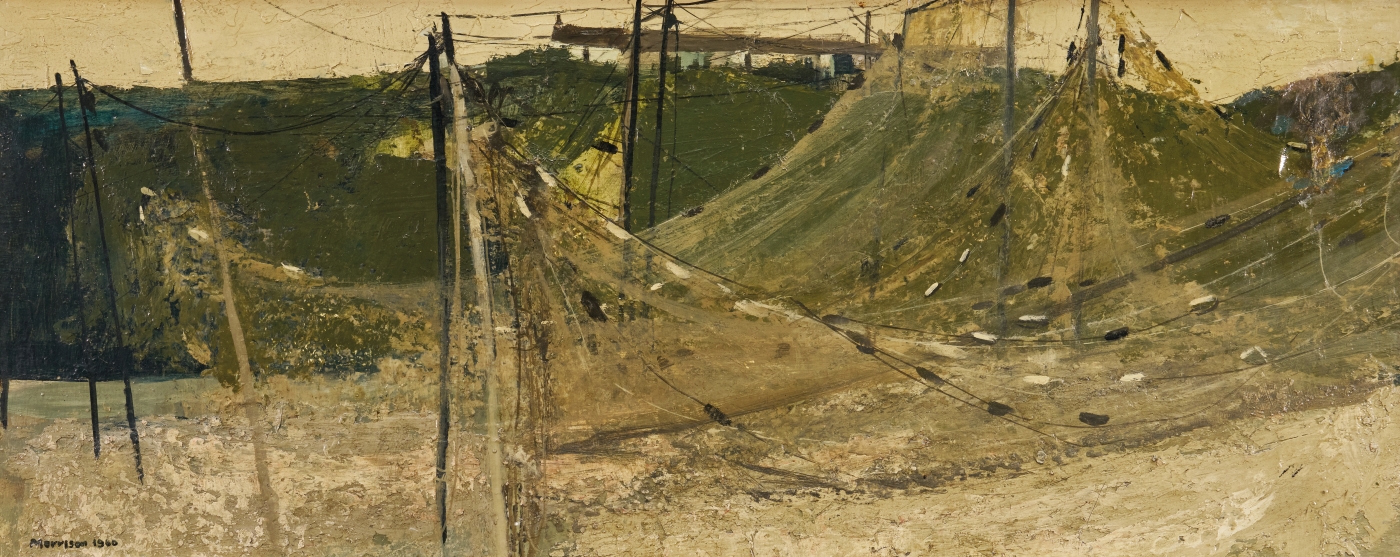
Painted just two years after James and his wife Dorothy Morrison arrived in Catterline, Drying the Fishing Nets, Catterline belongs to one of the most significant periods in the artist’s development. In 1958 the young couple left Glasgow after securing teaching posts in the northeast and settled in the small fishing village overlooking the North Sea. For Morrison, who had been born, educated and established as a painter in Glasgow, the move represented an encounter with a world entirely unfamiliar to him.
His first mature subject had been the tenements of Glasgow. The sandstone terraces and streets of the city provided both structure and human presence, allowing him to explore the relationship between people and place. Arriving in Catterline, he found himself confronted by an altogether different landscape, shaped by weather, farming, fishing and the sea. Morrison instinctively sought points of connection. He befriended the local fishermen, immersed himself in the rhythms of village life and began painting the boats, cottages, harbour and drying nets that surrounded him. These became the human anchors through which he could begin to understand the landscape itself. As Morrison later recalled, landscape was not simply something seen but something lived and worked.
In Drying the Fishing Nets, Catterline the village is viewed from below, looking up from the beach towards the row of cottages that crown the hillside. The composition is organised through a sequence of dark vertical poles and fence posts which draw the eye into the painting before carrying it upwards towards the houses above. Suspended between them, the great arcs of drying salmon nets sweep across the surface, creating a complex web of lines that binds together land, sea and sky. The nets are both subject and structure: traces of human labour that provide the framework through which the landscape is understood.
The cottages along the skyline are equally important. Morrison was fascinated by the relationship between the working community and the terrain it inhabited, and here the village appears almost as an extension of the hillside itself. At the left-hand end of the row stands No.1 South Row, the cottage and store associated with Joan Eardley, whose presence in Catterline was just another neighbour who was part of village life.
Of all Morrison’s early paintings, this one is closely aligned to Joan Eardley’s vision of the village whilst the painting remains unmistakably Morrison’s. Where Eardley often confronted the elemental drama of sea and storm directly, Morrison was already searching for the underlying order of the landscape. The vertical poles, the tension of the netting and the measured placement of the cottages reveal an artist increasingly concerned with structure, rhythm, and spatial relationships. The painting records Morrison’s first reckoning with the sea, the land and the people of the northeast. More importantly, it reveals the beginnings of the visual language that would sustain him for the rest of his career. The nets, poles and cottages perform the same role that the Glasgow tenements once had: they provide a human framework through which a larger understanding of landscape can emerge. Beyond them lies the subject that would occupy Morrison for the next six decades – the enduring relationship between land, light and atmosphere under a northern sky.
signed and dated lower left
About James Morrison

Born in Glasgow in 1932, James Morrison was one of the most significant Scottish landscape painters of the post-war period. He studied at Glasgow School of Art from 1950–54, developing the rigorous observational practice and draughtsmanship that would underpin a career spanning more than six decades. While his early paintings focused on the streets and tenements of Glasgow, his move to Catterline in 1958 marked a decisive shift towards landscape and established many of the themes that would define his mature work.