Close
Bet Low was a painter best known for her deceptively simple watercolours of Scottish landscapes. She also produced expressionist drawings of post-war Glasgow, portraits, atmospheric oil paintings and, later, finely detailed and haunting pencil drawings.
Born in Gourock, she developed an early love for landscape and the sea. At Greenock Academy, she showed talent in both art and music, winning the Rankin Art Prize. In 1942, she entered the Glasgow School of Art, where one of her tutors was David Donaldson, later the Queen’s Limner in Scotland. Among her friends were Benno Schotz, Joan Eardley, Stanley Baxter, Jack Gerson and Ian Hamilton Finlay.
After art school, she spent three months at Hospitalfield, Arbroath, under the guidance of James Cowie, who encouraged her interest in literature, drama, poetry, politics and philosophy an intellectual curiosity that remained with her throughout her life. Low briefly attended teacher training college at Jordanhill but found the experience uninspiring. A chance encounter with Stanley Baxter led her to Glasgow’s newly formed Unity Theatre, where she became involved with rehearsals and never returned to teaching. Unity Theatre shared a building with the Refugee Centre, and Low thrived in its cosmopolitan atmosphere, surrounded by actors, writers, folk singers and artists.
Living in a cold room on Sauchiehall Street, she supported herself through odd jobs at Unity Theatre and illustration work for periodicals, while painting portraits of actors and stage crew. In 1946, she joined the Clyde Group of Writers and Artists, whose manifesto was to take art to the people. She helped to organise exhibitions and poetry readings across Glasgow and produced evocative street drawings that now serve as a historical record of the time.
Low exhibited with the Society of Scottish Independent Artists, had paintings accepted by the Royal Glasgow Institute, and took part in shows at the New Art Club, founded by J. D. Fergusson and Margaret Morris. They became friends and mentors, supporting her and other independent artists. In 1956, she joined them in organising the first open-air exhibitions on the railings of Glasgow’s Botanic Gardens.
Low joined the Glasgow Group Society in the mid-1960s and exhibited regularly with them. In 1985, the Third Eye Centre, Glasgow, held a major retrospective exhibition of her work.
Edited extract from Bet Low’s Obituary, The Herald, 2007.
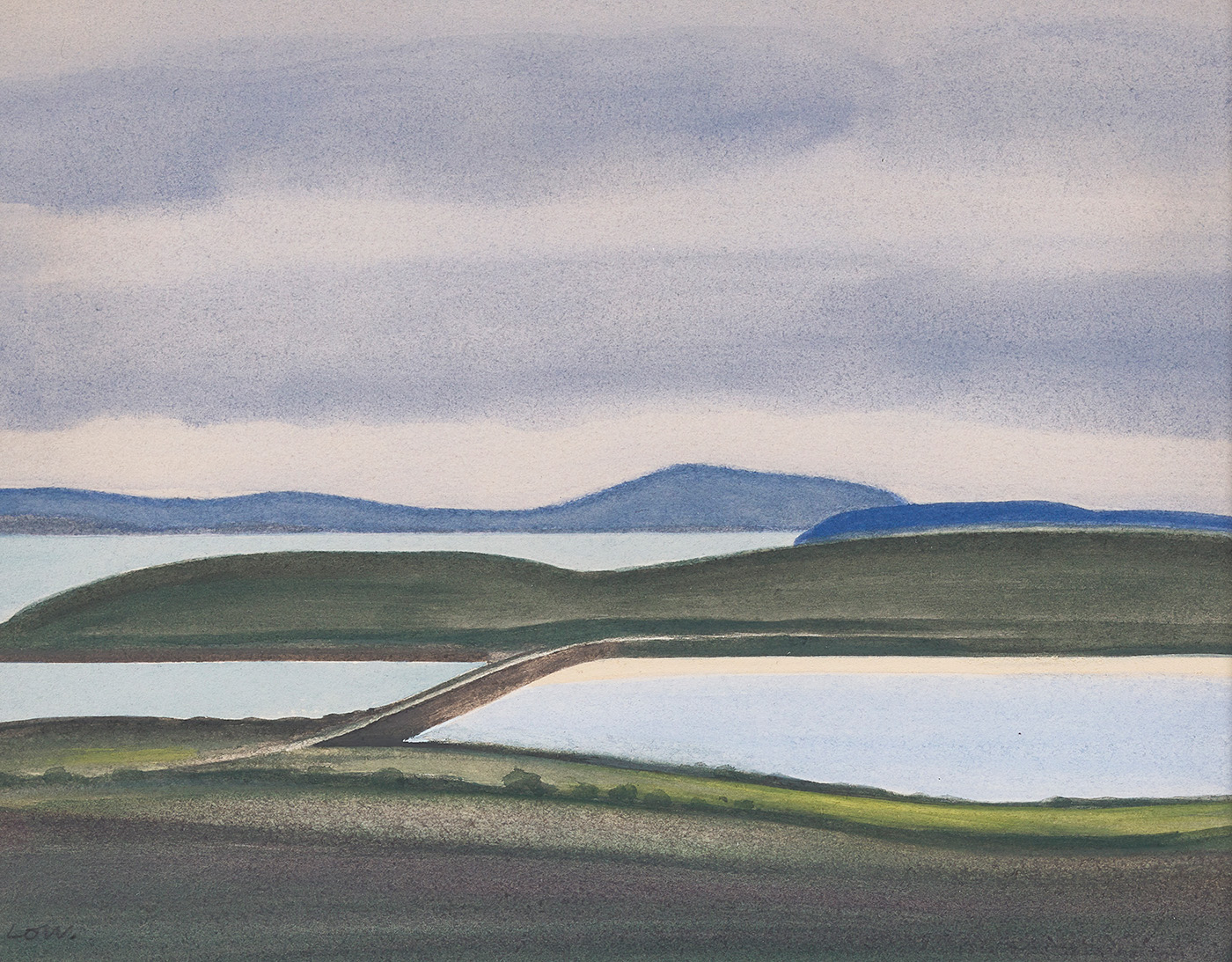
From the late 1960s, Bet Low’s connection with Orkney became central to her life and work. In 1967, she and her husband, the journalist Tom Macdonald, bought a small cottage at Lyness on the island of Hoy. Although she continued to live and work in Glasgow, the landscape of Hoy, with its vast horizons and ever-shifting light, came to define much of her later painting.
In Orkney, Low’s style evolved towards a language of quiet reduction and poetic clarity. The complex, urban expressionism of her early Glasgow work gave way to a restrained, contemplative approach in which land, sea and sky were distilled into broad tonal fields and simple geometric divisions. The Orkney paintings, often made from sketches and notes developed later in her studio, convey a deep sense of stillness and space.
Her island works reflect an intuitive understanding of the northern light, luminous, spare and at times austere and an emotional connection to place that transcends literal description. Critics have observed that in these works Low achieved a balance between abstraction and observation, creating landscapes that are both profoundly personal and universally resonant.
She spent many summers on Hoy, where her friendship with the poet George Mackay Brown led to a collaborative poster poem: Orkney, the Whale Islands. The Orkney period marked a culmination of her lifelong engagement with landscape, culminating in paintings that remain among the most meditative and distinctive in modern Scottish art.
Her work is widely collected with twelve examples in public collections.

Struggling to find that perfect gift? We have the solution! A Scottish Gallery Gift Voucher is the perfect gift for friends, family, customers and colleagues.

Own Art is a national initiative that makes buying contemporary art and craft affordable by providing interest-free credit for the purchase of original work.