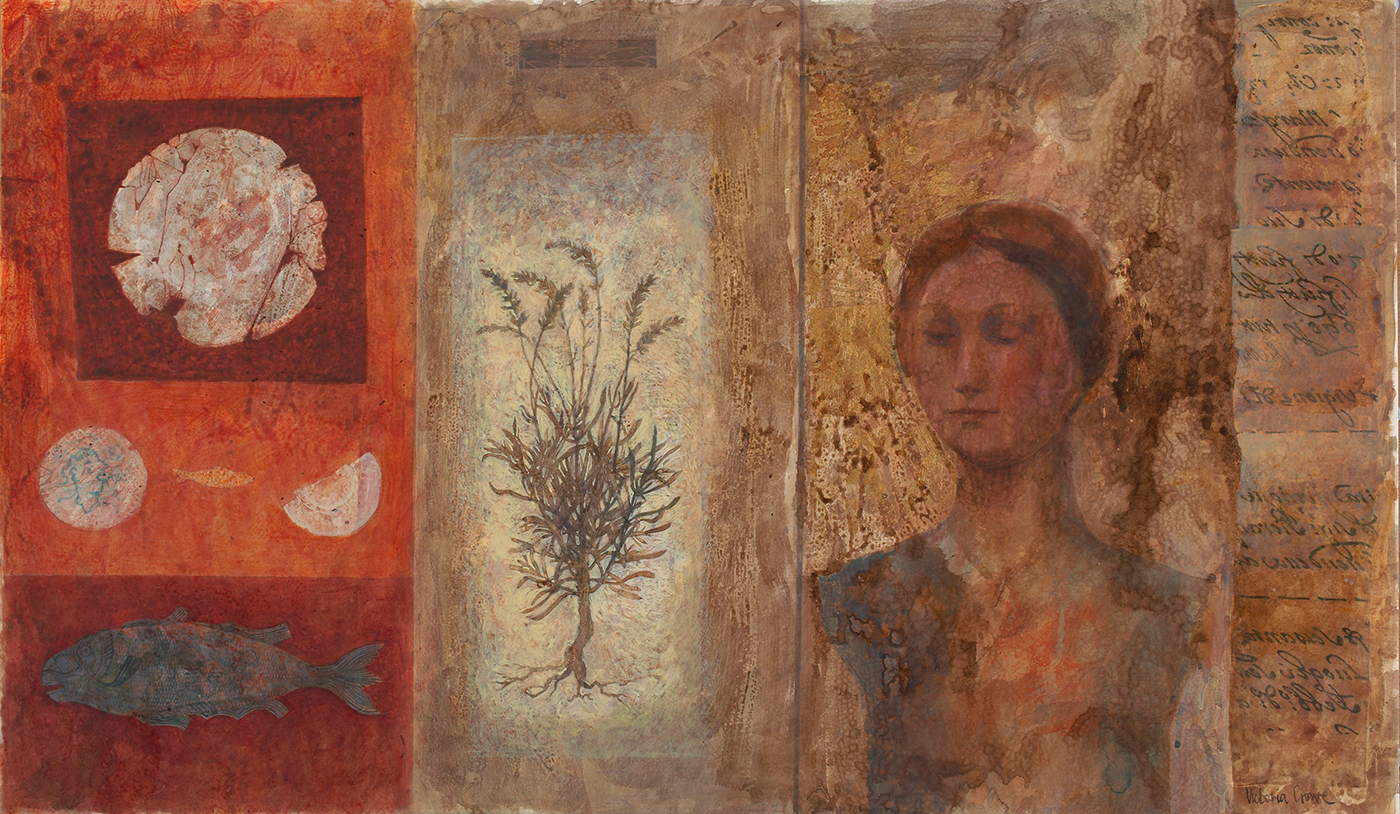
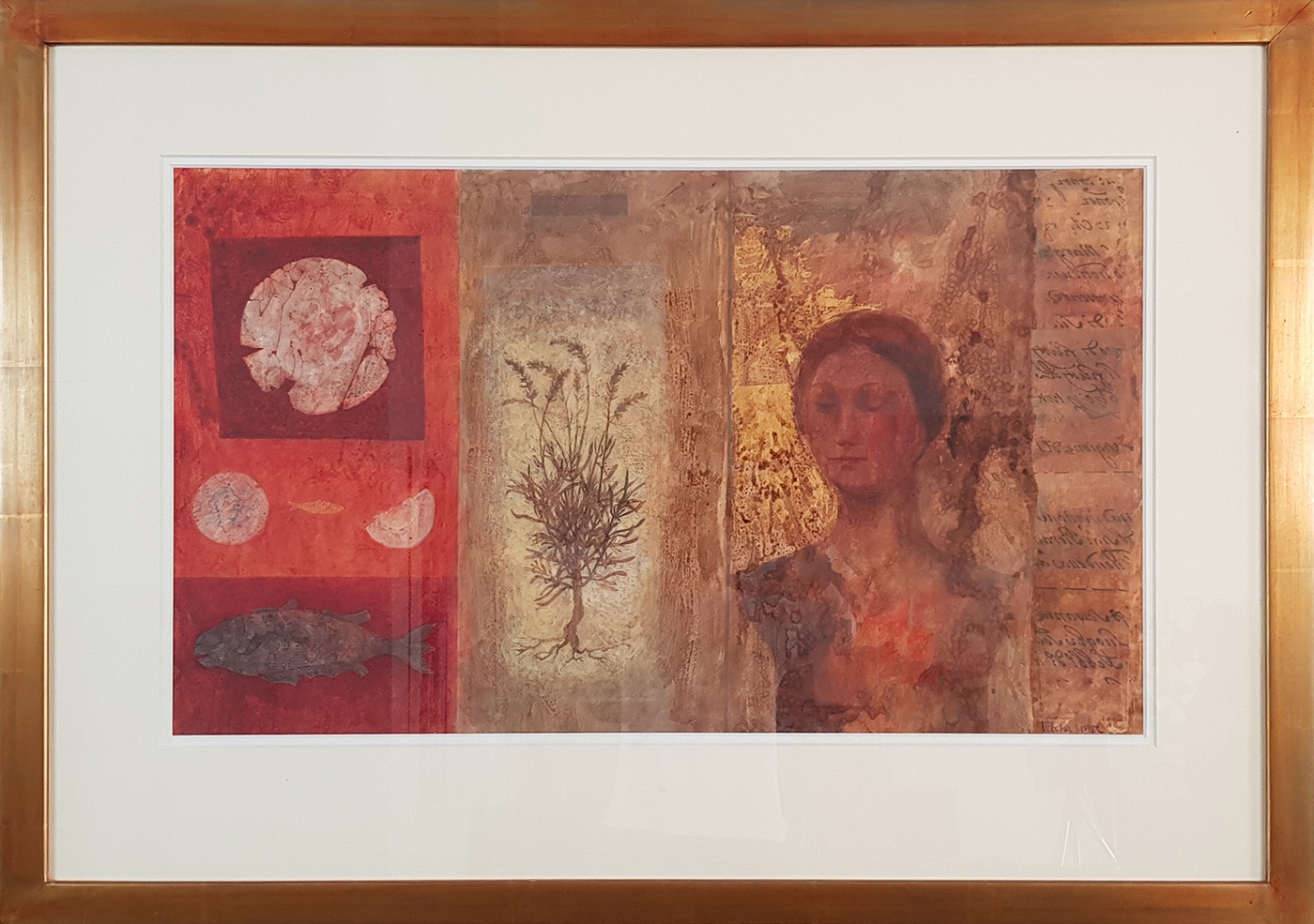
Marriage Piece is a richly layered and contemplative work from Victoria Crowe’s Venetian period, painted at a time when the artist worked between Scotland and her studio in Venice where she absorbed the atmosphere, textures, and symbolic language of the city. Structured across four vertical bands, the composition unfolds like a sequence of fragments or memories, each section holding traces of image, text, and symbolic form.
The painting combines elements associated with Renaissance devotional painting and Venetian decorative tradition. A downcast female figure, reminiscent of a Madonna or faded fresco fragment, emerges through translucent layers of paint. Nearby is a fish, botanical imagery, and fragments resembling a worn ceramic dish, shell, and Fortuny fabric patterns. Ancient script or partially obscured writing runs vertically along the right-hand edge, suggesting messages half-preserved through time.
Crowe has built the painting slowly through layers, allowing surfaces to be concealed and revealed simultaneously. Images appear to hover between material presence and disappearance, as though uncovered from walls weathered by heat, salt, and time. The dry, earth-rich palette evokes the sunlit plaster and crumbling surfaces of Venice, while the banded structure gives the composition the rhythm of panels, pages, or devotional compartments.
The title Marriage Piece invites multiple readings. It may suggest union and partnership, but also the joining together of memory, place, image, and time. Throughout Crowe’s work, objects and symbols rarely function literally. Instead, they accumulate emotional and psychological resonance through association and repetition. Here, the fish and fragments carry echoes of ancient symbolism and spiritual transformation, while the plant forms suggest preservation, growth, and the persistence of memory.
Painted shortly before Crowe’s appointment as Senior Visiting Scholar at St Catharine’s College, Cambridge in 2004, the painting also anticipates her growing interest in layered histories, botanical forms, and the idea of plant memory that would emerge more fully in a later series. As in much of Crowe’s practice, the painting moves between observation and meditation, balancing delicacy with material depth. What emerges is a painting of remarkable quietness and complexity. The viewer is invited to look and dwell within the image, moving slowly between surface and depth, between what is seen clearly and what remains partially concealed.
signed lower right
Exhibited:
Victoria Crowe – New Work, The Scottish Gallery, Edinburgh, 2004, cat. 29
About Victoria Crowe
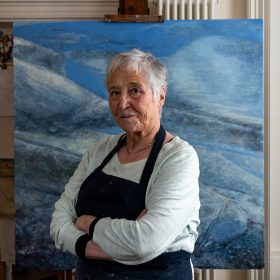
Victoria Crowe studied at Kingston School of Art from 1961-65 and at the Royal College of Art, London, from 1965-68. At her postgraduate show, she was invited by Sir Robin Philipson to teach at Edinburgh College of Art. For thirty years she worked as a part-time lecturer in the School of Drawing and Painting while developing her own artistic practice. She lives and works in West Linton and Edinburgh. Her first one-person exhibition, after leaving the Royal College of Art, was in London and has subsequently held over fifty, one person shows.