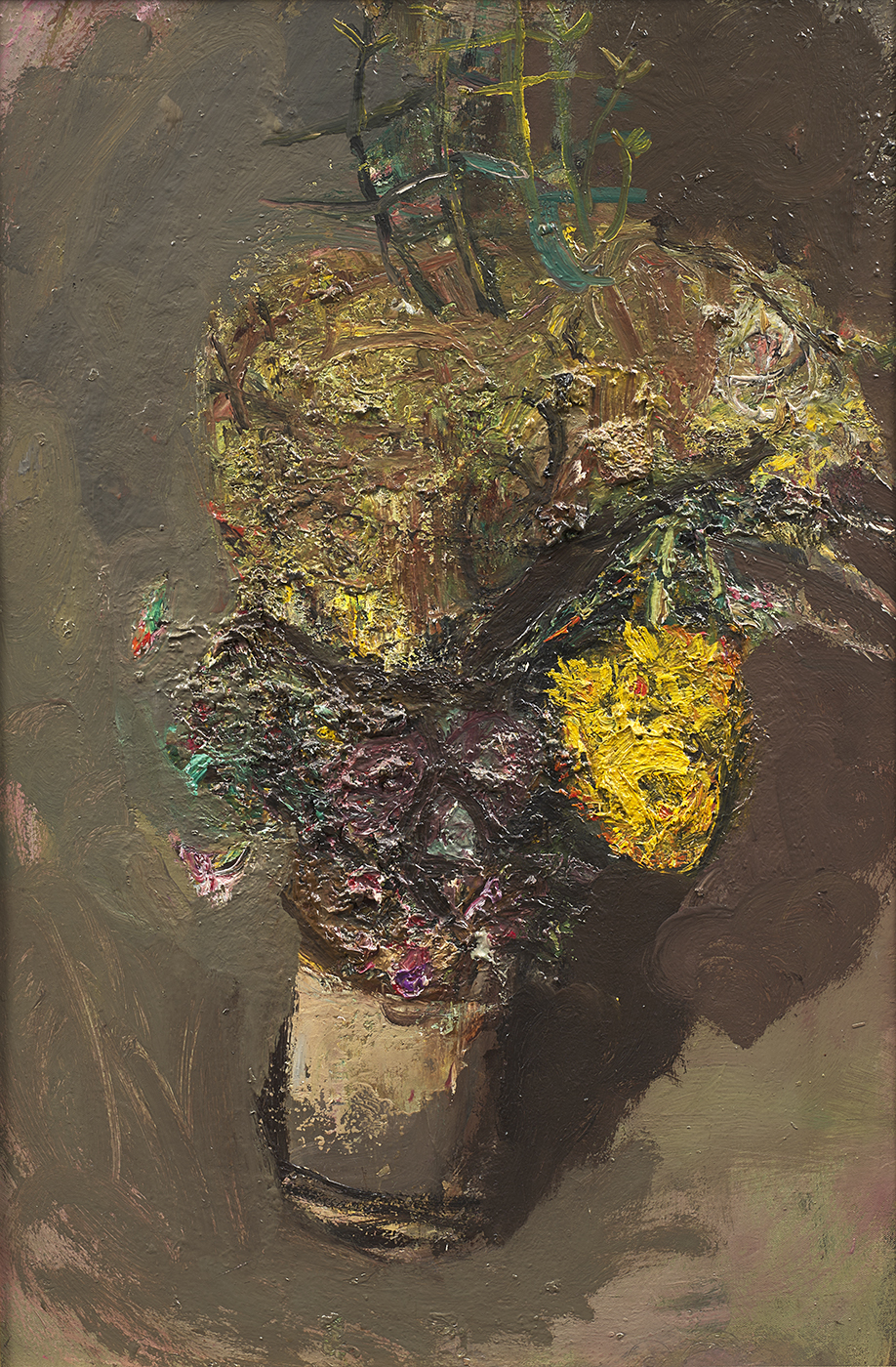
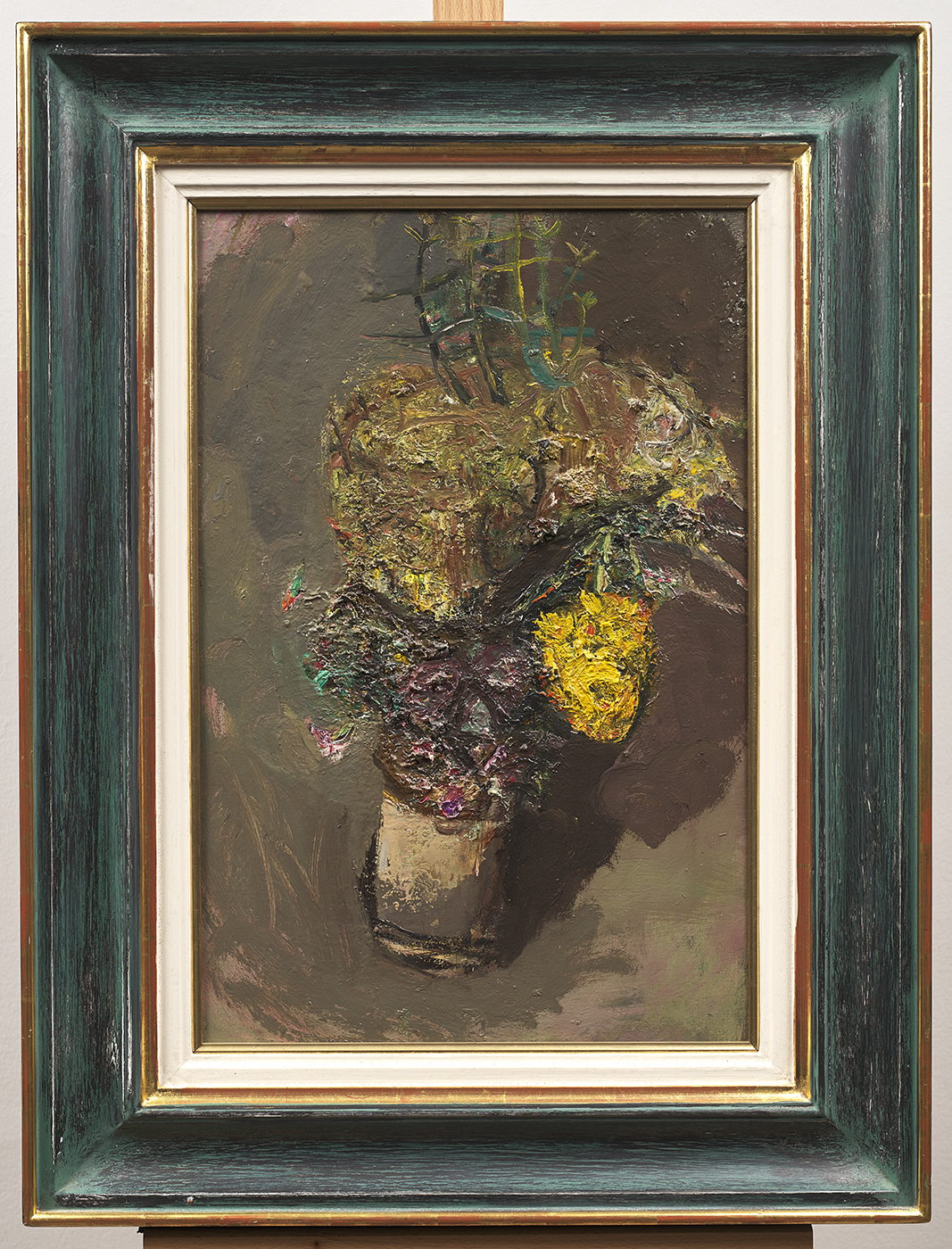
As with all of Joan Eardley’s work, there is an intensity to the subject which far exceeds its apparent simplicity. Pot of Wild Flowers belongs to a group of paintings made at Catterline when illness increasingly confined the artist indoors and the landscape itself migrated into the studio. Rather than a composed still life, this arrangement has been gathered from the field edges and coastal paths around the village: wild flowers and drying seed heads brought inside, perhaps during a period when Eardley no longer had the strength to work for long outdoors.
The arrangement refuses stillness. The vase tilts at an awkward angle, destabilising the composition and giving the impression that the artist is standing over the subject, working quickly and directly. The flowers rise upwards in dense, sculptural masses of impasto, their forms twisting and spreading like windswept hedgerow growth. Purple blooms, perhaps knapweed or wild scabious emerge amongst ochres, browns, various greens, and flashes of yellow, suggesting the late summer landscape of the east coast of Scotland in July or August, when flowers begin to dry at the edges and the fields are heavy with seed and pollen. Thickened pigment, dragged brushwork and scraped passages of paint create a surface alive with movement and texture. Like her late seascapes and field paintings, the work is less a still life than an arrangement than an attempt to capture something fleeting and unstable: weather, season, atmosphere, and the fragile persistence of life itself.
Exhibited:
Joan Eardley, RSA – Paintings and Drawings, The Scottish Gallery, Edinburgh, 2007
Provenance:
The artist’s studio, inventory no. EE92
About Joan Eardley

There is an enduring fascination for Joan Eardley far beyond her unconventional life and early death at the age of forty-two. Born in 1921 in Sussex, Joan Eardley’s family moved to Scotland in 1939 and a year later she joined the Glasgow School of Art. She found subjects in the shipyards of Clydebank and the slums of Townhead, at first the run-down tenements and buildings and later the children and streetlife around Rottenrow where the character of the people and the place became the vital subject of her work.