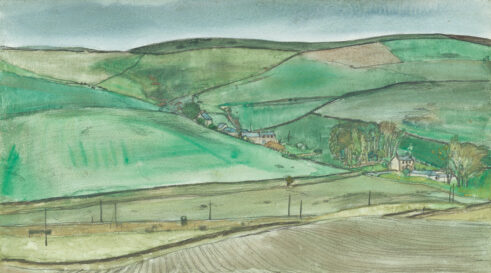
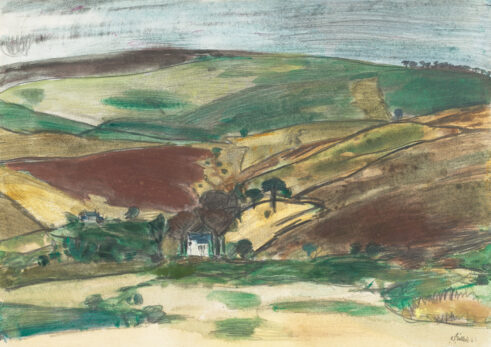
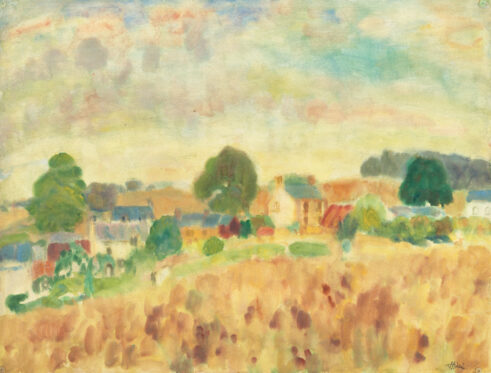
Gillies has packed information and atmosphere into this watercolour. Cruden Bay, in northern Aberdeenshire, saw a great Scottish victory over the Danes in 1012 and lies in the lea of a headland which ends with the remains of Slains Castle, the inspiration for Bram Stoker’s Castle Dracula. Gillies’ picture is far from bloody or sinister however, capturing a breezy summer day with assured drawing and delicate warm colour washes down by the estuary, with salmon nets and stone wharfs.
About Sir William Gillies

Sir William Gillies was the dominant figure of the Edinburgh School over which both his personality and his work had a quiet authority. He led by example at the College of Art, encouraging his students to experiment but from a firm grounding in looking, and of course practice, drawing in particular. He also selected his staff to reflect this ethos: men and women who had a similar independence but respected hard work, what William MacTaggart called the good habit. The duties of teaching for Gillies and many of his colleagues in the School of Drawing and Painting were combined with their own practice without conflict; being a professional painter: working and exhibiting, was understood as integral to the reputation and health of the School. Robin Philipson, Elizabeth Blackadder, John Houston, David Michie and James Cumming were the beneficiaries of this attitude, along with their students, quietly instilled by Gillies over his fifty years of influence.