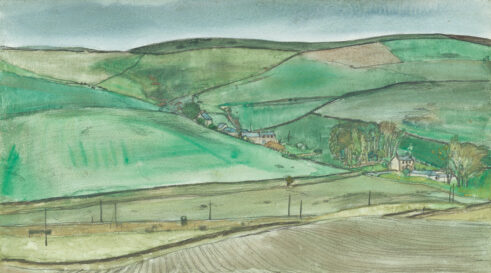
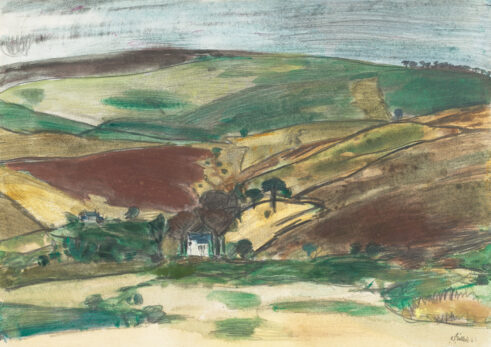
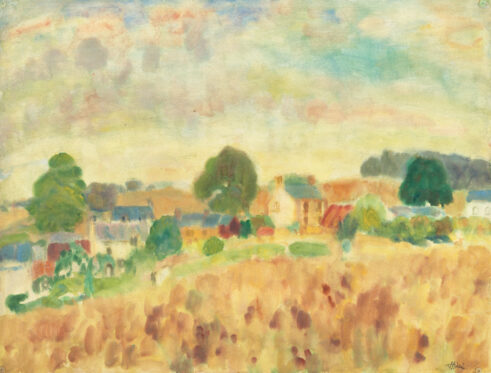
Tone is an integral quality of colour, and it is my belief that it is Gillies’ mastery of tone which lies at the root of his abilities as a colourist. Significantly, he would seem to be at his happiest when his palette employs a muted range of hues; of tertiary colours usually described as ‘neutral’ – off-whites, blacks and coloured greys. His still-life paintings are études in composition, giving full rein to his powers as a designer, juggling with placement and pattern, balance and imbalance. The end product is often exquisite, revealing a sensibility of great delicacy. In their deceptive simplicity and dryness, but most of all in their sense of distillation, one is reminded of the Gymnopédies of Erik Satie.
Peter Collins ARCA (1923-2001)
About Sir William Gillies

Sir William Gillies was the dominant figure of the Edinburgh School over which both his personality and his work had a quiet authority. He led by example at the College of Art, encouraging his students to experiment but from a firm grounding in looking, and of course practice, drawing in particular. He also selected his staff to reflect this ethos: men and women who had a similar independence but respected hard work, what William MacTaggart called the good habit. The duties of teaching for Gillies and many of his colleagues in the School of Drawing and Painting were combined with their own practice without conflict; being a professional painter: working and exhibiting, was understood as integral to the reputation and health of the School. Robin Philipson, Elizabeth Blackadder, John Houston, David Michie and James Cumming were the beneficiaries of this attitude, along with their students, quietly instilled by Gillies over his fifty years of influence.