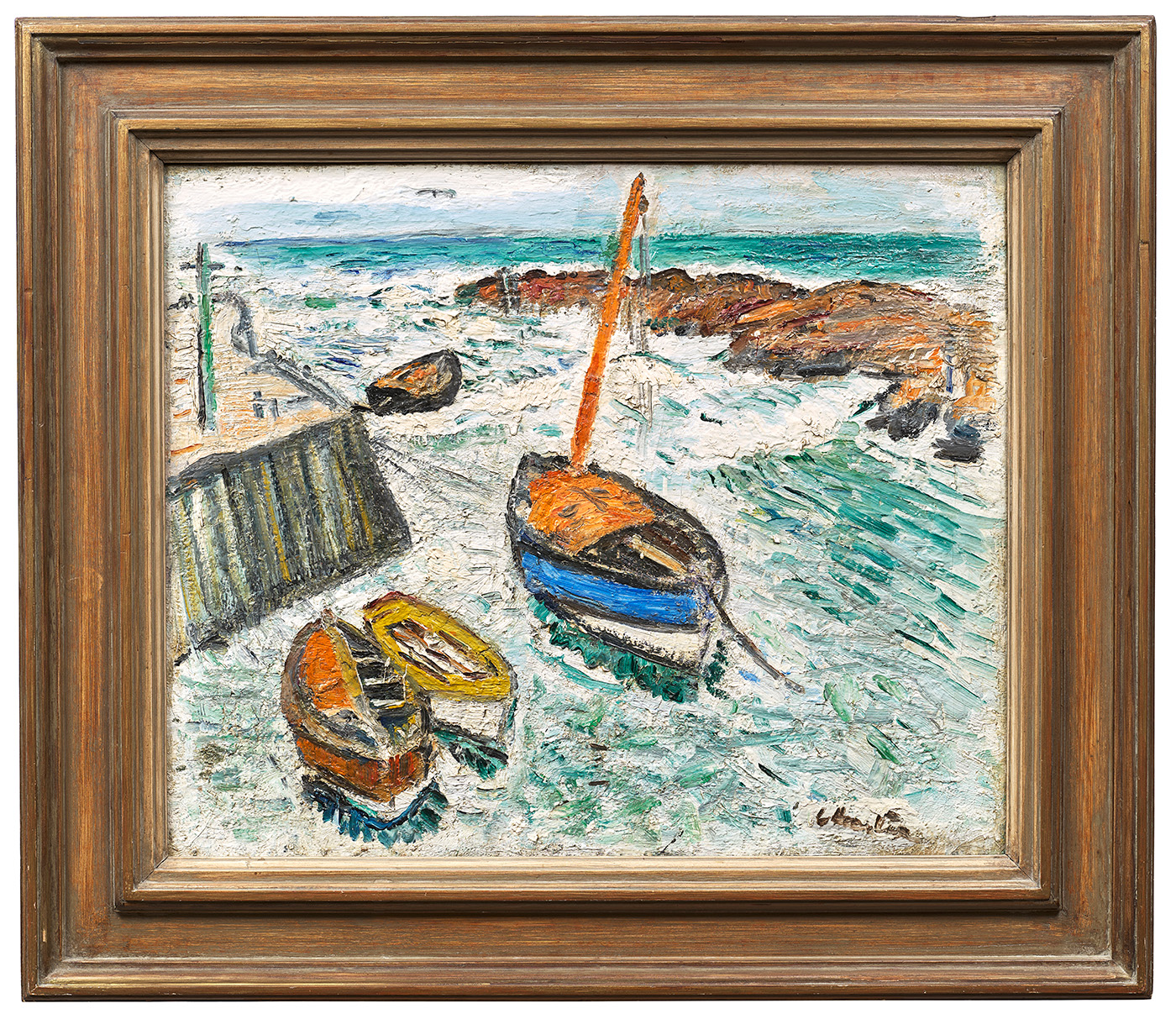
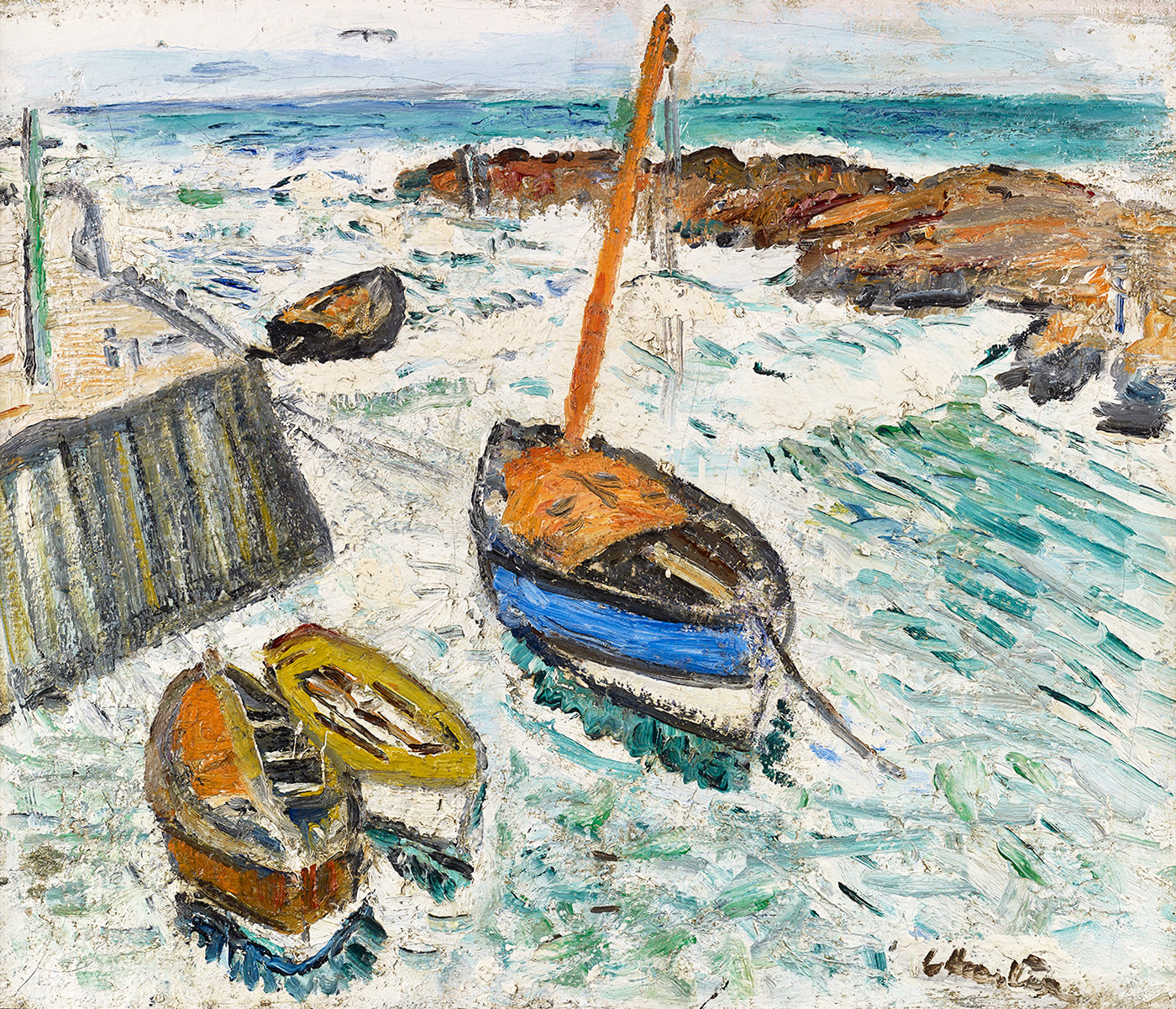
Storm, Lower Largo, Fife, 1925
signed lower right
EXHIBITED:
The Fine Art Society Ltd, London, 1971; The Scottish Gallery & Ewan Mundy Fine Art Ltd, Duke Street, London, 2018
ILLUSTRATED:
The Scottish Colourists, The Scottish Gallery Press, 2025
T.J. Honeyman, Three Scottish Colourists, Thomas Nelson and Sons Ltd, 1950, plate II
Hunter’s Storm, Lower Largo, Fife belongs to one of the most accomplished phases of his career, after his return from the avant-garde circles of Paris and London when he turned renewed attention to the East Neuk of Fife. Lower Largo offered a subject perfectly suited to his mature style: a working harbour where sea, sky, boats, and stone quays could be transformed through colour and movement.
Here, he captures the drama of an incoming storm, the small fishing boats tossed across the foreground by the wild tide, their vivid reds, oranges and blues set against the restless white water and turquoise greens of the sea. Energetic brushwork animates the surface building a thick impasto.
By the mid 1920s, Hunter was widely recognised as one of the leading figures in Scottish painting. Works such as Storm, Lower Largo, Fife demonstrate how he absorbed the lessons of impressionism to produce an original, powerful landscape vision.
About George Leslie Hunter

Born in Rothesay in 1877, George Leslie Hunter emigrated to California in 1892 where his father bought a farm. He spent all his time drawing and when his family came back to Scotland in 1900 he remained in California and became part of the Bohemian lifestyle of San Francisco. He earned money by acquiring illustration work for newspapers and magazines. He went to New York with friends and then on to Paris in 1904, working in each city for a few months.
Related Items


