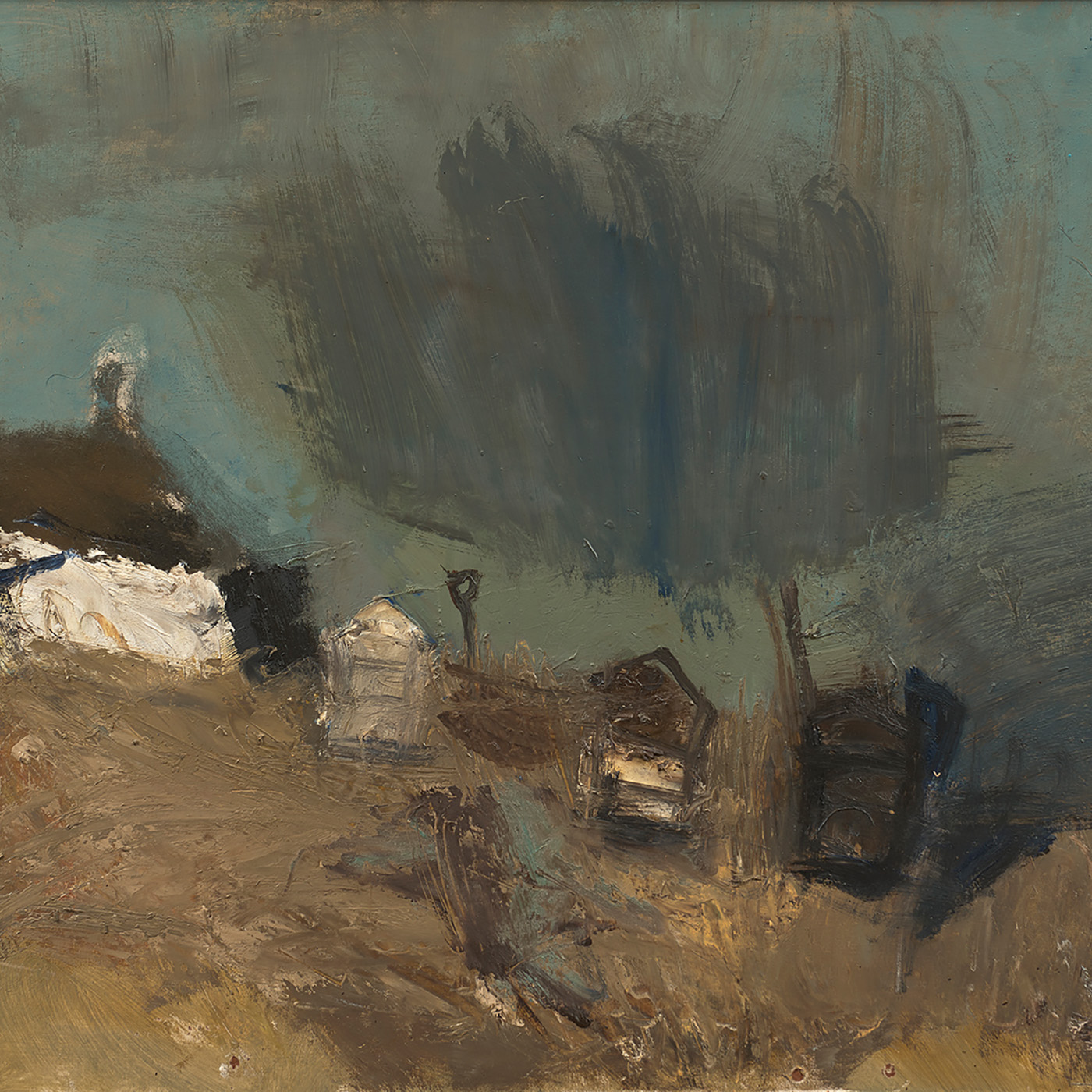
The Raincloud is a painting set in tension. The storm has not yet broken: the dark mass of raincloud looms ominously offshore, suspended in that charged stillness familiar to coastal weather before a sea squall finally releases itself. Behind Joan Eardley’s first cottage at No. 1 South Row, Catterline, three beehives sit exposed within a landscape that feels simultaneously observed and destabilised. There is something topsy-turvy in the composition, the abrupt edge of the gable end, the whitewashed stone wall against the black painted privy, the protruding spade, and stark cross-like form, where the architecture of the rural village become vehicles for graphic gesture as much as description.
Texture and movement animate the surface. Although the image appears spontaneous, every line, brushstroke and loaded passage of pigment is intensely considered. Eardley’s mark-making carries the urgency of direct experience while remaining wholly controlled. We are almost ambushed by the image, by its compression, its immediacy and by the psychological weight of the advancing weather. The subdued palette and raw earth tones suggest winter or early spring, when the Catterline landscape is stripped back and exposed to the full force of sea and sky.
Exhibited:
Roland, Browse and Delbanco, London
About Joan Eardley

There is an enduring fascination for Joan Eardley far beyond her unconventional life and early death at the age of forty-two. Born in 1921 in Sussex, Joan Eardley’s family moved to Scotland in 1939 and a year later she joined the Glasgow School of Art. She found subjects in the shipyards of Clydebank and the slums of Townhead, at first the run-down tenements and buildings and later the children and streetlife around Rottenrow where the character of the people and the place became the vital subject of her work.