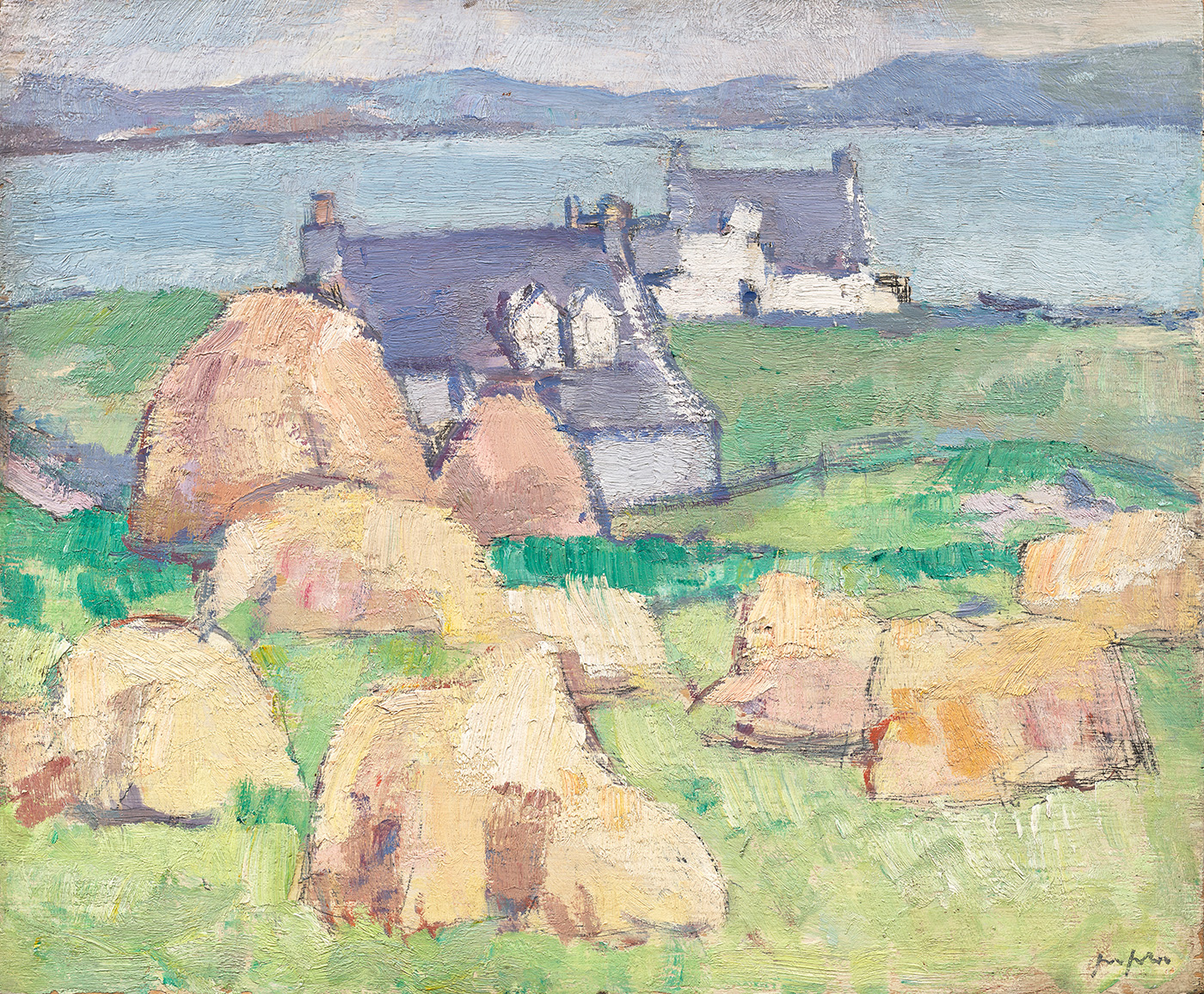
signed lower right
PROVENANCE:
The Artist’s Estate
Denis Peploe and thence by descent
Iona held a profound importance for S.J. Peploe throughout the 1920s and early 1930s. The Hebridean island offered the artist a great variety of subjects in shifting Atlantic light: the sand and rocks of the North End, the views north across the Strand of the Monks to Mull, the whitewashed cottages, the village and ancient sites. Tigh Shee is depicted from the hill above, the harvest in, and all bathed in a soft, late summer Hebridean light.
The architecture is simplified into planes of colour, while the light carries across the surface with a freshness and immediacy that reflects the artist painting directly before the motif. Like many of Peploe’s finest Iona paintings, the work balances observation with abstraction, transforming a specific place into something timeless and enduring.
This painting has never previously been exhibited and remained in the Peploe family collection, carefully kept by Denis Peploe as a memory of those summers spent together on the island. During these visits, the Peploe family would stay on Iona, with Denis sometimes helping his father carry his painting paraphernalia across the machair to a find a place to paint. In the summer, Iona was full of regular visitors, including collectors of pictures, whose arrivals departures and lives were of intense interest to Bunty Cadell, S.J. Peploe’s close friend, known as ‘himself’, or ‘The King of Iona’. Cadell’s Iona subjects are more varied than Peploe, and he did paint his version of this view.
For Peploe, Iona represented companionship, artistic renewal and spiritual ease. Removed from the pressures of Edinburgh and Paris, the island became a place of intense concentration and shared creativity. The annual journey west formed part of the rhythm of family life, but also of artistic production: the summer harvest from Iona would sustain exhibitions and studio work throughout the following year.
About S.J. Peploe

Born in 1871 in Edinburgh, S.J. Peploe is the senior of the four artists known as The Scottish Colourists. He lived in Paris from 1910 until 1912, where his work changed radically from paintings reminiscent of Manet and Sargent to brilliant Fauvist works which placed him in the vanguard of British Modernism.