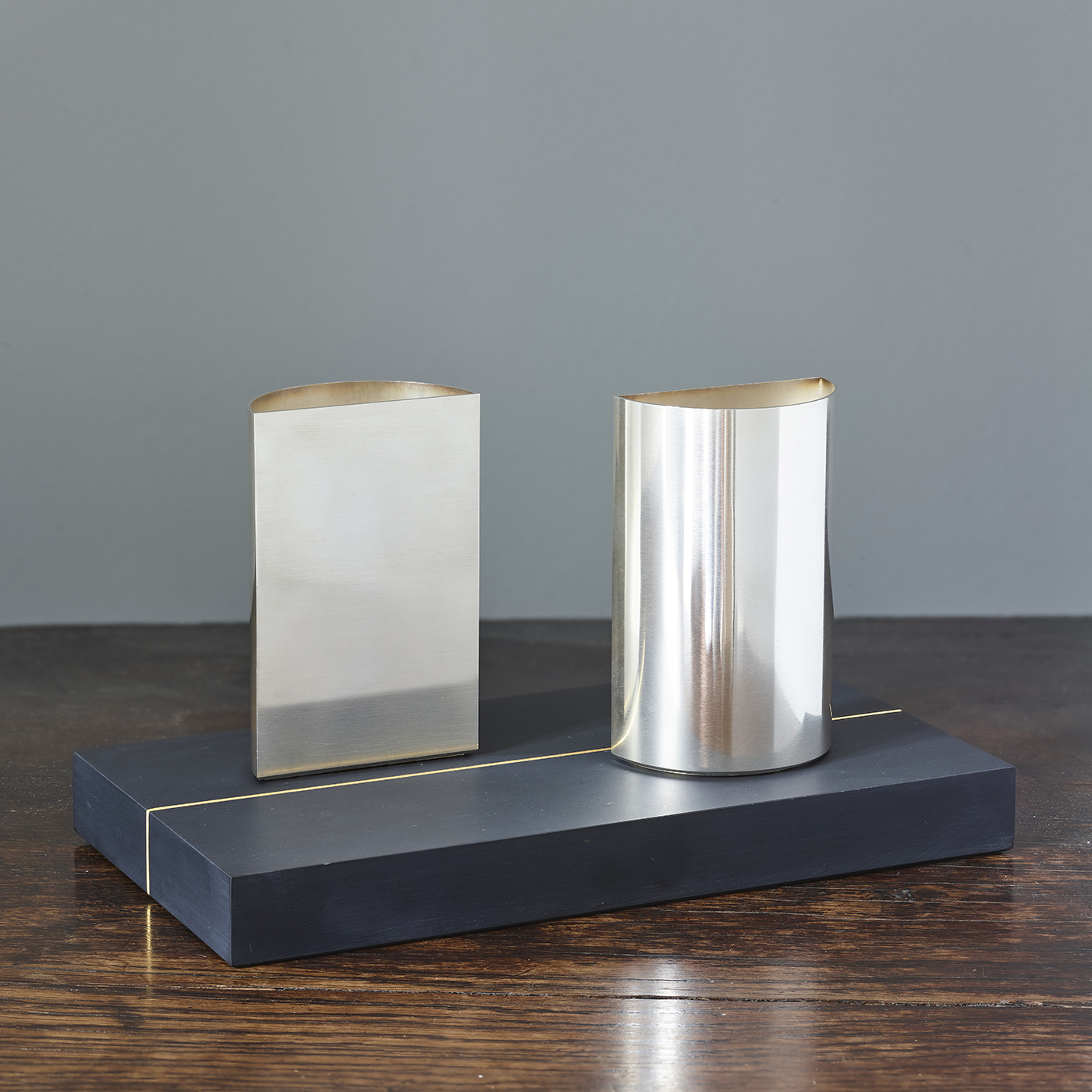
Two Semi-circular Containers on Gilded Slate, 2004
This rare sculptural work by William Kirk belongs to a small and highly resolved group made for his 2004 solo exhibition at The Scottish Gallery in Edinburgh, one of the few moments in which he brought together objects that move beyond vessel into a more explicitly abstract and relational language. Kirk’s output was always modest and exacting. He made little, and only when it met his own uncompromising standards. As such, works of this kind are exceptionally scarce and represent a distilled and important moment in his practice.
The piece comprises two semi-circular, silver forms set in parallel upon a slate base, divided by a single incised and gilded line. At first encounter, the work appears simple, even minimal, but like all of Kirk’s work, that simplicity is hard won. There is no ornament here, no distraction. The entire focus rests on proportion, surface, and the precision of making. The silver retains the subtle evidence of the hammer, alive to light and touch, while the slate provides a grounding weight that is geological, still, and enduring. The gilded line introduces both division and illumination, a fine incision that is both physical and conceptual.
Kirk was a master of line. He spoke of the journey of a line through a form, and here that thinking is laid bare. The line on the slate becomes an axis around which the work is held in tension. The two forms, though clearly related, are not identical in stance. They lean, respond, and hold themselves in a delicate balance. They appear to face one another, or perhaps to acknowledge one another across a boundary that cannot quite be crossed. In this way, the work moves beyond formal resolution into something more human and poetic. It can be understood as a meditation on relationship. Two entities derived from a shared origin are held apart yet intrinsically connected, balanced along a line that both unites and divides.
This dialogue between elements reflects Kirk’s wider practice, in which he moved fluently between silver and stone, between the intimate scale of the hand-held vessel and the permanence of carved inscription. His slate works are held in the collection of the National Museums of Scotland, and this piece sits naturally within that continuum, combining his sensitivity to material with his deep understanding of structure and meaning. As one colleague observed, his work is characterised by “strong, elegant, unembellished forms… transformed into a beautiful and satisfying form,” while another noted that “there are no hiding places in his work.”
Kirk himself was a private and disciplined man, wholly committed to his craft. When Dorothy Hogg MBE (1939–2022), Professor Emeritus at Edinburgh College of Art and a lifelong colleague, once asked him if he knew what it was like to be a piece of silver, he replied simply, Yes, I think I do. That remark reveals the depth of his empathy with material and helps explain the extraordinary clarity of his work. His forms are unembellished because nothing more is needed. They carry, in their stillness, the accumulated knowledge of a lifetime’s making.
Hogg, who regarded Kirk as a guru, teacher, colleague and friend, recognised in him a rare integrity, both as a craftsman and as a thinker. This work embodies that integrity. It is deceptively simple, quietly complex, and deeply considered. It asks very little at first glance, but rewards sustained looking. In its balance of form, material, and idea, it stands as a significant example of Kirk’s achievement, and as a poignant expression of his enduring concern with perfection, relationship and the line we each must find and hold. Christina Jansen
About William Kirk

William Kirk (1931–2010) was one of Scotland’s most accomplished silversmiths, celebrated for his masterful craftsmanship, influential teaching career and significant contribution to post-war British silver. Renowned for his exquisitely proportioned vessels, ceremonial silver and architectural lettering, Kirk combined technical perfection with a profound understanding of form, establishing a reputation that continues to influence generations of makers.