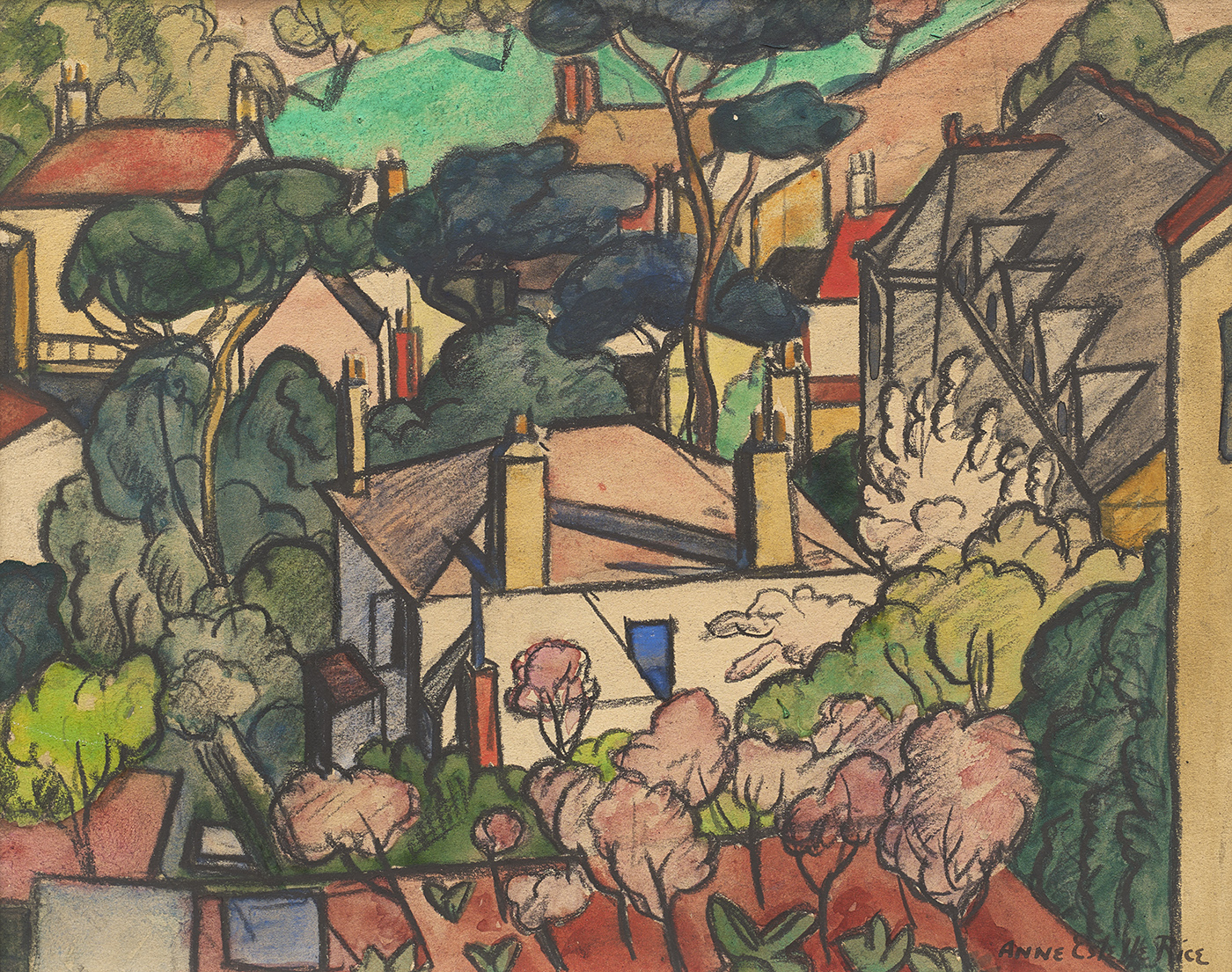
signed lower right
Likely dating from Anne Estelle Rice’s visits to Looe, Cornwall, in 1917–18, this striking work on paper belongs to a relatively littleknown period in her career. It may also be one of the artist’s celebrated coloured drawings exhibited at the Burlington Gallery, London, in May 1918, where Rice showed alongside J.D. Fergusson, S.J. Peploe, Margaret Morris and other leading figures of British modernism.
Looe, with its steep streets, tightly clustered houses and busy fishing harbour, has offered Rice a rich source of visual material. Rather than producing a descriptive record of the town, she transforms the scene into a carefully orchestrated arrangement of colour, line and pattern. Strong dark outlines organise the composition into interlocking planes of rooftops, walls, and pathways, while broad passages of colour flatten and simplify the forms. This approach recalls the colour-print convention seen in the modern watercolour exhibitions of the period, where black outlines and flat masses of colour were employed to create bold decorative effects. Rice handles these devices with remarkable confidence, producing an image that is both structurally rigorous and visually vibrant.
At the heart of the composition lies a small but compelling blue window. In a picture animated by warm earth tones, soft pinks and sunlit ochres, this concentrated note of cobalt blue immediately captures the eye. The surrounding architecture directs viewer towards it through a carefully balanced rhythm of walls, rooftops, and passages. Whether the window references the room in which Rice herself was staying cannot be known, but its presence introduces a dramatic dimension to the work. Windows often function as thresholds between private and public worlds, between observation and experience, and here the blue opening becomes a point of quiet focus within the lively geometry of the townscape.
Looe also occupies an intriguing place within the wider circle of artists associated with Rice. In 1926, S.J. Peploe and his wife Margaret visited the Cornish fishing town, perhaps encouraged by Rice’s own enthusiasm for the area, although no paintings from the trip are known today. The connection serves as a reminder of the close personal and artistic relationships that linked many of the leading figures of British modernism during this period.
Rarely seen and exceptional in quality, this work highlights Anne Estelle Rice’s outstanding confidence and originality as an artist.
About Anne Estelle Rice
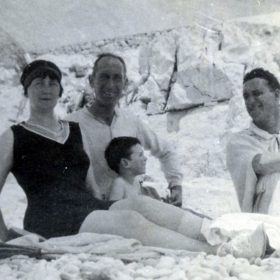
Anne Estelle Rice was an American painter closely associated with the circle of the Scottish Colourists, particularly through her relationship with J.D. Fergusson.


