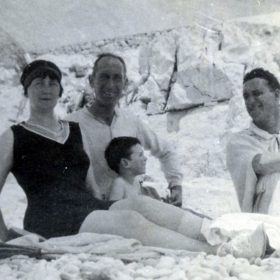
Anne Estelle Rice was an American painter closely associated with the circle of the Scottish Colourists, particularly through her relationship with J.D. Fergusson.
Born in Pennsylvania, she trained at the Pennsylvania Academy of the Fine Arts before establishing herself as a successful illustrator. In 1905 she moved to Paris, where immersion in the avant garde transformed her practice. Her partnership with Fergusson, from around 1907 to 1913, was one of mutual artistic development, as both responded to the radical shifts of Post-Impressionism and Fauvism.
Rice exhibited widely in Paris and London, including at the Salon d’Automne, to which she was elected a member, and at the Baillie Gallery, where she held successful solo exhibitions. By 1910 she was being described in the American press as a leader of a new movement in painting, and her work was given prominent positions in major exhibitions. At the same time, she undertook ambitious decorative commissions, producing large-scale mural panels for the Wanamaker department store in Philadelphia.
Her painting developed a distinctive modern language, characterised by bold, unmodulated colour, strong contour lines and an emphasis on rhythm and surface design. Through her involement with the periodical Rhythm between 1911 and 1913, she contributed to a wider Anglo-American avant garde that included Fergusson, writers such as Katherine Mansfield, and leading European artists. This placed her at the centre of a progressive cultural network that extended beyond painting into literature and performance.
Although her association with Fergusson and the Scottish Colourists situates her within their wider circle, Rice is recognised as a major modernist artist in her own right. In the years before the First World War she was widely exhibited and critically acclaimed across Europe and America, and her work formed part of the international dialogue that defined early twentieth century modernism. Her career, later overshadowed, is now increasingly reassessed, revealing an artist whose contribution was both independent and central to the development of modern painting.

