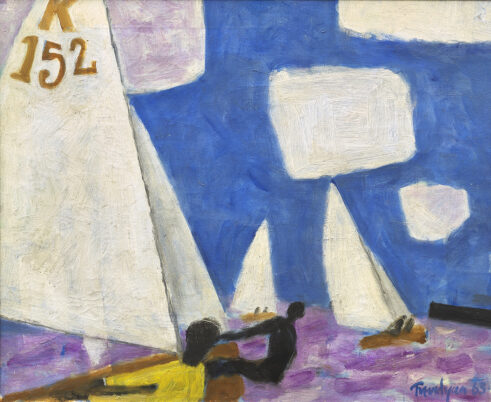
Julian Trevelyan was born into an intellectually distinguished family, initially reading English at Cambridge before leaving for Paris in the early 1930s, where he studied printmaking at Stanley William Hayter’s influential Atelier 17. There he encountered many of the leading figures of European modernism and Surrealism, including Joan Miró, Max Ernst and Pablo Picasso, while absorbing the experimental atmosphere that defined the Paris avant-garde. Those formative years immersed him in Surrealism and European modernism, influences that never entirely left his work. In 1936 his work was included in the landmark International Surrealist Exhibition in London, confirming his place within the emerging British Surrealist movement. Even when painting recognisable landscapes or harbours, he approached composition as a process of visual invention rather than transcription.