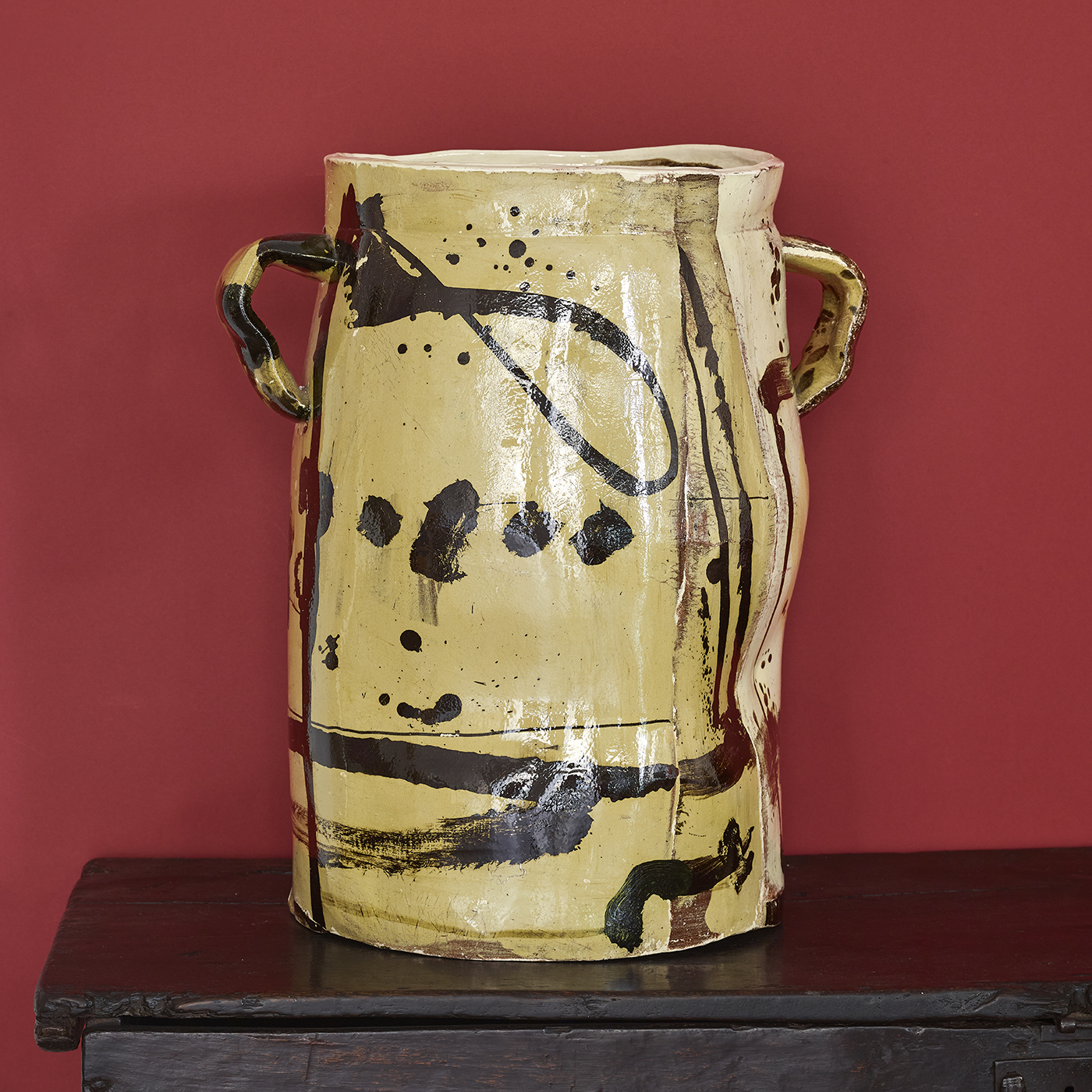


Philip Eglin’s Churn is a sculptural ceramic that draws on the language of traditional vessel forms while pushing them into something far more expressive and contemporary. Its robust, upright structure carries a strong physical presence, grounding the work in the history of utilitarian pottery while allowing space for a more expansive visual treatment.
Churn was made by pressing a series of large soft, slip decorated clay sheets over a composite plaster and clay form and on release, inverting and re-joining the slabs to form a cylindrical shape which while still plastic was further altered and added to. Working in richly layered iron bearing slips under a transparent lead glaze, Eglin uses the surface as an active field for mark-making and colour. Gestural lines, graphic elements, and shifts in tone animate the form, encouraging the eye to move across and around the object. As with much of his work, imagery and reference remain fluid, suggesting fragments of cultural memory without settling into a fixed narrative.
The intuitive treatment of surface and colour show influence of both 18th century English slipware and the gestural paintings of artists such as Cy Twombly and Robert Motherwell. Eglin’s practice is rooted in a wide range of influences, from historic ceramic traditions to popular culture and contemporary painting. His work often brings these sources together in unexpected ways, combining the functional origins of the vessel with a more playful and subversive visual language. In Churn, the familiar becomes reimagined. The vessel is no longer simply a container but a site for experimentation and expression.
Philip Eglin’s work is held in numerous public collections in the UK and internationally.
About Philip Eglin
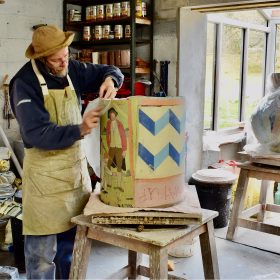
Philip Eglin (b.1959, Gibraltar) studied at Staffordshire Polytechnic and the Royal College of Art, London. He was awarded the prestigious Jerwood Prize for Applied Arts in 1996, and The Scottish Gallery has exhibited his work regularly since the 1980s.
Related Items

Venus et Amour, 2024


