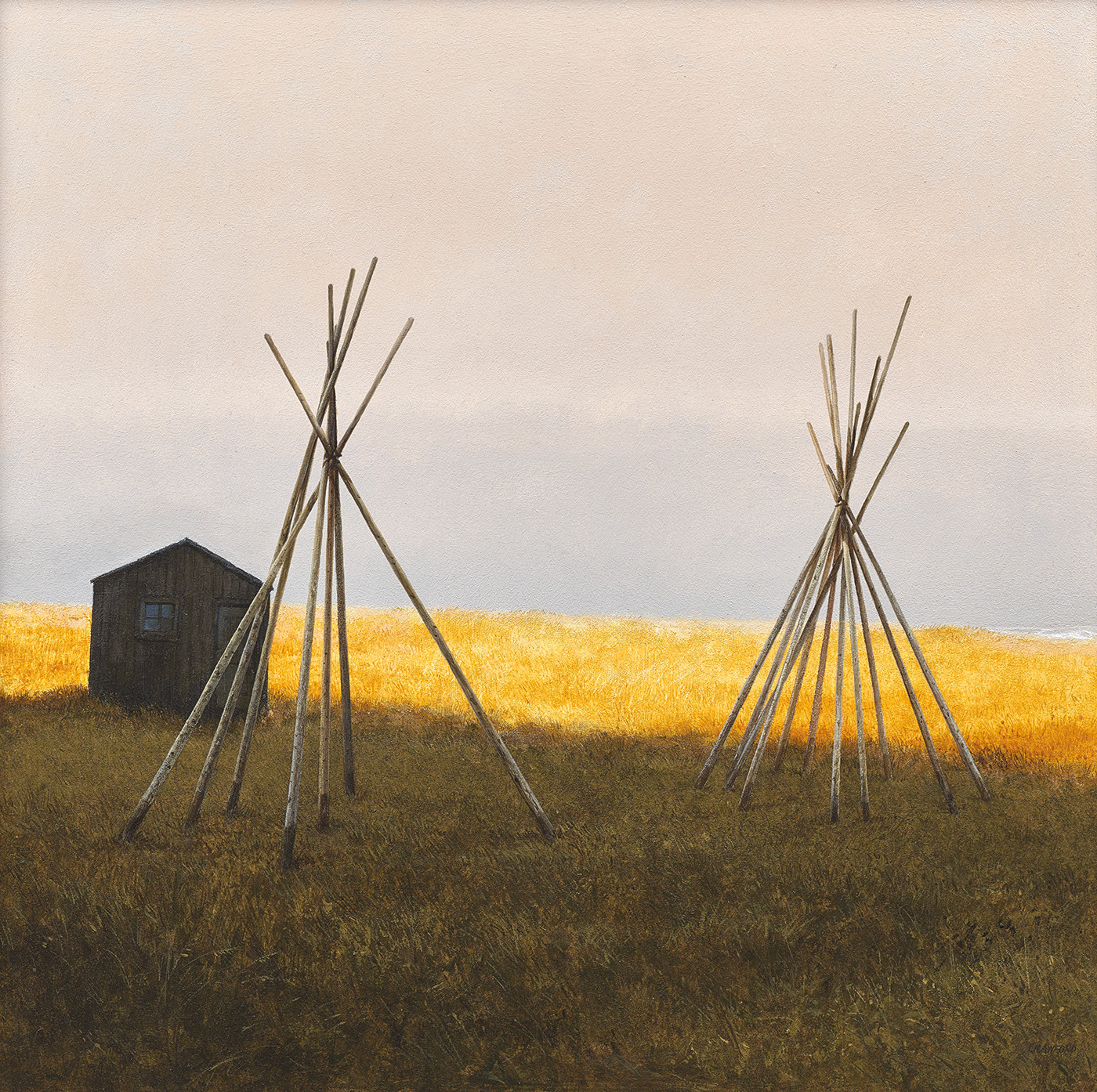
Evening Shadow, 1991
Evening Shadow is a haunting meditation on the agricultural landscape of north-east Scotland. Set beneath a vast pale sky, two tall wooden drying frames rise from rough grassland beside a small dark shed, while a golden strip of harvested field glimmers across the horizon.
The tripod-like structures are traditional drying frames, once commonly used across Scotland’s northern farming regions to dry harvested grain or hay in wet and windy conditions. Built from long saplings, often birch or other slender local woods, they allowed air to circulate through tied sheaves of oats or barley before storage. Their skeletal forms, both practical and sculptural, were part of the visual identity of the Scottish rural landscape, particularly in regions where harvesting demanded ingenuity in difficult climates.
Crawford transforms these humble agricultural structures into something ceremonial. Their resemblance to temporary shelters lends the scene a quiet monumentality, while the small shed nearby introduces another fragile sign of human occupation within the exposed landscape. The glowing band of wheatfield beyond suggests the close of harvest and the fading light of evening, creating a sense of seasonal transition and rural continuity.
Evening Shadow balances precision with atmosphere. It is not simply a record of agricultural life; it is a quiet elegy to labour, landscape, and the fragile structures through which people have historically inhabited and worked the land.
signed lower right; title inscribed on label verso
Exhibited:
William Hardie Gallery, Glasgow
About John Gardiner Crawford
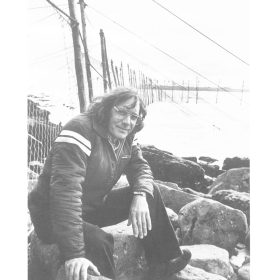
There is no shortage of subjects within a few miles of Crawford’s home in Arbroath. He is attracted to the marchlands where sea meets land, where low buildings are scoured by wind and sand, where a lighthouse gives succour to a seafarer’s eye, where the chance order of a row of seagulls or reflection on a cottage window makes us pause, think and wonder. He paints the wilderness of the North Sea, lent significance by the fisherman’s blood that runs in his veins.


