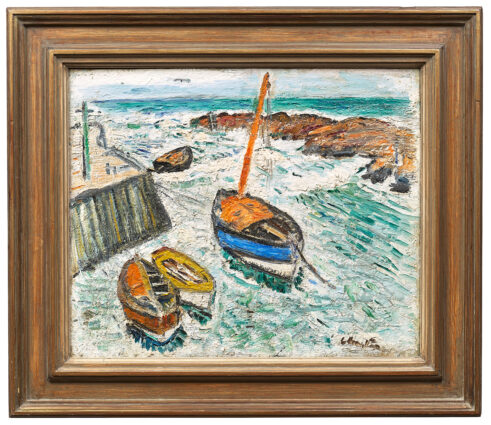
Harbour Scene, Largo, c.1919
signed lower left
ILLUSTRATED:
The Scottish Colourists, The Scottish Gallery Press, 2025
EXHIBITED:
Three Scottish Colourists Exhibition, The Scottish Arts Council, 1970, Cat. 42
George Leslie Hunter was a brilliant and instinctive draughtsman, and his late watercolours possess a freedom and immediacy that sit alongside the finest achievements of his oil painting. The east coast of Scotland, and Fife in particular, became an important source of inspiration during the later years of his career. The fishing villages and harbours of the East Neuk offered subjects rich in atmosphere, structure and working life, while the changing coastal light allowed Hunter to explore colour and line with remarkable spontaneity.
In Harbour Scene, Largo, painted around 1919, Hunter captures the bustling reality of a working harbour rather than a picturesque coastal view. Lobster creels, ropes, rigging, and harbour equipment crowd the composition, while fishermen move amongst the boats preparing gear and working along the quay. The scene is animated by labour and movement, reflecting the reality of the fishing communities that still shaped much of the east coast economy during the interwar years.
The palette is unmistakably Hunter’s. Warm rust reds, ochres, dusty pinks, and pale sea blues evoke both the weathered surfaces of the harbour and the soft maritime light of Fife. Watercolour and pencil offered Hunter a sense of liberation at a time when much of the commercial expectation surrounding his work rested upon oil painting. The medium allowed him to work quickly and experimentally, capturing sensation and movement with extraordinary fluency.
About George Leslie Hunter

Born in Rothesay in 1877, George Leslie Hunter emigrated to California in 1892 where his father bought a farm. He spent all his time drawing and when his family came back to Scotland in 1900 he remained in California and became part of the Bohemian lifestyle of San Francisco. He earned money by acquiring illustration work for newspapers and magazines. He went to New York with friends and then on to Paris in 1904, working in each city for a few months.
Related Items