Close

For many he is an artist whose name has now become synonymous with depictions of modern interiors. From dramatizing sunlight as it tilts through windows, or celebrating the formal beauty of everyday objects, Caulfield creates endlessly beguiling images that cross-examine the spaces we inhabit.
Patrick Caulfield (1936–2005) was one of the defining figures of post-war British art, celebrated for paintings and prints that transformed ordinary interiors and everyday objects into images of striking clarity, wit and psychological depth. Although frequently associated with Pop Art following his inclusion in the landmark New Generation exhibition at London’s Whitechapel Gallery in 1964, Caulfield’s work occupied a distinctive position within British painting, balancing the cool visual language of popular culture with a deep engagement with art history, perception and illusion.
Born in West London in 1936, Caulfield studied at Chelsea School of Art from 1956–1960 before continuing at the Royal College of Art alongside contemporaries including David Hockney, Allen Jones and R.B. Kitaj. Early travelling scholarships enabled him to visit Greece and Crete, experiences that sharpened his fascination with architecture, light and spatial structure. From 1963–1971 he taught at Chelsea School of Art while simultaneously establishing an increasingly important exhibiting career.
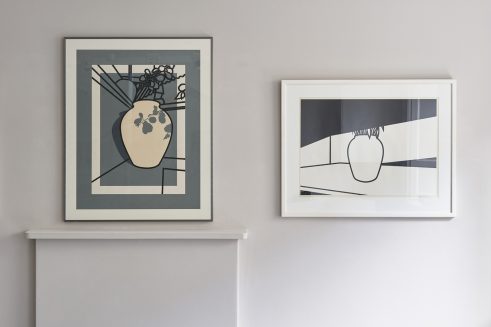
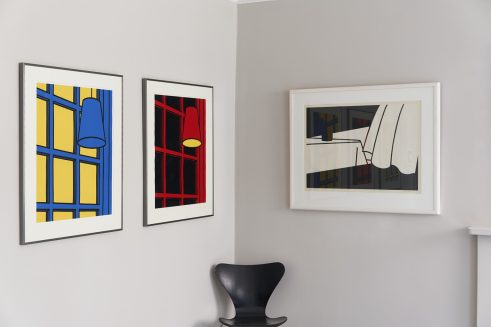
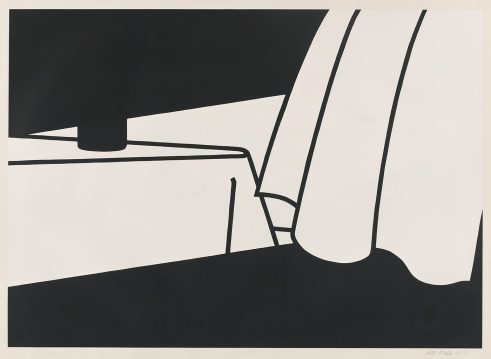
Caulfield became renowned for his instantly recognisable visual language: areas of flat, saturated colour bounded by bold black outlines, combined with highly controlled perspective and carefully orchestrated compositions. Yet beneath this apparent simplicity lies a sophisticated exploration of space, memory and atmosphere. His paintings frequently depict empty dining rooms, hotel lounges, cafés, bottles, cigarettes, curtains and domestic interiors, scenes at once familiar and strangely theatrical. Sunlight cuts dramatically across walls and tables, objects appear isolated within carefully ordered rooms, and ordinary surroundings are transformed into meditations on modern life, solitude and desire.
While Pop Art often celebrated consumer culture and mass imagery, Caulfield’s work possessed a quieter and more ambiguous sensibility. His paintings draw as much from Giorgio de Chirico, Juan Gris and the still-life tradition as from advertising or design. The tension between realism and abstraction became central to his practice, with illusionistic passages often interrupted by areas of flat decorative colour or graphic simplification. This visual interplay gives his work a timeless and enigmatic quality that continues to resonate strongly today.
Alongside painting, printmaking formed a significant part of Caulfield’s practice. He produced a remarkable body of screenprints, etchings and lithographs which extended his exploration of line, colour and spatial illusion. These works demonstrate the same formal precision and elegance found within his paintings, while allowing for playful experimentation with surface and composition.
Caulfield represented Britain at the Venice Biennale in 1968 and was elected to the Royal Academy in 1976. In 1987 he was nominated for the Turner Prize, and in 2004 he was appointed CBE for services to art. His work is held in major international collections including Tate, the Museum of Modern Art in New York, the Centre Pompidou in Paris and the Art Institute of Chicago.
Today, Patrick Caulfield remains one of the most distinctive and influential British artists of the twentieth century. His paintings and prints continue to captivate audiences through their elegant balance of humour, restraint and psychological complexity, revealing the extraordinary visual poetry embedded within the ordinary spaces of modern life.

Struggling to find that perfect gift? We have the solution! A Scottish Gallery Gift Voucher is the perfect gift for friends, family, customers and colleagues.

Own Art is a national initiative that makes buying contemporary art and craft affordable by providing interest-free credit for the purchase of original work.