Close


Born in North Carolina, Kate Downie studied at Grays School of Art in Aberdeen before travel and residencies took her to the United States, England, Amsterdam and Paris. Over the past two decades Downie has established herself as one of Scotland’s most prominent artists. Her skill not restricted to painting alone, she works across a diverse range of artistic medium. One recent project for Pittenweem Arts Festival saw Kate juxtapose large colour-field prints with architectural charcoal drawings with extraordinary results. The majority of her work is defined by geography, and the artist’s response to the landscape or subject in front of her. Kate’s constant search for new challenges and inspirations has seen her set up studios in such diverse places as a brewery, an oil rig, and for her most recent show an abandoned Hydroponicum. Her work is held in many public collections including Glasgow Gallery of Modern Art; Kelvingrove, Art Gallery: Reitveld Kunst Academie, Amsterdam; the BBC and Edinburgh Council. Downie has enjoyed ten solo exhibitions at The Scottish Gallery. She is currently exhibiting at the Glasgow Women’s Library with Conversations with Joan. An exhibition based around Downie’s creative journey to complete a version of Joan Eardley’s painting Two Children left unfinished on her Townhead Studio easel at the time of her death in 1963.
In August 2025 I travelled with my partner by rail and ship to the archipelago of Shetland for the first time to meet with fellow artists and explore the contrasting geology and grasslands of this beautiful place.
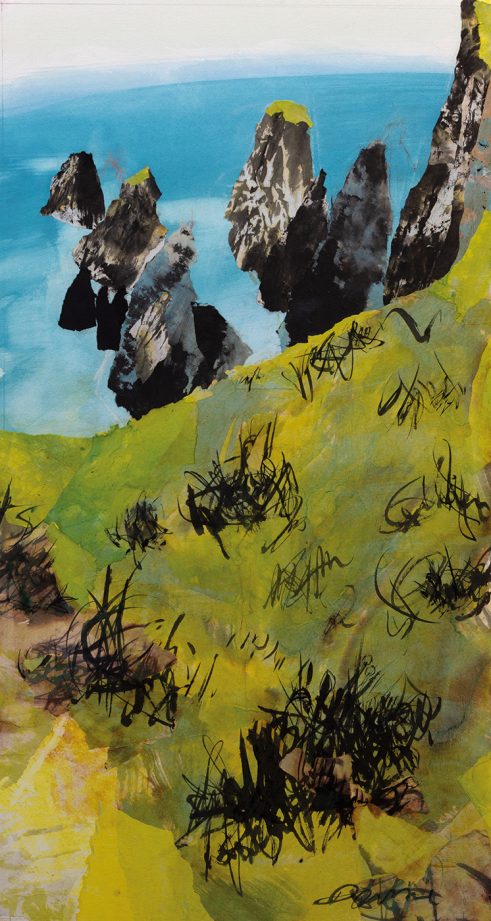
Towards the end of our Shetland journey, we visited Peter Davis, the watercolourist nonpareil, who kindly guided us to the edge of his walkable land. We found ourselves teetering upon the cliffs at Silwick absorbing the full sun and the shimmering blue infinity of the ocean, keenly feeling the heady risks, the contrasts of substance and absence beneath our feet.
Peter confessed his preference for wilder days of storm and ambiguous light filtered through cloud and fleeting weather patterns which he expresses so beautifully in his veiled washes of colour, whereas I am perhaps more responsive to the raucous play of the wind & water upon this rugged land. Happily, we had much in common; our shared experience as artists, our mutual appreciation of certain painters who had altered our sense of what painting could be, how they interpreted the land through their vision: Helen Frankenthaler, Morris Louis,
Georgia O’Keeffe, those mid-20th Century pioneers of open spaces and imagination. There we were, made tiny by the grand craggy cliffs, walking and talking art and the pleasure of moving amongst this giant land: the turf of Silwick’s eroded edges with plunging depth to our left and the brave calligraphic grasses clinging to the tops of the vast rocky shard-islands as the tides swirled below

Struggling to find that perfect gift? We have the solution! A Scottish Gallery Gift Voucher is the perfect gift for friends, family, customers and colleagues.

Own Art is a national initiative that makes buying contemporary art and craft affordable by providing interest-free credit for the purchase of original work.