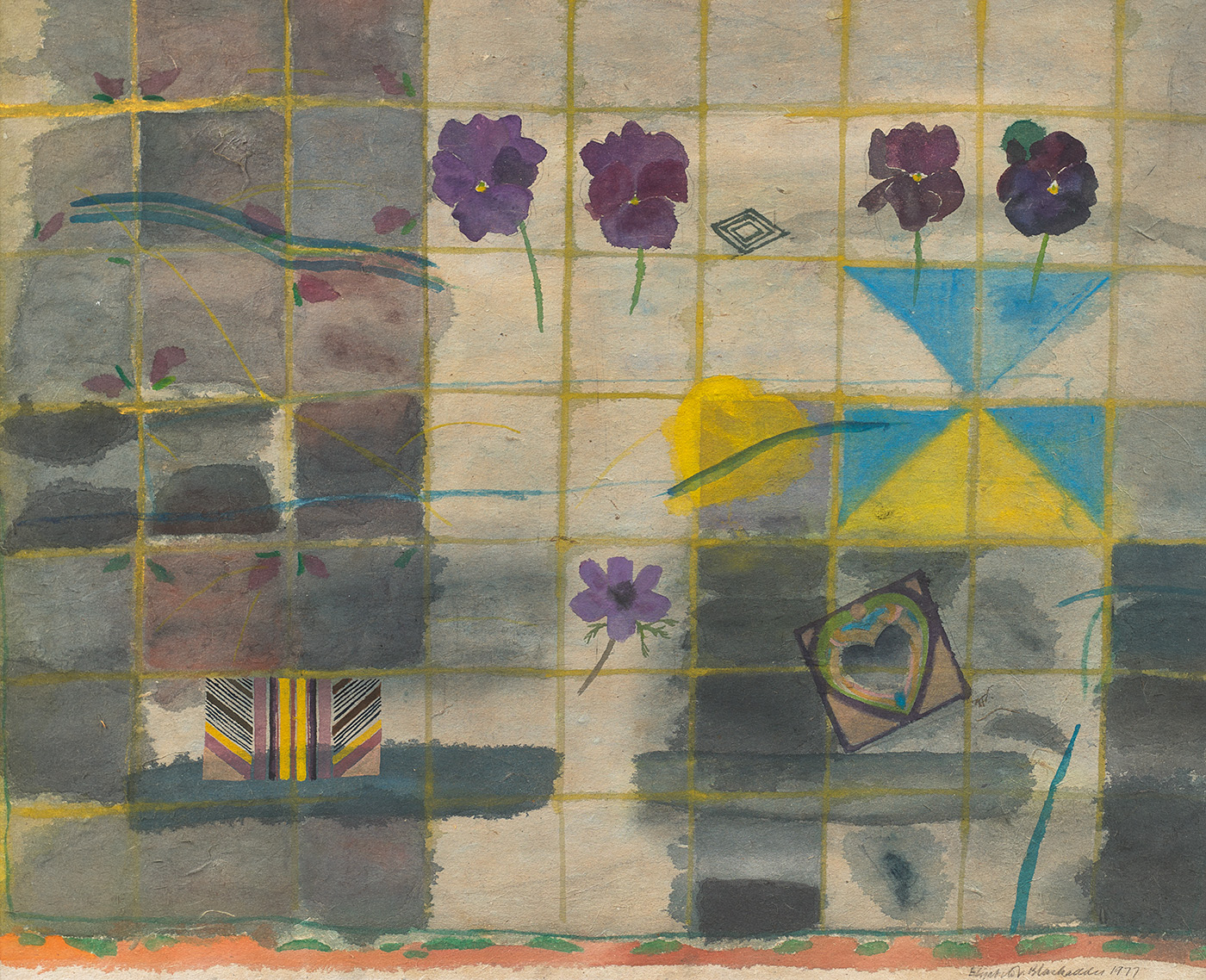
Elizabeth Blackadder demonstrates her distinctive approach to pattern, space, and arrangement. Structured around a delicate grid, the composition recalls the surface of a Japanese screen, with motifs suspended across a flattened pictorial field rather than arranged within a conventional still-life interior.
Four deep purple pansies with a single lilac bloom appear alongside geometric forms, fragments resembling a Japanese postcard or folded patterned paper, and a small heart enclosed within a box-like outline. Rather than functioning as objects, these elements read as tokens or emblems, creating an intimate atmosphere. Soft washes of grey, blue, and violet suggest glimpses of landscape and cascading water beneath the lattice-like structure, while the transparency of watercolour allows forms to dissolve gently into one another.
Painted before her first visit to Japan in 1978, Still Life with Pansies anticipates many qualities associated with her later engagement with Eastern aesthetics, particularly the emphasis on asymmetry, negative space, and the contemplative relationship between image and emptiness.
signed and dated lower right
About Elizabeth Blackadder

Dame Elizabeth Blackadder (1931–2021) stands as one of the most important figures in modern Scottish art. Born in Falkirk, she studied at Edinburgh College of Art from 1949–1954 under influential teachers including William Gillies and Robert Henderson Blyth, graduating into what would become one of the most remarkable artistic careers of the twentieth century. Early travelling scholarships to southern Europe and Italy introduced Blackadder to the light, architecture and visual cultures that would profoundly shape her work for decades to come.