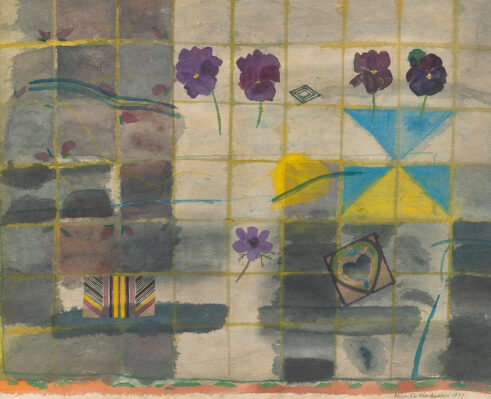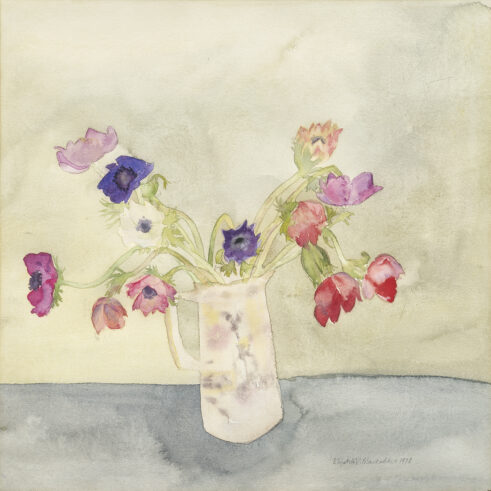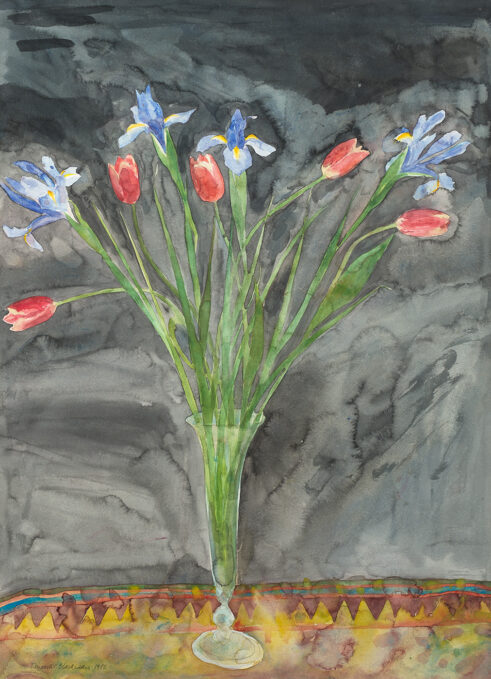
Blackadder and her husband, the painter John Houston, surrounded themselves with collected objects gathered over decades. Their home and studios in the southside of Edinburgh was filled with ephemera, flowers, toys, vessels, ornaments, and small keepsakes from Scotland and travels together. These objects were not displayed as a formal collection but existed as part of the disciplined and continuous process of making pictures. Blackadder would carefully select and arrange items in the studio until she was ready to start on a painting.
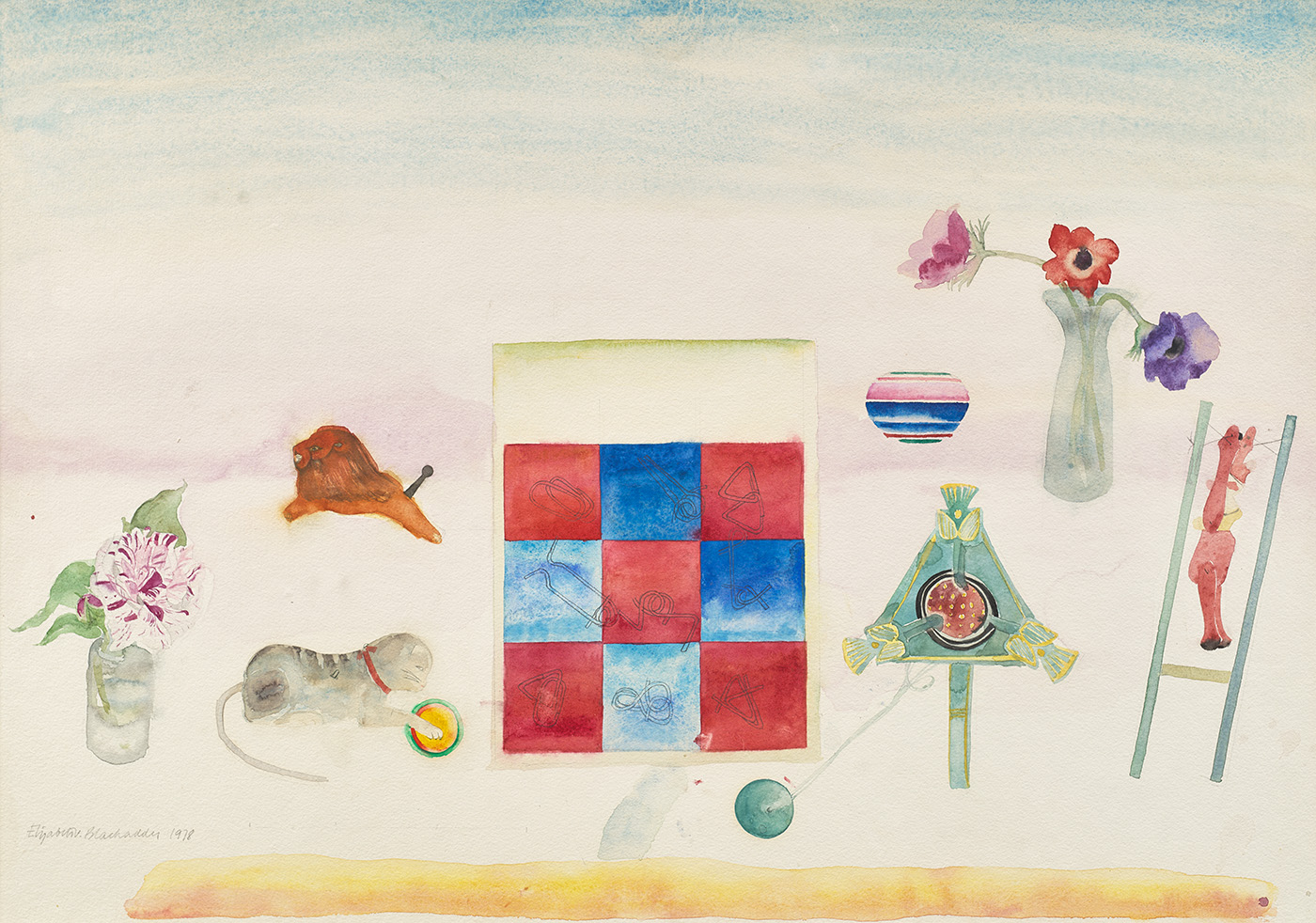
In Still Life with Toys, Blackadder has assembled two wind-up toys, a small striped hand drum, a suspended circus acrobat, delicate flowers, and a mysterious chequered box containing metal puzzles. The circus figure, poised on its tiny trapeze, recalls a child’s toy activated by touch, while the chequered box invites recognition through memory rather than explanation. These are objects made to be handled, spun, squeezed, and played with. Rather than constructing a traditional still life, Blackadder creates a spacious and theatrical arrangement in which intervals between objects become as important as the objects themselves. The pale washes of watercolour and the openness of the composition allow each form to exist both as a real thing and as an element within a carefully orchestrated visual rhythm.
By making a picture about toys, Blackadder gently invites the viewer into a world shaped by curiosity, collecting, and play. The work evokes childhood memories and the pleasures of handling treasured objects, while also reflecting upon the playful nature of picture making itself. The still life becomes an imaginative space in which observation, memory, and invention quietly unfold together.
signed and dated lower left
About Elizabeth Blackadder

Dame Elizabeth Blackadder (1931–2021) stands as one of the most important figures in modern Scottish art. Born in Falkirk, she studied at Edinburgh College of Art from 1949–1954 under influential teachers including William Gillies and Robert Henderson Blyth, graduating into what would become one of the most remarkable artistic careers of the twentieth century. Early travelling scholarships to southern Europe and Italy introduced Blackadder to the light, architecture and visual cultures that would profoundly shape her work for decades to come.