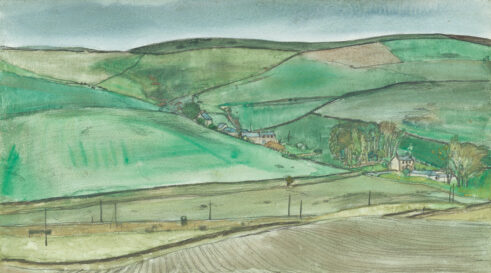
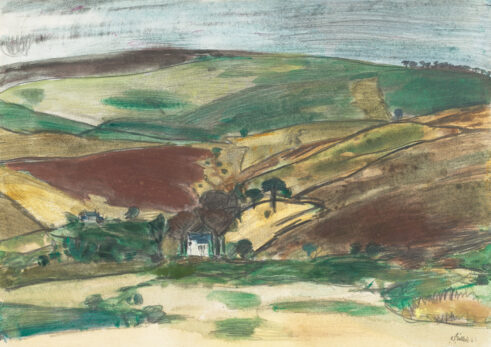
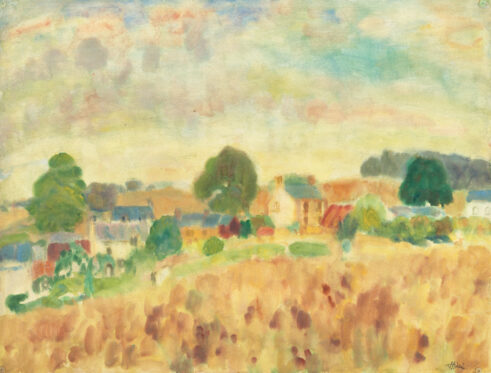
I often wondered whether the fact that he rode a fast powerful motorbike, accounted for the strong rhythmic lines of walls and fields in his paintings. At other times one sensed an inner stillness in the artist, enabling him to take insignificant bits of landscape detail – a scree slope, a winding hedgerow, village gable-ends – and turn them into pictorial magic. Other Scottish artists of his generation seem to receive more than their fair share of fashionable acclaim south of the Border. In Scotland, Gillies’ paintings need no hype to recommend them. He made us see his beloved Lothian and Border landscape through his eyes and heart, and enriched our lives accordingly.
John Busby RSA RSW SWLA (1928-2015)
About Sir William Gillies

Sir William Gillies was the dominant figure of the Edinburgh School over which both his personality and his work had a quiet authority. He led by example at the College of Art, encouraging his students to experiment but from a firm grounding in looking, and of course practice, drawing in particular. He also selected his staff to reflect this ethos: men and women who had a similar independence but respected hard work, what William MacTaggart called the good habit. The duties of teaching for Gillies and many of his colleagues in the School of Drawing and Painting were combined with their own practice without conflict; being a professional painter: working and exhibiting, was understood as integral to the reputation and health of the School. Robin Philipson, Elizabeth Blackadder, John Houston, David Michie and James Cumming were the beneficiaries of this attitude, along with their students, quietly instilled by Gillies over his fifty years of influence.