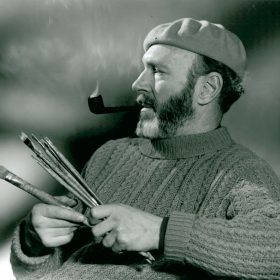
Denis Peploe RSA (1914–1993) was born in Edinburgh, the second son of the Scottish Colourist S. J. Peploe. Growing up within one of Scotland’s most distinguished artistic families, he accompanied his father on painting trips to Iona and the south of France, yet from an early stage developed an independent artistic identity and remained wary of direct comparison with his celebrated parent.
At seventeen he enrolled at Edinburgh College of Art, where contemporaries included Wilhelmina Barns-Graham and Margaret Mellis. His talent was quickly recognised through scholarships to Paris and Florence, followed by extensive travels in Spain, Italy and Yugoslavia. Exposure to European modernism informed his early work, but his career was interrupted by six years of military service during the Second World War, during which he rose from enlisted soldier to Captain in the Special Operations Executive.
Returning to painting in 1946, Peploe sought inspiration in the dramatic landscapes of the West Highlands. The mountains and sea lochs around Plockton, Applecross and Torridon became enduring subjects, painted with an expressive intensity that distinguished his work from the more decorative traditions associated with the Scottish Colourists. His first exhibition at The Scottish Gallery in 1947 was met with remarkable critical acclaim, prompting one reviewer to describe him as “an artist born fully armed” and another as “a vital and adventurous painter.”
Throughout his career Peploe remained committed to direct observation, whether painting Highland landscapes, Mediterranean harbours, still life or the human figure. Travel to Cyprus, Spain and France enriched his palette and broadened his vision, while his teaching at Fettes College and later Edinburgh College of Art provided a stable framework for a deeply personal studio practice.
His son, Guy Peploe, explains:
“While he was intimately exposed to the mainstream of European art he remained better defined as an artist who responded directly to his subject, en plein air or in the studio. Here the challenge was a live model, or the intellectual exercise of reinvigorating the still life subject. His work remained free of political or art-world references but was at the same time formed by the century of modernism, the times of unprecedented turmoil and change to which he belonged. His response was to cleave to the idea that art was important, even redemptive and that it could somehow describe a better, or more vital place.”
A longstanding artist of The Scottish Gallery, Denis Peploe first exhibited with the Gallery in 1947 and remained an important presence throughout his career. Today his work is recognised for its painterly vigour, emotional honesty and singular contribution to twentieth-century Scottish art.
The Scottish Gallery exhibitions: 1947, 1948, 1951, 1954, 1984, 1988, 1990, 1995 (Memorial Exhibition), 2006, 2010, 2014 (Centenary Exhibition).