Various Artists

In The Grain

1 April 2021 - 24 April 2021

This April, The Gallery brings together several artists whose practice is immersed in making furniture, sculpture and objects from wood. In the Grain will help us welcome Spring to The Gallery as we recognise the richness and diversity of artworks made in wood.

Exhibiting artists include: Gary Allson, Anthony Bryant, Ash & Plumb, Lizzie Farey, Richard Goldsworthy, Owen Jones, Adrian McCurdy, Jim Partridge & Liz Walmsley, Angus Ross, Edward Teasdale, The Tim Stead Trust, Tim Willey.

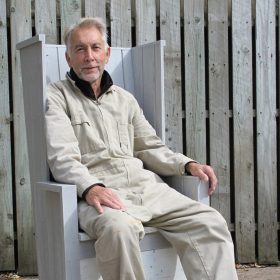
Craftsmanship is key; each artists’ technical genius and understanding of the medium comes from deep, personal engagement with sustainability and the environment. The Gallery will be filled with examples from familiar and current artists alongside emerging talent. From Scotland, we are delighted to showcase the furniture of Angus Ross, who has a studio and workshop in Perthshire, and Adrian McCurdy, who is based in the Scottish Borders. We have an enigmatic hazel sculpture by Lizzie Farey who lives and works in Dumfries and Galloway. In the Grain also pays tribute to the late Tim Stead (1952-2000) and we are delighted to be showing the magnificent King Chair, 1985, in The Gallery. From the rest of the UK, we have examples by artists The Gallery has represented over several decades, including the eminent furniture makers and sculptors Jim Partridge and Liz Walmsley, alongside Edward Teasdale’s chests, made from reclaimed wood. We are delighted to be able to include an example of Anthony Bryant’s outstanding woodturning. New to The Gallery are Barnaby Ash and Dru Plumb, who together are known as Ash & Plumb. Based in Brighton, they have given us a beautiful series of hand turned vases. We are also taking this opportunity to present Tim Willey’s sustainable carved wooden vessels. Welcome to the warmth and humanity of In The Grain.

About Gary Allson

Gary Allson designs and makes hand turned wooden bowls and plates. The work is made in his studio in Cornwall using locally sourced sustainable timber: oak, beech, cherry and ash. Following traditional techniques the work focuses on elemental forms with natural surface finishes and a contemporary identity.

MA Graduate of RCA, Gary assisted Anthony Gormley in the making of Angel of the North, as well as working on projects for Raffo Design Associates, Granada TV (Richard and Judy), Roger Taylor (of rock band Queen), BBC2 Windfall Films, comedians Bill Bailey and Sean Lock, and Habitat. Gary is a lecturer at University College Falmouth and continues to develop his digital work from his studio.

‘I design and make hand turned wooden bowls, plates. The work is made in Cornwall from locally sourced sustainable timber. Using traditional techniques the work focuses on elemental forms with natural surface finishes and a contemporary identity.’ – Gary Allson

Gary is part of our current group exhibition, In the Grain, which runs until 24th April at The Scottish Gallery.

About Anthony Bryant

Anthony Bryant
Born: 1960
Place of Birth: Ashton, Cornwall

Anthony Bryant is internationally recognised for his unsurpassed work in ‘green’ woodturning. He creates work which stretches the potential of the material to its furthest limits – both in scale and in his unrivalled ability to turn to an absolutely breathtaking thinness. Anthony turns over the space of a few days using hand-made tools, before leaving it to dry as it warps into its eventual shape. Anthony only uses English wood, such as an oak or ash, for their unique aesthetic and materiality.

‘I am not concerned with function in my work. Instead, I prefer to explore the sculptural potential of the vessel at the physical limits of woodturning. My driving aim is to create powerful forms with poise and presence’ – Anthony Bryant.

Selected public collections:
The Sainsbury Centre, University of East Anglia; The Arts Council of Wales; Liverpool Museum and Art Gallery; The Museum of Ulster; The Fitzwilliam Museum, Cambridge; The Crafts Council; The Contemporary Art Museum, Honolulu

About Ash & Plumb

Ash & Plumb
Born: 1988, 1987
Place of Birth: Edinburgh and Perth, Western Australia

Ash & Plumb was created by design duo Barnaby Ash and Dru Plumb, born of a desire to honour naturally sustainable materials; crafting unique and functional works that breathe life into the living spaces they inhabit.

‘In an increasingly mass-produced culture, we have decided to walk a different path; paying tribute to traditional craft in a modern context we realise classically formed pieces that allow the natural beauty of the material to shine. We consider ourselves editors not creators of nature’s finest work. For this new collection, we wanted to symbolise the strength that comes with a diverse and physically connected community; communities that we have all been so starved of in recent times and yet are so essential to our sense of belonging and support systems. Each piece we have created is unique in character and form whilst bearing a familial aesthetic that brings them together, celebrating the magnificent diversity within our native hardwoods that mirrors that of our own human counterparts.’ – Ash & Plumb

Ash & Plumb present their second solo exhibition with The Gallery in June-July 2024 – Echoes.

About Lizzie Farey

Lizzie Farey
Born: 1962

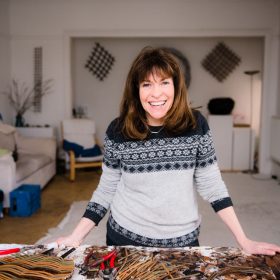
Lizzie Farey (b.1962) trained in fine art and stained glass before turning to basketry in 1991, learning the first steps from her sister-in-law in North Wales. She planted a field of willow cuttings and her passion for working with natural materials began.

Always keen to try new approaches to this traditional craft Lizzie gradually gained a strong reputation for her simple innovative forms, especially the spheres often decorated with catkins or pussy willow. A cover article in Crafts Magazine in 1997 helped establish Lizzie’s career in Britain and abroad – especially in the U.S. where she started selling her work at Browngrotta Arts. This, in turn, led to numerous awards and offers to show her work in Sotheby’s New York, SOFA Chicago, The V & A London etc. In 2004 Lizzie won the BBC Homes & Antiques ‘Talent around Britain’ award, voted for by the public and sponsored by John Lewis.

In 2007 Lizzie received the Creative Development Award from the Scottish Arts Council (now Creative Scotland) allowing her to pursue her new interest in ‘willow wall drawings’. These new pieces were exhibited in a solo exhibition at Edinburgh’s City Art Centre in 2010 and a large piece was commissioned for their stairwell, spanning two floors.

In July 2011 Lizzie’s willow light installation ‘Heart’ went on permanent display in the newly refurbished National Museum in Edinburgh, and other collections include Priors Court School, Reading; The City Arts Centre, Edinburgh; and The Shipley Art Gallery, Gateshead

I take my influences from the Galloway countryside where I live and work. I am surrounded by hills, lochs, larch and heather, the essence of which I try to recapture in my work. I grow my willow in nearby farmer’s fields and collect ash and other materials from the hedgerows. My working life is governed by the cycle of nature.
The work leads me and stimulates me at the same time. The pieces that I forge create a sense of spaciousness and take on a life of their own.
I try to express the complex in as simple a way as possible the natural materials often having a quiet and still effect on the viewer. – Lizzie Farey, 2012

Photograph by David Moses

About Richard Goldsworthy

Richard Goldsworthy
Born: 1995
Place of Birth: Macclesfield

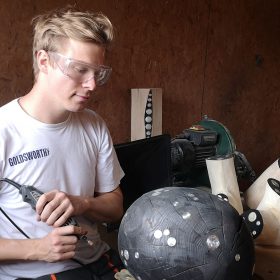
Richard Goldsworthy (b.1995, Macclesfield) graduated from Edinburgh College of Art with a BA (Hons) in Sculpture in 2019. During his studies, Richard was awarded the RSA Barns-Graham Travel Award in 2019 and completed a residency at Hospitalfields, Arbroath in 2018. Working mainly with wood, Richard carves, chars, bleaches or casts elements to create highly contrasted objects that are visually intriguing.

Charring gives the wood a denser, deeper texture beyond its basic colour and contrasts with any metal inclusions, which Richard casts into the wood, as well as with the natural grain and colour of the wood itself.

‘The exploration and transformation of material has always been a crucial part of my practice. Growing up in the British countryside, I have always been drawn to nature to source the materials I work with. From this ongoing relationship I have developed my study of wood and its intrinsic qualities, as well as its behaviour when acted upon through man-made materials and tools. This juxtaposition, both enhances and transforms the natural beauty of the materials I work with. My aim as an artist is to show off these natural materials and to guide the viewer back to these resources and the meditative power of nature we tap into when confronted by it.

The process of making, for example, the selection and seasoning of the wood, as well as working with it, is as important to me as the object itself. This gives me an intimate understanding of each work, allowing me to demonstrate the different ways in which a material can be looked at and used. By burning, carving and casting the wood, I create contrasting patterns that highlight and transform the shape and surface. I choose to celebrate the defects created by these actions such as my markings, and expose the ones caused by nature such as knots, cracks and ageing. Setting metal into the wood has the potential to create a friction between these two polar materials; yet aesthetically, it appears harmonious as a single object. The alchemical quality of this fusion is solidified, for me, by the casting process, in which the metal roots into the wood, similar in which a tree root takes to the soil.’ – Richard Goldsworthy.

Richard Goldsworthy presented a new selection of work in July 2020 – Wood, Metal & Fire and his work was also exhibited within In the Grain, April 2021.

About Owen Jones

Owen Jones
Born: 1959
Place of Birth: Cumbria

‘From selecting and felling the oak, through to completing the swill, all is done by my hand and so to complete the final link and meet the customer is most rewarding.’ Owen Jones

Owen Jones MBE lives and works in Cumbria and has been making traditional oak swills and baskets since 1988.

‘I was taught to make swills in 1988 by a retired ‘Swiller’ from Broughton-in-Furness, called John Barker. John had served his time in a 1930’s swill shop and when I met him he was one of the last swillers from that generation who were still making them. Now there is no one left alive from that era and I feel very privileged to have been taught by John, to have learnt from within the tradition and to now continue a local trade which has remained largely unchanged for centuries. When I first started I was supplied my oak and hazel by a local coppice man, Bill Hogarth, who was reliable, knew what I wanted and became a good friend. Bill was the last true coppice merchant in this area and after he died I had to source my own wood and so for the last 17 years I have been coppicing in the local Rusland valley. When I learnt the trade, I just caught the tail end of their previous uses and sold to farmers and industries e.g a snuff factory. However this market soon dried up and so from the early days I travelled countrywide to demonstrate and sell at fairs and shows. From selecting and felling the oak, through to completing the swill, all is done by my hand.’

About Adrian McCurdy

Adrian McCurdy
Born: 1953
Place of Birth: Kendal

Adrian McCurdy (b.1953, Kendal) is one of Scotland’s most respected furniture makers, celebrated for work that combines traditional craftsmanship with a refined contemporary sensibility. Working from his workshop in the Scottish Borders, he creates furniture and sculptural objects from locally sourced timber, often using storm-felled trees and sustainably harvested hardwoods from the surrounding landscape.

Although trained in Fine Art, McCurdy’s relationship with wood began in childhood. Raised in a household where furniture making was both profession and daily conversation, he developed an early appreciation for the value of skilled handwork and the enduring qualities of well-made objects. After initially pursuing painting, he gradually returned to woodworking, discovering that the language of timber offered a more natural and direct means of expression.

A pivotal moment came when he moved to the Scottish Borders more than four decades ago to work alongside the celebrated furniture maker and artist Tim Stead. While developing his own distinct voice, McCurdy absorbed the values that would shape his career: respect for materials, honesty in construction and a belief that furniture should possess both utility and presence.

His work is characterised by an elegant economy of form. Drawing inspiration from vernacular furniture traditions, early cottage furniture and the structural logic of historic woodworking, he pares forms back to their essentials. Through uncomplicated joinery, carefully considered proportions and an exceptional understanding of timber, McCurdy creates pieces that are both sculptural and functional. Cleft oak, hand-worked surfaces and subtle evidence of the maker’s hand remain central to a practice that values authenticity over ornament.

As the artist explains:

“I have managed to blend uncomplicated jointing with sculptural minimalism expressed through the wood craft of cleft oak. Referring back to early styles of cottage furniture has become a frequent source of inspiration and rudimentary character. I like things to last well and be relevant over time to fresh interpretation.”

Alongside furniture, McCurdy has increasingly explored carved panels and wall-based works, extending his investigation of form, texture and material into a more explicitly sculptural territory. Throughout his practice there remains a commitment to creating objects that feel rooted in place, crafted with care and capable of lasting for generations.

His work is held in public and private collections including Perth Art Gallery, National Museums Scotland, the Globe Theatre, London, and the Ann Getty Collection, Hawaii.

Adrian McCurdy is exclusively represented by The Scottish Gallery in Scotland.

About Jim Partridge and Liz Walmsley

Jim Partridge and Liz Walmsley
MBE
Born: 1953

For almost four decades, Jim Partridge (b.1953) and Liz Walmsley (b.1952) have been among the leading voices in contemporary British furniture making. Working from their studio near Oswestry on the Welsh border, they have developed a distinctive body of work that combines exceptional craftsmanship with a deep sensitivity to material, landscape and place.

Partridge studied at John Makepeace’s influential Parnham House School for Craftsmen in Wood during the 1970s, while Walmsley began her career in ceramics before turning her attention to furniture and collaborative design. Since 1986 they have worked in partnership, designing and making furniture, sculptural objects and ambitious site-specific commissions. Alongside their collaborative practice, Partridge continues to create the carved and turned vessels for which he is widely admired.

Their work is rooted in a profound understanding of wood as both material and subject. Frequently working with green oak, ash and other native timbers, they embrace the natural character of the material, allowing grain, movement, texture and the passage of time to inform the final form. Many pieces are carved from solid timber before being scorched, brushed and polished to create richly textured surfaces that reveal the inherent beauty and complexity of the wood. The resulting works occupy a compelling space between furniture and sculpture: functional objects that possess a powerful physical presence and a strong sense of place.

Landscape has always been central to their practice. Whether creating furniture for domestic interiors or large-scale public commissions, Partridge and Walmsley seek to make work that is both grounded and enduring. As they have often said, their ambition is to create “work with a strong but quiet presence in the landscape.” This philosophy has informed a career that has successfully bridged craft, design, architecture and environmental art.

Their work has been commissioned for a wide range of public projects and cultural institutions, including Grizedale Forest, Christ Church Cathedral, Oxford, the Royal Botanic Garden Edinburgh, Compton Verney, Ruthin Craft Centre and RHS Wisley. Their furniture and sculptural works are held in major public collections including the Victoria & Albert Museum, the Crafts Council Collection, Manchester Art Gallery, the Fitzwilliam Museum, Cambridge, the British Council Collection, the Kyoto Museum of Modern Art, Japan, and the Museum of Fine Arts, Boston.

Widely respected for their contribution to contemporary craft and design, Partridge and Walmsley have exhibited internationally throughout their careers and were shortlisted for the LOEWE Craft Prize in 2019. Their work continues to demonstrate how furniture can transcend function, becoming a powerful expression of material, landscape and human connection to the natural world.

The Scottish Gallery has exhibited their work since the early 1990s, celebrating a partnership whose influence on contemporary furniture making remains profound.

About Angus Ross

Angus Ross
Born: 1963
Place of Birth: Edinburgh

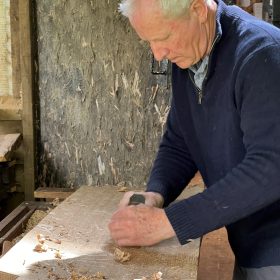
Angus Ross transforms trees into elegant furniture. He is best known as a designer and maker of exquisite, sculptural furniture with a sense of movement and flow. He has been innovating with wood for almost thirty years and remains curious about the possibilities of our local timber. As a maker, Angus draws on wood-work traditions from across the globe and combines ancient steam-bending of green wood with traditional cabinet-making and contemporary digital cutting to develop the craft of woodwork.

Angus was born in Edinburgh in 1963, but grew up near Inverness. He returned to Edinburgh to study and graduated from Napier University in 1985. He then moved to London where many of his designs were mass produced for brands such as Mothercare and Glaxo Smith Kline. After becoming disillusioned designing mass manufactured plastic products, and wanting to use his hands to make low volume, highly valued furniture and objects in wood, he retrained in practical furniture making at Rycotewood College, Oxfordshire graduating in 1992.

Public collections include: V&A Dundee, Inverness Museum and Art Gallery

Awards include: Walpole Crafted, Scottish Arts Council, Arts and Business Award and nominated four times for TRADA Wood Awards best bespoke furniture design.

Angus exhibited in our Wood exhibition, April 2019 and In the Grain, April 2021. Angus is part of our current group exhibition, In the Grain, which runs until 24th April at The Scottish Gallery.

About Edward Teasdale

Edward Teasdale
Born: 1945
Place of Birth: Lake District, England

Edward Teasdale appeared on the UK craft scene in the 1980’s at a time when ‘creative salvage’, ‘recycling’, and wider environmental issues were having a strong influence on design theory and practice. His forms and construction make common reference to a rationale of both formality and utility while the individuality of each piece comes from interplay of scale, proportion and sculptural detail. In contrast to his pared down and refined approach to design, the wood selected; processes used; and the finishes created do not aim for the perfectly controlled appearance of machine production but accentuate much of the rawness and weathering of the reclaimed natural material used. Teasdale received a National Diploma in Design (Furniture/Interior) in 1965 from Newcastle-upon-Tyne College of Art and a Master of Arts (Art and Design Education) from Manchester Polytechnic in 1984.

‘I was born and raised in England’s ‘Lake District’, in a place where you could feel almost smothered by the proximity of mountains, woodlands and water in all its forms (lakes, tarns, rivers, streams and lots of rain). As I remember it my childhood environment was pretty much devoid of any sophisticated culture. I spent all of my time outdoors building mossy dens in dark pine forests, light filled tree houses in deciduous woodlands and erecting improbable floating structures and bridges to explore the watery landscape. All the time using whatever was available to hand. My eyes and hands were the font of my practical education, noting the characteristics of every fence, stile and farm building as I was allowed to freely roam the largely empty countryside. My aesthetic sensibilities evolved through constant awareness and close examination of trees, rocks, cliffs and the ever changing light and surfaces of hillside, lake and sky. I devoted my adult life to adult education, simply sharing my love of everyday things; natural materials, visual beauty, practical skills and personal creativity. In my midlife crisis I determined I could probably better express my joy of things through making some of my own objects, rather than assisting others whose focus anyway seemed increasingly on academic rather than artistic issues. Now I find I’ve come full circle, sure, I now have knowledge, experience and interests in many things, some sophisticated, but I’m happiest outdoors among nature or in my workshop making useful things out of the elemental materials I stumble across.’ – Edward Teasdale, 2019

Edward exhibited in our Wood exhibition, April 2019 and also In the Grain, in April 2021 at The Scottish Gallery.

About Tim Stead

Tim Stead
Born: 1952
Died: 2000

‘Stead’s life and work manifested an integration that defies division: furniture, sculpture, photographs, poems, late nights around the dining-table, each were part of the same life that he grabbed with both hands, wringing out its very essence.’ Giles Sutherland

Tim Stead’s Four Poster Bed, 1995

This extravagant, fantastical essay in burr elm, is the last in a series of five beds made by Stead between 1975 and 1995. In true Stead fashion, the form links the deep past with a kind of indeterminate future – what the filmmaker Murray Grigor with characteristic, elegant wit termed ‘Pre-Hellenic Post Modernism’.

The bed was made at a time when there was a surfeit of cheaply available elm, the silver lining in the cloud we know as Dutch elm disease. Stead was one of the first artist-woodworkers to unlock the mysterious inner structures and patterns of burr elm and the bed, by definition on a large scale, allowed imagination and material to collide, giving Stead the intellectual and physical space to explore the vast, unknown hinterland the wood offered.

As another astute Stead commentator, Andrew Guest, noted the artist was obsessed by atavistic thoughts, so what better place to lay these bare in the place most of us begin and end our lives, where we procreate and seek solace and comfort?

At the ‘Scotland Creates’ exhibition in Glasgow, in 1990, Stead exhibited a reinterpretation in wood of one of the dwellings at Skara Brae, Orkney’s Neolithic village that lay buried for thousands of years until uncovered by a storm in the winter of 1850.

This bed continues Stead’s pre-occupation with the deep past. Its corbelled roof is an echo of the technique favoured by the builders of stone structures such as Maes Howe, the burial chamber illuminated by the Sun’s rays for a few minutes on the winter solstice. In the bed, lying on one’s back, looking upwards, it’s possible to stare back into the abyss of time and to be moved by the same energies that inspired the neolithic builders of Orkney. In this curtained bed, as in Maeshowe, in the words of Orcadian poet, George Mackay Brown, … The blackness is as solid as a / stone that locks a tomb. / No star shines here…

Here we may sleep and dream, as secure as in the womb, temporarily untroubled and untouched by the colder outside world. Dr Giles Sutherland

The Tim Stead Trust

The Tim Stead Trust was set up to save and preserve ‘The Steading’ in The Scottish Borders, of the eminent sculptor and artist Tim Stead (1952– 2000). Established in 2015, The Trust looks after The Steading and the Tim Stead Archive, to safeguard its future for the nation as an influential and internationally significant example of Scottish craftsmanship and environmental philosophy, all for the benefit of local, national and international communities.

Tim Stead, MBE, was a sculptor, wood artist, furniture designer and maker, photographer, poet, environmentalist, and out-of-the-box thinker. He died in 2000 aged 48. In his all-too-short life, he made furniture for galleries, castles, cathedrals and even for Pope John Paul II for his visit to the UK, yet it was the intuitive, untutored response of ordinary people that most excited Tim. People delighted in his work’s warm honesty and they wanted to live with it. Amongst his most well-loved public works are the interior of Café Gandolfi in Glasgow, the Millennium Clock in Edinburgh and the Oil Industry Memorial Chapel in Aberdeen. Born in Helsby, Cheshire, the youngest of four brothers, Stead was a natural anarchist and a sociable loner. Though rebellious at boarding school, The Leys in Cambridge, he achieved first-class honours in fine art at Trent Polytechnic through a clarity of vision and a passionate dedication to unfashionably palpable, narrative work. There Stead discovered wood with the unstinting support of technician Frank Lindlay. In 1975, Stead did postgraduate work at the School of Art in Glasgow, where he met his life partner, Maggy Lenert, a student from Luxembourg, the day before she was about to leave Scotland.

The Trust wants to use the unique asset of The Steading and its collections as the hub for a Centre for Wood Culture that will build on Tim’s vision and offer the real potential for a sustainable future to support the buildings, the collection, and community-facing activities in the longer-term. The aims of the Tim Stead Trust are to make The Steading and its contents, including the archive works of Tim Stead, accessible to the public and researchers. To provide educational activities that will interpret Tim Stead’s furniture, sculpture, philosophy and poetry. To provide an environment that will encourage wood working skills and enable other artists to flourish. And, to organize workshops that encourage environmental awareness and the artistic use of wood in all its guises.

Photograph by Robert Walker

About Tim Willey

Tim Willey

Tim Willey is a sculptor, craftsman and applied ecologist. He established his own practice in the North Norfolk countryside, where he manages 12 acres of mixed woodland. This provides him with a continuous supply of sustainable materials and a perfect working environment, which he happily shares with numerous species of birds, mammals and insects. Tim is an active researcher in adaptive construction, open-fired ceramics and experimental archaeology and runs regular practical workshops, often in collaboration with the Norfolk Wildlife Trust, where he can share his knowledge and enthusiasm with others.

‘It is important that my work reacts to the material situation at hand, rather than being the result of an inwardly conceived idea. I like to follow a cyclical and rather seasonal pattern of working; from the planting of trees to the harvesting and processing of timber, and finally through to constructing, which might involve, cleaving, turning, carving, or indeed any action which seems appropriate.’ – Tim Willey

Tim was part of our group exhibition, In the Grain, in April 2021 at The Scottish Gallery.

Gift Card

Struggling to find that perfect gift? We have the solution! A Scottish Gallery Gift Voucher is the perfect gift for friends, family, customers and colleagues.

Own Art

Own Art is a national initiative that makes buying contemporary art and craft affordable by providing interest-free credit for the purchase of original work.


Join our mailing list

Sign up to receive the latest art news from The Scottish Gallery including forthcoming exhibitions, films, podcasts, blogs, events and more.