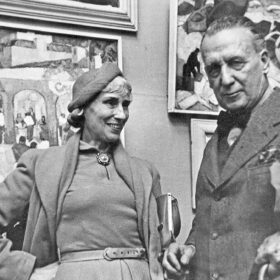
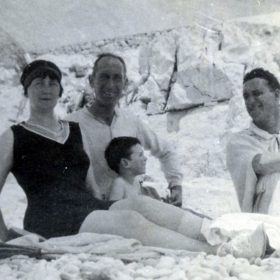
Margaret Morris was a dancer, choreographer, artist and teacher, and a pioneering figure in the development of modern dance in Britain. Born in 1891, London, she trained from an early age but rejected the constraints of classical ballet, developing instead a freer, more expressive approach to movement. In 1910, she opened her first school in London, and over the following decades formalised her ideas into the Margaret Morris Movement, an innovative system that united dance, design, music and physical training through principles of rhythm, harmony and natural motion.
Her work placed her at the centre of influential avant-garde circles in London and Paris, bringing her into contact with leading writers, artists and intellectuals including George Bernard Shaw, Ezra Pound and Wyndham Lewis. Morris’s practice extended beyond performance into teaching, theory and publication, and she championed dance as both an artistic and therapeutic discipline, anticipating later developments in movement education, physiotherapy and physical wellbeing.
Morris first met J.D. Fergusson in Paris in 1913, and their partnership became both personal and artistic, lasting for the remainder of their lives. Far more than a muse or model, she was a significant creative force in her own right and an important influence on Fergusson’s thinking.
Her understanding of movement, rhythm and bodily expression resonated strongly with his long-standing interest in dynamic form, while their shared belief in a modern artistic language created a rich dialogue between dance and painting. Together they collaborated on theatre productions, costume designs and stage settings, reinforcing the close relationship between their respective disciplines.
Alongside her work in dance, Morris was also an accomplished visual artist, working in painting, design and illustration. Her artistic practice reflected many of the same principles that informed her choreography, exploring pattern, line and spatial rhythm across different media. After settling in Glasgow in 1939, she became a significant force in Scottish cultural life, founding the Celtic Ballet Club in 1940 and contributing to the vibrant artistic community that developed around Fergusson and the New Art Club. Through her teaching, performances and publications, she helped establish Scotland as an important centre for progressive approaches to movement and artistic education.
Morris’s legacy reaches beyond the history of dance alone, encompassing a wider vision of creativity in which movement, art and
personal expression were fundamentally connected.