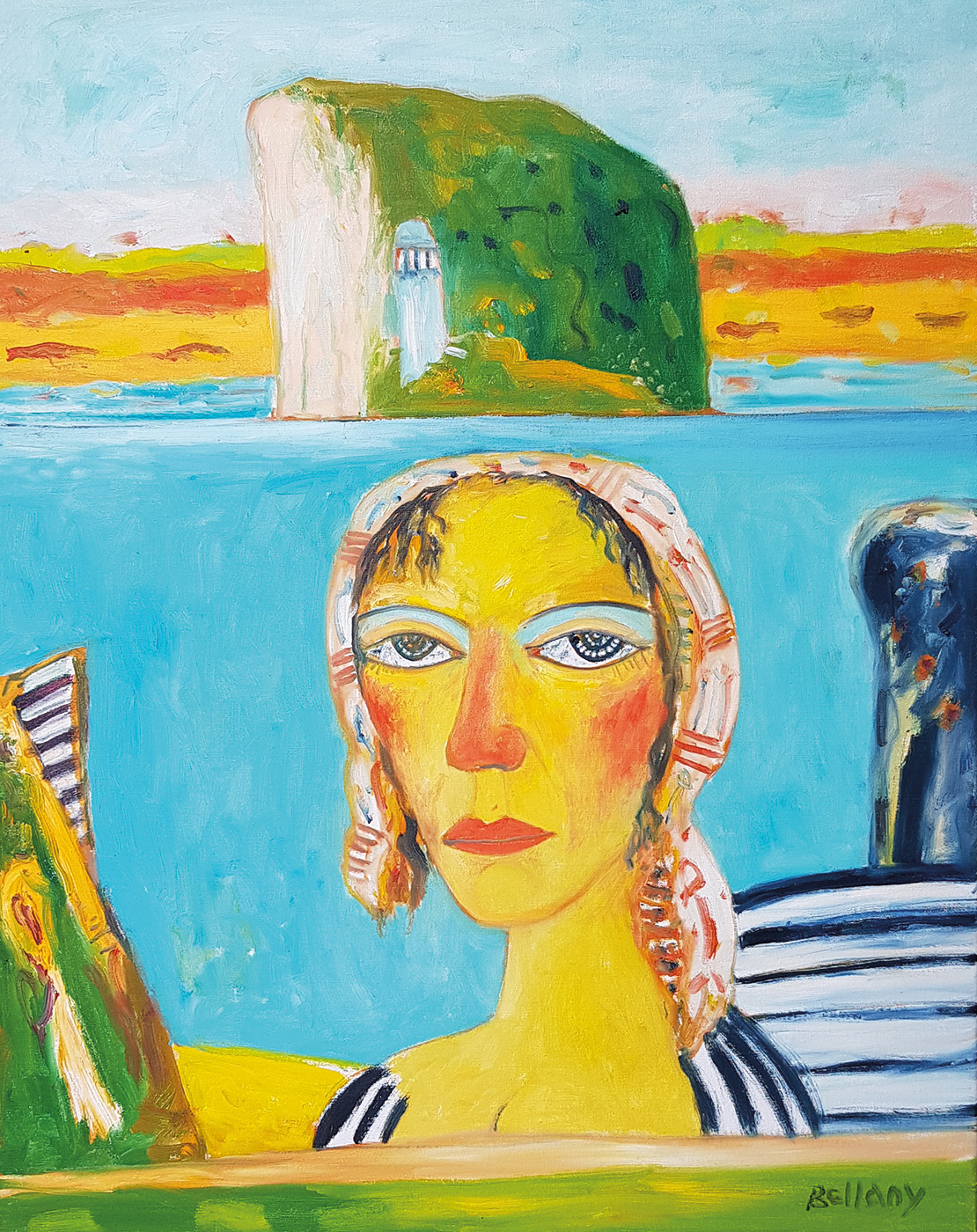
Fisherwoman and The Bass Rock, c.1999
The Bass Rock rises dramatically from the Firth of Forth, its white volcanic cliffs visible for miles along Scotland’s east coast. Home to the world’s largest colony of northern gannets, it has long occupied a special place in Scotland’s imagination. Through the centuries it has served as a royal fortress, a notorious prison for Covenanters and Jacobites, and today remains one of the country’s most recognisable natural landmarks. Steeped in folklore and history, the island has inspired generations of artists, writers and visitors drawn to its commanding presence.
For Bellany, the Bass Rock became far more than a distinctive feature of the East Lothian coastline. Painted on numerous occasions during his later career, it emerges as a powerful symbol of permanence, memory, and spiritual refuge. Like the sea that surrounds it, the Rock became part of Bellany’s own visual language, a place where landscape and human experience meet. Dominating the foreground is a striking female figure whose calm, unwavering gaze lends the composition an almost iconic quality. Her patterned headscarf recalls the women of Scotland’s east coast fishing communities, so familiar to Bellany from his upbringing in Port Seton. Throughout his career he returned to these figures, not as portraits of specific individuals, but as enduring symbols of resilience, family and the enduring relationship between people and the sea.
Around her, Bellany weaves together fragments of the maritime world. Striped forms and vertical structures evoke the language of boats, harbour architecture and fishing equipment, although they remain deliberately ambiguous, balancing the composition while hinting at the traditions that shaped both the artist’s life and imagination. As in much of Bellany’s mature work, recognisable forms dissolve into a richly symbolic visual vocabulary.
signed lower right
About John Bellany

John Bellany CBE RA HRSA (1942–2013) was one of the most powerful and uncompromising voices in post-war British art, celebrated for emotionally charged paintings that fused autobiography, symbolism and the traditions of Scottish maritime life. Born into a fishing family in the East Lothian village of Port Seton, Bellany’s upbringing within a deeply rooted Presbyterian and sea-faring community became the enduring foundation of his artistic imagination. The rituals, hardships and folklore of fishing life, alongside themes of mortality, faith, guilt and redemption, would remain central to his work throughout his career.