Various Artists

A Japanese Design

30 July 2020 - 29 August 2020

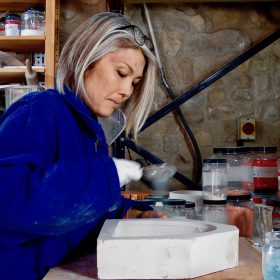
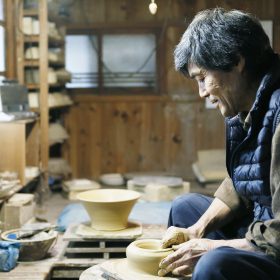
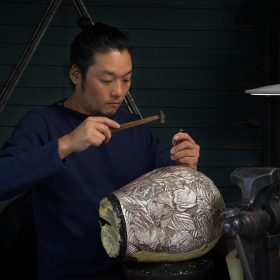
This August we present A Japanese Design, in the spirit of the International Festival. Our exhibition brings together an impressive selection of Japanese makers, many of whom have trained in the UK or have made their home here and have been represented by The Scottish Gallery for the span of their professional careers. The Gallery has been instrumental in placing many of the artists’ works in Public Collections. Many disciplines are explored by artists specialising in ceramics, glass, jewellery and metalwork and we can remark on the Japanese creative ability to master and innovate in a chosen medium; embracing and advancing tradition.

The Scottish Gallery would like to thank Adrian Sassoon London, who represents Hiroshi Suzuki and Hitomi Hosono, for their generous help and input.

A Japanese Design features work from: Miki Asai, Professor Koji Hatakeyama, Akiko Hirai, Professor Yasuki Hiramatsu, Hitomi Hosono, Koichi Io, Takuya Kamiyama, Tsubusa Kato, Miyu Kurihara, Kazuko Mitsushima, Yoshiko Okada, Yuta Segawa, Masaaki Shibata, Etsuko Sonobe, Hiroshi Suzuki, Yusuke Yamamoto.

About Miki Asai

Miki Asai
Born: 1988

Miki Asai is a graduate of Silversmithing and Jewellery from The Glasgow School of Art. Miki’s intricate jewellery collection is strongly based on the Japanese aesthetic that finds beauty in impermanence, imperfection, transience and the ephemeral.

‘My work is based on the Japanese philosophical concept called Wabi-sabi, which means finding beauty in imperfection and transience. I read a book on the subject that said, ‘things are beautiful because they are fleeting.’ This can apply to various aspects of life, whether it be emotions or something as simple as a bunch of leaves in the street. The fact that everything will one day be nothing is beautiful; flowers grow up and then they die, that is the nature of life.’

She has won several awards for her work during her studies including the Prize for Graduation Work at Musashino Art University 2011, Japan Jewellery Designers Associations Student Class Award 2012, Japan Craft Design Association Student Class 2014, The Goldsmiths’ Craft & Design Council Awards 2016 Design Section Pearl Jewellery Award and the Japan Jewellery Design Association General Category 2017.

About Professor Koji Hatakeyama

Professor Koji Hatakeyama
Born: 1956
Place of Birth: Takaoka, Japan

Professor Koji Hatakeyama (b. 1956) is one of Japan’s most celebrated contemporary metal artists, internationally recognised for his cast bronze boxes and vessels with richly patinated surfaces. He was born in Takaoka, Toyama Prefecture, a mountainous region northwest of Tokyo that has been a centre for bronze, copper and lacquerware production since the early seventeenth century.

Hatakeyama studied metalwork at Kanazawa College of Arts and Crafts, graduating in 1980, and later served as Professor of Metal Casting in the Department of Craft at Kanazawa College of Art from 2017 to 2022. Throughout his career, he has remained deeply committed to the ancient process of bronze casting, using traditional sand-casting methods before subjecting each work to months of complex patination. His surfaces, created through carefully controlled chemical processes, evoke erosion, mineral deposits, weather systems, volcanic terrain and vast Japanese landscapes.

His works are rooted in Buddhist philosophy and the aesthetics of the Japanese tea ceremony. The exterior of each box often appears darkened, weathered or ancient, while the interior may be lined with gold, silver or platinum leaf. This contrast transforms the act of opening the box into a contemplative experience, suggesting ideas of emptiness, consciousness, memory and spiritual awakening.

Although often modest in scale, Hatakeyama’s boxes possess a powerful physical presence. Their faceted forms recall reliquaries, architectural structures and ritual objects, while their patinated surfaces suggest landscapes viewed from above, celestial bodies or ancient walls marked by time. Each work rewards close and sustained looking, revealing subtle shifts of colour, texture and reflected light.

Hatakeyama’s work is held in major international public collections, including the Victoria and Albert Museum, London; The British Museum, London; The Metropolitan Museum of Art, New York; Musée des Arts Décoratifs, Paris; National Museums Scotland, Edinburgh; the Ashmolean Museum, Oxford; Philadelphia Museum of Art; and the National Museum of Modern Art, Tokyo. A work from his 2024 exhibition Scenes in Bronze at The Scottish Gallery was acquired for the collection of National Museums Scotland.

In 2022, a major retrospective of his work was held at Musée Tomo in Tokyo, tracing the development of his bronze box forms and pioneering patination techniques. A major new monograph on the artist’s work was published in 2026, further confirming his reputation as one of the most important contemporary metal artists working internationally today.

Hatakeyama has exhibited widely in Japan, Europe and Australia, and has enjoyed a longstanding relationship with The Scottish Gallery, with solo exhibitions in 2009, 2011, 2014, 2018 and 2024.

About Akiko Hirai

Akiko Hirai
Born: 1970
Place of Birth: Shizuoka, Japan

Akiko Hirai (b.1970, Shizuoka, Japan) moved to London in 1999, studying ceramics at the University of Westminster and Central St. Martins. Hirai’s work is both a blend of Japanese and British studio pottery traditions resulting in asymmetrical, ‘imperfect’ organic forms.

Hirai studied at Central Saint Martins, School of Graphics and Industrial Design, London from 2002-2003 and was shortlisted for the LOEWE craft prize 2019.

My preference of choosing types of clay when making white ware is the dark and coarse clay most of the time. The whiteness acts as a membrane or a veil. The hints of the true nature of the material appear slightly on the surface. Dark clay which consists of many impurities induces strong chemical changes in heat and the trace of events remains under the veil when it cools down. White, on the other hand, is more stable because of its purity. It is already settled and has a feeling of stillness. Superficially my work appears to be quiet in white. It does not show the rawness of Mother Nature directly. A symbolic figure always looks more perfect than the actual person he/she is. Imagination and fantasy always reinforce the imperfection and achieve the perfection with its own originality. Therefore the completion of my work is done by the viewers. My work is a creation on its own. – Akiko Hirai

Public Collections include:
Hepworth Wakefield Collection; Everson Museum, Syracuse, New York, USA; Victoria and Albert Museum, London; National Museum of Ireland; The Fitzwilliam Museum, Cambridge; Keramikmuseum Westerwald (Westerwald Ceramic Museum), Germany

About Professor Yasuki Hiramatsu

Professor Yasuki Hiramatsu
Born: 1926
Place of Birth: Osaka
Died: 2012

Professor Yasuki Hiramatsu (1926–2012) stands as one of the most important and influential figures in twentieth-century Japanese jewellery, celebrated internationally for redefining the possibilities of metal within contemporary art jewellery.

Born in Osaka in 1926, Hiramatsu forged an extraordinary career not only as a maker but also as an educator, becoming Professor at the Tokyo National University of Fine Arts and Music and later Director of the Japan Jewellery Designers Association. Through both his teaching and practice, he played a pivotal role in establishing contemporary jewellery as a serious artistic discipline in Japan.

Hiramatsu was a true pioneer, bridging ancient Japanese metalworking traditions with a modern sculptural sensibility. Rather than viewing jewellery as purely decorative, he approached each work as an exploration of form, material, texture and light. His pieces possess a profound stillness and clarity, often pared back to elemental shapes that radiate strength, balance and quiet contemplation. Surface was central to his practice. Delicately worked textures catch and diffuse light with extraordinary subtlety, allowing metal to appear almost alive in the hand and on the body.

What distinguishes Hiramatsu’s work is its remarkable sense of humanity and intimacy. Despite the precision and discipline behind each piece, his jewellery never feels rigid or purely formal. Instead, there is warmth, sensitivity and an almost spiritual connection to the material itself. Hiramatsu spoke of metal as though it were a living collaborator:

“The metals which I mainly use are also like living things. When I make a piece, I play, worry, struggle with it and encourage it.”

This deeply philosophical approach resulted in jewellery that feels meditative yet powerfully present, where simplicity becomes a vehicle for emotional and material depth. His works reveal an extraordinary understanding of proportion and restraint, qualities closely aligned with Japanese aesthetics while remaining entirely contemporary and internationally resonant.

Throughout his distinguished career, Hiramatsu received numerous major honours. In 1991 he was awarded the Forty-First Crafts Award in Excellence by the Japanese Government Ministry of Education, and in 1994 became the first non-European maker to receive the prestigious Ring of Honour from the Gesellschaft für Goldschmiedekunst in Germany, one of the highest accolades in the field of contemporary jewellery.

Today, Hiramatsu’s work is held in many of the world’s leading museum collections, including The National Museum of Modern Art, Tokyo; Museum für Kunst und Gewerbe, Hamburg; Schmuckmuseum, Pforzheim; the Royal College of Art, London; the Victoria & Albert Museum, London; National Museums Scotland, Edinburgh; and The Imperial Household Agency, Tokyo.

About Hitomi Hosono

Hitomi Hosono
Born: 1978
Place of Birth: Japan

“I sculpted a leaf that I found in the garden at home. It was a simple leaf, not particularly special amongst other leaves. However, when I started sculpting its shape with clay, I was drawn into its intricacy; the manner in which the veins were branching, how the margins ended. I found many details that I admired in this small leaf. It is my intention to transfer the leaf’s beauty and detail into my ceramic work, using it as my own language to weave new stories for objects.” Hitomi Hosono

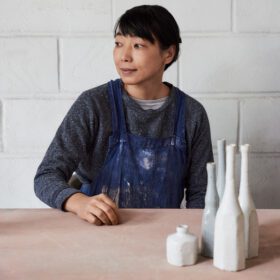
Hitomi Hosono’s exquisitely delicate and detailed sculptures began when she sculpted a simple leaf from the garden and found herself drawn into its intricacy.

Hitomi Hosono’s ceramics are rooted in both Japanese and European traditions. Hitomi studied Kutani Pottery at Kanazawa College of Art, Japan from 1998-2002, before studying Ceramic Product Design at Danmarks Designskole, Copenhagen, Denmark from 2005-2006. She then completed an MA in Ceramics and Glass at the Royal College of Art, London from 2007-2009. Hitomi Hosono has exhibited both nationally and internationally and received the 2014 Jerwood Makers Open Prize, Jerwood Visual Arts, London and the Perrier-Jouët Arts Salon Prize, London in 2013. Hitomi is now based in London and is represented by Adrian Sassoon, London.

Public collections include: Aberdeen Art Gallery & Museums; Oriental Museum, Durham University; The British Museum, London; The Wedgwood Museum, Stoke-on-Trent; Victoria and Albert Museum, London; Musée national des arts asiatiques – Guimet, Paris, France; Porzellanikon – Staatliches Museum für Porzellan, Selb, Germany; Cooper-Hewitt, National Design Museum, New York, USA; Los Angeles County Museum of Art, Los Angeles, USA

The Scottish Gallery is honoured to present Hitomi Hosono’s first solo exhibition in Scotland, The White Garden, in February 2025 in conjunction with Adrian Sassoon, London

Photograph by Sylvain Deleu

About Koichi Io

Koichi Io
Born: 1987
Place of Birth: Tokyo, Japan

Takuya Kamiyama (b. 1989, Tochigi, Japan) is a silversmith whose work explores the intricate textures, structures and patterns found in the natural world. Drawing inspiration from organic forms such as moss, fungi, bacteria and the layers of soil beneath our feet, he creates contemporary vessels and objects that combine technical precision with a highly individual visual language.

Kamiyama studied Industrial, Interior and Craft Design at Musashino Art University, Tokyo, graduating in 2017. During his studies he trained under the influential silversmith Hiroshi Suzuki, specialising in traditional craft and metalworking techniques, and subsequently worked as a Metal Department Assistant.

Following his graduation, he moved to the United Kingdom to continue his training as a Fellow at Bishopsland Educational Trust. There he further refined his skills in hand-raising, hammering, engraving and chasing, later collaborating with leading contemporary silversmith Ndidi Ekubia MBE in Manchester.

Working predominantly in silver, Kamiyama combines traditional silversmithing techniques with a contemporary aesthetic. His vessels, beakers and tableware transform often overlooked natural phenomena into richly textured surfaces that balance beauty and functionality. Through meticulous observation and experimentation, he seeks to reveal unexpected elegance in forms not traditionally associated with beauty.

Kamiyama was awarded the Goldsmiths’ Company Bursary Award in 2017 and was a winner of the Young Designer Competition organised by Jacobs the Jewellers and Bishopsland Educational Trust in 2018. His work has been exhibited internationally, including at Collect at Saatchi Gallery, Made for the Table at the Goldsmiths’ Centre, and exhibitions at The Scottish Gallery including A Natural Selection and A Japanese Design.

His work is held in important public collections including the Victoria and Albert Museum, London, and the collection of Cheongju City, South Korea.


About Takuya Kamiyama

Takuya Kamiyama
Born: 1989
Place of Birth: Tochigi, Japan

Takuya Kamiyama (b. 1989, Tochigi, Japan) is a silversmith whose work explores the intricate textures, structures and patterns found in the natural world. Drawing inspiration from organic forms such as moss, fungi, bacteria and the layers of soil beneath our feet, he creates contemporary vessels and objects that combine technical precision with a highly individual visual language.

Kamiyama studied Industrial, Interior and Craft Design at Musashino Art University, Tokyo, graduating in 2017. During his studies he trained under the influential silversmith Hiroshi Suzuki, specialising in traditional craft and metalworking techniques, and subsequently worked as a Metal Department Assistant.

Following his graduation, he moved to the United Kingdom to continue his training as a Fellow at Bishopsland Educational Trust. There he further refined his skills in hand-raising, hammering, engraving and chasing, later collaborating with leading contemporary silversmith Ndidi Ekubia MBE in Manchester.

Working predominantly in silver, Kamiyama combines traditional silversmithing techniques with a contemporary aesthetic. His vessels, beakers and tableware transform often overlooked natural phenomena into richly textured surfaces that balance beauty and functionality. Through meticulous observation and experimentation, he seeks to reveal unexpected elegance in forms not traditionally associated with beauty.

Kamiyama was awarded the Goldsmiths’ Company Bursary Award in 2017 and was a winner of the Young Designer Competition organised by Jacobs the Jewellers and Bishopsland Educational Trust in 2018. His work has been exhibited internationally, including at Collect at Saatchi Gallery, Made for the Table at the Goldsmiths’ Centre, and exhibitions at The Scottish Gallery including A Natural Selection and A Japanese Design.

His work is held in important public collections including the Victoria and Albert Museum, London, and the collection of Cheongju City, South Korea.

About Tsubusa Kato

Tsubusa Kato
Born: 1962
Place of Birth: Gifu, Japan
Died: 2025

Tsubusa Kato (b.1962, Onadacho, Tajimi, in Japan’s Gifu Prefecture) belonged to one of the great ceramic regions of Japan, an area with a centuries-old tradition of pottery and glaze innovation.

Kato graduated from the Tajimi City Pottery Design and Technical Centre, Gifu, in 1979, and went on to establish a singular and highly respected ceramic practice that combined technical mastery with an intensely physical and instinctive approach to making.

Kato became internationally recognised for his extraordinary manipulation of porcelain and celadon glaze. Working primarily with a distinctive New Zealand porcelain, he pushed the material to its limits, folding, stretching and compressing the clay with immense physical force while maintaining a remarkable sense of balance and refinement. His sculptures often appear suspended between states, simultaneously fragile and monumental, fluid and architectural. Although abstract in form, they evoke natural phenomena such as rock formations, waves, clouds or eroded landscapes shaped by wind and water.

Central to Kato’s practice was his understanding of glaze not as decoration, but as an expressive material in its own right. His celebrated celadon surfaces move across the clay like water or mist, pooling, cracking and thinning unpredictably during firing. The relationship between glaze and form is never fixed; instead, the surfaces shift continually with changes in light and perspective, revealing new depths, tones and textures with each viewing. This sensitivity to transformation and impermanence places his work within a broader Japanese aesthetic tradition that values subtlety, transience and the beauty of natural process.

Despite the technical sophistication of his ceramics, Kato approached making with an intuitive freedom. His works retain traces of movement and touch, capturing the tension between control and chance that lies at the heart of ceramic practice. The physicality of his process is essential to the finished work, with each piece recording the energy of its making while arriving at a final form that feels effortless and organic.

Kato’s sculpture occupies a space between ceramics, painting and contemporary abstraction. While deeply informed by Japanese ceramic traditions, his work also resonated internationally through its sculptural ambition and its exploration of materiality. The subtle tonal shifts of his celadon glazes and the dynamic asymmetry of his forms have drawn comparisons with both natural geology and modernist sculpture.

His work is held in important public collections including the Tomo Museum, Tokyo; The Brooklyn Museum, New York; and The Art Institute of Chicago. Through exhibitions in Japan, Europe and the United States, Kato established a significant international reputation as one of the most innovative contemporary ceramic artists working in porcelain and celadon.

Tsubusa Kato’s work featured in A Japanese Design at The Scottish Gallery in August 2020, introducing audiences to the remarkable sensitivity, energy and material intelligence that defined his practice.

Tsubusa Kato died in 2025, leaving behind a body of work distinguished by its quiet power, technical daring and deeply poetic relationship with clay and glaze.
About Miyu Kurihara

Miyu Kurihara
Born: 1989
Place of Birth: Frankfurt, Germany

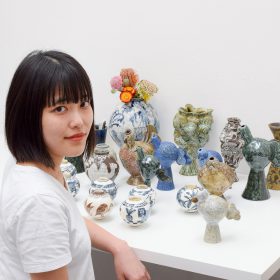
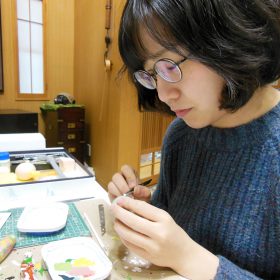
Miyu Kurihara (b.1989, Frankfurt, Germany) is a Japanese ceramic artist whose intricately hand-painted vessels combine contemporary craftsmanship with deep-rooted references to textile design and historic porcelain traditions.

Her practice is defined by an exceptional sensitivity to pattern, rhythm and surface, bringing together the decorative languages of Japanese kimono culture, traditional Asian ceramics and contemporary design.

Kurihara’s work is distinguished by its meticulous hand-drawn detail. Every piece is individually painted, often using fine cobalt blue decoration inspired by the blue and white porcelain traditions that originated in China and were later refined in Japan. Her vessels carry an extraordinary sense of precision and delicacy, yet remain deeply personal and expressive through the fluidity of the brushwork and the subtle irregularities of the handmade process.

Kurihara originally graduated from the Department of Product and Textile Design at Tama Art University, Tokyo, before moving to London to complete a Masters in Textile Design at Chelsea College of Arts, University of the Arts London in 2016. Her background in textile design continues to shape her ceramic practice, informing both her refined visual language and her understanding of how pattern interacts with three-dimensional form.  The influence of kimono design can be seen in her careful balancing of symmetry and asymmetry, as well as in the way patterns flow across curved surfaces with elegance and movement. Floral imagery, geometric arrangements and motifs drawn from nature recur throughout her work, creating pieces that feel simultaneously historic and contemporary.

Living and working in London, Miyu Kurihara has developed an increasingly recognised international practice, admired for its technical sophistication, quiet elegance and richly layered surfaces. Her ceramics honour the traditions from which they emerge while reinterpreting them for a contemporary audience, bringing together Japanese heritage, textile design and the enduring beauty of hand-painted porcelain.

About Yoshiko Okada

Yoshiko Okada
Born: 1972
Place of Birth: Tokyo

Yoshiko Okada was born in Tokyo in Japan in 1972. From 1990-92 she studied clothing and kimono design at Seitoku Technical college in Japan, before coming to the UK in 1995. After a prolonged education studying engraving and stained glass, Yoshiko graduated in three-dimensional design and glass from The Surrey Institute of Art and Design in 2004. Yoshiko works from her studio in London and works primarily with kiln formed glass, using simple forms symbolically related to the piece, often with small jewel-like elements. Her inspiration is drawn from her own Japanese background in conjunction with her personal experience of western culture. A personal narrative runs through her work.

‘My work explores themes of memory, identity, time and the human condition. Although seemingly complicated this often leads me to simple forms of expression and symbolism. Another concern for me are my childhood memories which are a sort of puzzle; to find and piece together the missing pieces, which do not always fit together precisely. I like exploring the surface image,deliberately veiling or reflecting the image.’ – Yoshiko Okada

Yoshiko Okada’s work featured in the exhibition A Japanese Design in August 2020.

About Yuta Segawa

Yuta Segawa
Born: 1988
Place of Birth: Shizuoka, Japan

Yuta Segawa (b.1988, Shizuoka, Japan) lives and works in London specialising in producing miniature pottery. He honed his ceramic skills in Japan, China, and London; completing a BA at Musashion Art University, Toyko and his MA at Camberwell College of Arts, London.

All of Segawa’s miniature pots are thrown individually by hand and he has more than five hundred original glazes which he applies to each miniature. Working in miniature poses a real challenge – testing the limits of what a human body can make on such a small scale. Segawa’s work has been exhibited both in the UK and internationally.

About Masaaki Shibata

Masaaki Shibata
Born: 1948
Place of Birth: Tokyo

Masaaki Shibata was born in 1948 in Tokyo. He studied at Chuo University, Tokyo and then was apprenticed to Kazutaka Ikuta in Tamba for 4 years. In 1975 Masaaki Shibata established his Sasayama pottery in Tamba, Japan, where he is still based today. He has received numerous awards for his work over the intervening years and is now one of the most respected slipware potters in Japan.

Masaaki Shibata exhibited for the first time at The Scottish Gallery alongside Clive Bowen in Masters of Slipware: East & West in April 2020. Masaaki’s work also featured in A Japanese Design, August 2020.

About Etsuko Sonobe

Etsuko Sonobe
Born: 1955

Etsuko Sonobe is an established Japanese jewellery artist who trained at Musashino Art University in Tokyo. Over the past twenty years, her striking understated gold jewellery has been exhibited and is collected internationally. There is a formal strength and invention to her pieces, as she says: ‘the form, the material and the structure must relate to one another: I am always aware of this necessity when I am making a piece’.

Please contact the gallery for available work.

About Hiroshi Suzuki

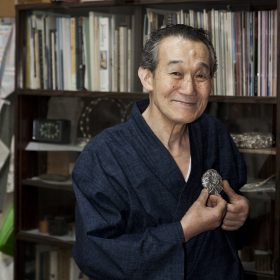
Born in Japan, Hiroshi Suzuki initially trained in Industrial design in Tokyo before moving to London in 1994 to study metalwork at Camberwell College and then at the Royal College of Art. After establishing a studio in England in 1998, he now lives and works in Japan and is a Professor at the Musashino Art University in Tokyo. Hiroshi Suzuki has had two solo exhibitions at The Scottish Gallery. His hammer raised vessels are iconic and his work is recognised internationally for its outstanding quality. In 2010, he was honoured with a retrospective exhibition at Goldsmiths’ Hall, London. Hiroshi Suzuki is represented by Adrian Sassoon, London.

“Intuition and feeling are core to my creative process, allowing me to maintain sensitivity with the material. The thematic influences in my work explore the subtleties within fluidity and sensuality, a very personal expression applied with an all-encompassing hand.”

Public Collections include: National Museums Scotland, Edinburgh, Aberdeen Art Gallery & Museums Aberdeen, Victoria & Albert Museum, London, The Ashmolean Museum, Oxford, The Worshipful Company of Goldsmiths, London, Royal College of Art, London, The Fitzwilliam Museum, Cambridge, Birmingham Museum and Art Gallery, Birmingham, Shipley Art Gallery, Gateshead, Sainsbury Centre for Visual Arts, Norwich, National Museums Liverpool, Merseyside, The National Museum of Wales, Cardiff.


Hiroshi Suzuki’s work featured in the exhibition A Japanese Design in August 2020.

Born: 1961

About Yusuke Yamamoto

Yusuke Yamamoto
Born: 1979
Place of Birth: Kanagawa, Japan

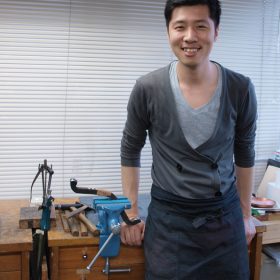
Yusuke Yamamoto (b.1979, Kanagawa, Japan) lives and works in North Wales. He trained in silversmithing at the renowned Musashino Art University, Tokyo. In 2011 Yusuke met Anna Gordon (currently the Head of the Silversmithing and Jewellery at Glasgow School of Art) and she invited him to take up an academic research position at GSA in 2012. In 2011 he visited Musashino Art University in Tokyo which has a world class reputation for metalwork, headed by Professor Hiroshi Suzuki.

Yamamoto shapes metal by hammer raising and chasing techniques and draws inspiration from the natural world. With each stroke of the hammer, he tries to evoke an expression, atmosphere and emotion.

Public Collections include:
Victoria and Albert Museum, London; National Museum Wales; The Clothworkers’ Company, London; The Goldsmiths’ Company, London; New College, Oxford

In August 2025, The Scottish Gallery will host a solo exhibition from Yusuke Yamamoto as part of the Edinburgh Art Festival – The Dappled Garden.

Photograph by Stephen Heaton
Gift Card

Struggling to find that perfect gift? We have the solution! A Scottish Gallery Gift Voucher is the perfect gift for friends, family, customers and colleagues.

Own Art

Own Art is a national initiative that makes buying contemporary art and craft affordable by providing interest-free credit for the purchase of original work.


Join our mailing list

Sign up to receive the latest art news from The Scottish Gallery including forthcoming exhibitions, films, podcasts, blogs, events and more.