Various Artists

Pinning Our Hopes

2 December 2021 - 23 December 2021

Pinning our Hopes is a continuation of our iconic miniaturists series. We present a specially commissioned, world-class selection of miniature brooches which are approximately 3 x 3 cm, made for the lapel to be worn and loved universally.

Exhibiting artists include: Jane Adam, Disa Allsop, Malcolm Appleby, Zoe Arnold, Miki Asai, Ash & Plumb, Julie Blyfield, Elizabeth Jane Campbell, Susan Cross, Jack Cunningham, Michelle Currie, Ella Fearon-Low, Grace Girvan, Choi Keeryong, Andrew Lamb, Ruth Leslie, Grant McCaig, Heather McDermott, Jacqueline Mina, Harry Morgan, Cara Murphy, Jacqueline Ryan, Paul Scott, Jane Short, Etsuko Sonobe, Joanne Thompson, Jessica Turrell, Tim Willey, Misun Won and Yusuke Yamamoto.

About Jane Adam

Jane Adam
Born: 1954
Place of Birth: London

Jane Adam is a leading British contemporary jeweller, who has an international reputation for her work in aluminium, a field in which she revolutionised contemporary practice and gained many significant awards. Her work in fine metals is gaining her even greater recognition.

‘I experiment with materials to explore their inherent qualities. Rather than imposing my own preconceptions upon them, I then set out conditions in which they will behave in a certain way. This approach gives my work a quality that relates to natural forms and to the way they change and grow. I aim to create pieces that extend traditional jewellery values: beauty, femininity and preciousness. My work explores female sensuality, both in the nature of the forms themselves and in the way they feel when worn. By becoming part of the wearer’s experience and expression of her self, my jewellery is transformed and completed.’ – Jane Adam, 2016.

Public collections include: The Goldsmiths’ Company, London; Victoria & Albert Museum, London

Jane Adam was the subject of solo exhibitions: Beyond The Surface during the Edinburgh International Festival in August 2013, and Duality in May 2018.

About Disa Allsopp

Disa Allsopp
Born: 1958

Disa was born in London and grew up in Barbados. This special island really influenced her jewellery designs, visible in her use of colourful gemstones. Disa personally selects each stone such as golden citrines, warm garnets, rubies, sapphires and morganites.

White and coloured diamonds are set on unique bands while rough and rare cut gemstones make Disa’s work contemporary and current, maintaining a timeless charm.

Disa exhibits internationally throughout the UK, United States, Japan and France. All work is individually handmade in Disa’s London studio.

About Malcolm Appleby

Malcolm Appleby
MBE
Born: 1946
Place of Birth: West Wickham, London

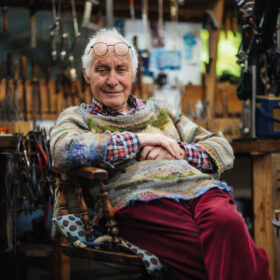
Malcolm Appleby was born in 1946. He studied at Central School of Art, Sir John Cass and the Royal College of Art in London before establishing his studio in Scotland in 1969. A silversmith and metal engraver, known for his imaginative use of line and form, he considers gold “just another lovely material to work with.”

The Scottish Gallery has been associated with Malcolm Appleby since the 1970s; the many facets of his work have brought joy to many, each piece sold marking the beginning of a journey of discovery around this senior artist. The Gallery honoured Malcolm Appleby’s seventieth birthday in January 2016, which marked over fifty years of a creative tour de force. Malcolm Appleby has dedicated his artistic practice primarily to engraving and pushing the boundaries of metalwork; constant experimentation has made him a master of his craft and in 2014 he received an MBE for his outstanding contribution to the arts.

2019 marked fifty years since Malcolm Appleby first set up his studio in Scotland and the exhibition 50 Golden Years in Scotland, featuring both jewellery and silversmithing, recognised his unique contribution to the arts. Malcolm’s infectious enthusiasm for his craft, his willingness to work with other artists and his pleasure in sharing his skills is characteristic of his generosity and pre-eminence. The natural world that surrounds Malcolm’s studio informs every piece; the artist’s inspiration unlimited in the abundance of the world around him.

Public Collections include:
The Victoria & Albert Museum, London; The Goldsmiths’ Company, London; British Museum, London; Royal Armouries, Tower of London; Ashmolean Museum, Oxford; Aberdeen Art Gallery & Museums; The Fitzwilliam Museum, Cambridge; National Museums Scotland, Edinburgh; and Perth Museum & Art Gallery

Malcolm’s jewellery collection can be viewed here.

In August 2021 we celebrated Malcolm Appleby’s 75th birthday with Malcolm Appleby & Friends. Previous exhibitions include 50 Golden Years in Scotland in March 2019 and The Gallery also hosted a special exhibition in January 2016 to celebrate Malcolm Appleby’s 70th birthday.

About Zoe Arnold

Zoe Arnold
Born: 1976

Zoe Arnold graduated in 2003 from Central Saint Martins College of Art and Design, London having completed a first class jewellery degree, and set up her own workshop. Having initial interests in being a sculptor, she fell into the jewellery world as a way of satisfying a need to work in fine detail and on a smaller scale. This is very evident in her work, which can be described as a wearable form of art.

I don’t particularly like being described as a jeweller, simply because most peoples’ perceptions of what a jeweller is, or does, are completely wrong in relation to my work. I do make jewellery, but I write poetry, short stories, make automata and larger more sculptural works. In the past an artist would have had many strings to their bow, but now society likes to file us under comfortable titles, and these don’t always fit.

Photograph by Fife Contemporary

About Miki Asai

Miki Asai
Born: 1988

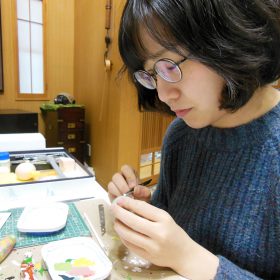
Miki Asai is a graduate of Silversmithing and Jewellery from The Glasgow School of Art. Miki’s intricate jewellery collection is strongly based on the Japanese aesthetic that finds beauty in impermanence, imperfection, transience and the ephemeral.

‘My work is based on the Japanese philosophical concept called Wabi-sabi, which means finding beauty in imperfection and transience. I read a book on the subject that said, ‘things are beautiful because they are fleeting.’ This can apply to various aspects of life, whether it be emotions or something as simple as a bunch of leaves in the street. The fact that everything will one day be nothing is beautiful; flowers grow up and then they die, that is the nature of life.’

She has won several awards for her work during her studies including the Prize for Graduation Work at Musashino Art University 2011, Japan Jewellery Designers Associations Student Class Award 2012, Japan Craft Design Association Student Class 2014, The Goldsmiths’ Craft & Design Council Awards 2016 Design Section Pearl Jewellery Award and the Japan Jewellery Design Association General Category 2017.

About Ash & Plumb

Ash & Plumb
Born: 1988, 1987
Place of Birth: Edinburgh and Perth, Western Australia

Ash & Plumb was created by design duo Barnaby Ash and Dru Plumb, born of a desire to honour naturally sustainable materials; crafting unique and functional works that breathe life into the living spaces they inhabit.

‘In an increasingly mass-produced culture, we have decided to walk a different path; paying tribute to traditional craft in a modern context we realise classically formed pieces that allow the natural beauty of the material to shine. We consider ourselves editors not creators of nature’s finest work. For this new collection, we wanted to symbolise the strength that comes with a diverse and physically connected community; communities that we have all been so starved of in recent times and yet are so essential to our sense of belonging and support systems. Each piece we have created is unique in character and form whilst bearing a familial aesthetic that brings them together, celebrating the magnificent diversity within our native hardwoods that mirrors that of our own human counterparts.’ – Ash & Plumb

Ash & Plumb present their second solo exhibition with The Gallery in June-July 2024 – Echoes.

About Julie Blyfield

Julie Blyfield
Born: 1957
Place of Birth: Melbourne, Australia

Julie Blyfield makes jewellery, small-scale vessels and sculptural objects in her studio nestling in the garden of her home in Adelaide, South Australia. Inspired by the botanical landscape in Australia, Julie’s favoured medium of expression is silver. This she uses in its softer pure form as well as in its stronger alloyed form – sterling silver. Her jewellery and vessels are characterised by seductive textured surfaces created using traditional silversmithing techniques such as hammering, chasing, punching and piercing. Rhythmical repetition is a key element of both her design process and her aesthetic, and the use of colour is also apparent. Following the traumatising Australian bushfires of 2007, Blyfield echoed the scorched colour and searing heat with enamel paint and startling glints of gold and silver set against charred blacks and ash greys.

‘My work is inspired by the botanical landscape in Australia, which I interpret in my metal work using the technique of ‘metal raising’ and ‘chasing’. I enjoy exploring and collecting plant specimens from rich and diverse environments such as the Simpson Desert in the north of South Australia and further south around the coast of Kangaroo Island. Working with both pure silver and sterling silver as my preferred choice of material, I texture the surface to create individual pieces in the form of vessels and also more sculptural pieces. During the making process, I enjoy the way the metal ‘moves and shifts’ in almost unpredictable ways to create the organic forms which shimmer with the silver textures or colours derived from nature.’ – Julie Blyfield, 2016

Public Collections include:

Aberdeen Art Gallery; Art Gallery of Western Australia, Perth, Australia; National Gallery of Australia, Canberra, Australia; National Museums Scotland, Edinburgh; V&A, London

About Elizabeth Jane Campbell

Elizabeth Jane Campbell
Born: 1989
Place of Birth: Scotland

Elizabeth Jane Campbell graduated from Edinburgh College of Art in 2013, and then spent a year as Artist in Residence at Glasgow School of Art before establishing her own studio in Edinburgh. Elizabeth’s award winning jewellery has been exhibited across the UK and abroad – most recently in Milan, Munich and America.

‘My recent work explores the connection between colour and shape – taking inspiration from colour theory, colour connotations and visual literacy. Using vitreous enamel enables me to achieve fantastic colours which I contrast with simple oxidised silver settings. The surface finish of the enamel is really important, as a gloss or matt finish can really change the quality of the enamel colour. Each piece is hand finished to highlight the vibrancy of the colour.’

Permanent collections include:
The National Museum of Scotland, Edinburgh; The Goldsmiths’ Company, London

Elizabeth was the subject of a solo exhibition in March 2020 – Colour Connections. Read our blog for an insight into her studio and the inspiration behind her work.

About Susan Cross

Susan Cross
Born: 1964
Place of Birth: Ledbury

Susan Cross (b.1964, Ledbury) graduated from Middlesex Polytechnic University in 1986, setting up her first studio in London before relocating to Edinburgh in 1989. Susan has been a part-time lecturer in the Jewellery & Silversmithing department at Edinburgh College of Art since this time and in 2008 was awarded a Readership following her success in the Jerwood Applied Arts Award for Jewellery in 2007.

Alongside her teaching she has continued to develop her work exhibiting both nationally and internationally. Susan has also been invited to initiate projects and workshops in Finland, India, New Zealand & South Korea and awarded a travel bursary by the Scottish Arts Council to study Japanese textiles.

As a jeweller I aim to explore the sensuality of the body through the tactility of materials. My work is fueled by a deeply rooted interest in textiles, both in terms of borrowed techniques and the range of visual references. More recently plant forms have inspired new ways of construction and a wider use of colour through the use of semi-precious stones. – Susan Cross

Public Collections include:
V&A Museum, London; V&A Museum, Dundee; National Museums Scotland, Edinburgh; Crafts Council, London; The Goldsmiths’ Company, London; Birmingham Museum and Art Gallery; Edinburgh Royal Infirmary; Alice & Louis Koch Collection, Switzerland; Spencer Museum of Art, USA; Arkansas Museum of Fine Arts, USA.

About Jack Cunningham

Jack Cunningham
Born: 1953
Place of Birth: Glasgow

Jack Cunningham trained at Duncan of Jordanstone College of Art in Dundee and was head of silversmithing and jewellery at Glasgow School of Art; he was then Head of the School of Jewelley at Birmingham City University. He is a contemporary studio jeweller whose particular interest is narrative jewellery, being that which tells a story or makes a statement through visual imagery.

‘I am motivated by the construct of our relationship with family, place, of recollection and memory, life and death. I am also interested in the dialogue that is consequently established between the maker – the originator of the artefacts statement, the wearer – the vehicle by which the work is seen, and the viewer – the audience who thereafter engages with the work.’
Public collections include: National Museums of Scotland, Musee des Arts Decoratif in Montreal.

He has exhibited widely in the UK and abroad and was a shortlisted finalist for the Jerwood Applied Arts Prize 2000.

About Michelle Currie

Michelle Currie
Born: 1985
Place of Birth: Vale of Leven, Scotland

Michelle Currie is currently Artist in Residence at The Glasgow School of Art Silversmithing and Jewellery Department after graduating with a First-Class Honours degree in 2020. Her unique practice combines traditional Silversmithing techniques with her love of Science and Astronomy. For her recent collection, Michelle visited the Physics and Astronomy Laboratories at The University of Glasgow, learning from Technicians and Scientists about their world leading research into Black Holes and Gravitational Waves. This unique collection is the result of an exploration into the unseen forces that govern and shape our world. By combining silver and precious stones with ferromagnetic materials containing iron particles, Michelle captures the exciting variety of textures and movement created when exposing iron particles to neodymium magnets. She creates her own mixtures of iron particles that are sculpted directly onto magnetic field lines using the invisible structure as a canvas to capture the explosive moments as static ominous wearable sculptures.

‘I am ever captivated and inspired by the beauty of the intrinsically interwoven nature of ‘Science and Art,’ sharing the pursuit of knowledge and an understanding of our place in the universe. Although often communicated in different ways, the fields are deeply connected by curiosity and the need to explore the unexplored, making sense of our observations and experiences.’

Michelle’s has received multiple industry awards such as a Goldsmiths’ Craft and Design Council Award, Goldsmiths’ Centre Precious Metal Bursary Award 2020 and received a prestigious ceremonial mace commission by The University of Glasgow to be unveiled in 2021. Michelle’s graduate work has also been awarded both the Fife Contemporary New Maker Award 2020 and the Incorporation of Goldsmiths Graduate Award 2020.

About Ella Fearon-Low

Ella Fearon-Low
Born: 1975
Place of Birth: London

Ella Fearon-Low mixes materials to create playful sophisticated contemporary jewellery that references historical forms. These forms are themselves a layering up of different visual and cultural references. Having studied at Morley College Ella now works from her London studio to develop and hand produce small collections and one off pieces.

‘Materials are key to my work, often having been collected over time, awaiting the right project to bring their qualities to the fore. They include brass to balsa, sea worn plastic to gold, and pearls to Lucite as well as a treasure trove of found objects. I enjoy the conversation between precious and non-precious components and often position them side-by-side.’

Awards include: Goldsmiths’ Craftsmanship and Design Council Awards 2020 – Bronze, Goldsmiths’ Craftsmanship and Design Council Awards 2018 – Bronze

About Grace Girvan

Grace Girvan
Born: 1981
Place of Birth: Orkney

The unique landscape of the Orkney Islands provides inspiration for Grace Girvan’s jewellery. She enjoys beach combing and uses the objects that she unearths on her expeditions in her work, combining found objects such as pebbles, driftwood and shell with precious metal and enamel.

Her work is evocative of her inspiration, through a restrained colour palette of soft greys, blues, greens and browns she conveys the washed out, sun bleached colours of the sea and shore.

Public Collections include:
Aberdeen Art Gallery and Museums, Aberdeen

I grew up on South Ronaldsay, the southernmost island in Orkney that is connected to the mainland by the Churchill Barriers. My childhood was spent on a farm, surrounded by open space and the outdoors. My grandparents lived very close by, and if there weren’t cattle in the fields, we would head straight across to visit them. Otherwise, we would take the road, which passed by the beach. That beach became an important place for us; we would often go there to search for Groatie Buckies (arctic cowries), smooth pebbles, and to watch the curious seals basking on the rocks. When I return to Orkney now, what strikes me most is the vastness of the sky. The land is relatively flat and there are very few trees, so the sky feels endless. The special quality of the light, combined with that great sense of space, is something I treasure deeply. The beach I most often return to is Chapel Point, the same one we used to visit on the way to my grandparents’ house. The pebbles there are perfectly formed, flat, smooth, and need no cutting, polishing, or shaping. I use them exactly as I find them, in their natural state.
In my work, I aim to translate the colours, light, and calmness of Orkney into jewellery. I use transparent enamels in soft blues, greens, and greys on silver. The silver beneath creates a luminous glow through the enamel, echoing Orkney’s unique light. By matting the surface of the enamel, the colours take on a watercolour-like softness, reminiscent of the landscapes I love. The pebbles themselves are always left unaltered, flat, smooth, and with naturally regular edges. I feel it is more honest to use them exactly as they are. Recently, I have been embracing their variety, celebrating the different hues and textures that reflect Orkney’s rich geology.

When I am in Orkney now, I am more intentional. I try to slow down, to absorb the landscape, the light, and the colours that inspire me. I take photographs, I collect pebbles, and I let those experiences feed into my designs. Collecting pebbles has also become a family ritual. My parents often join me, and they have an excellent eye for the shapes I am looking for. When I work with certain pebbles, I remember who picked them up, or I recall the exact beach where I found them. That connection to my family, to place, and to memory feels as important as the physical material itself. I am still excited every time I find a new pebble; their beauty never ceases to amaze me. Some of my favourite places to collect include the beach at Chapel Point, Newark or Dingieshowe in Deerness, and the beach at the fourth Churchill Barrier on South Ronaldsay. Each of these places holds its own sense of discovery and connection to home.

About Choi Keeryong

Choi Keeryong
Born: 1976
Place of Birth: South Korea

Originally from South Korea, Choi Keeryong came to Britain to complete a Master of Design at Edinburgh College of Art and in 2010, continued to embark on a PhD in Glass and Architectural Glass. Keeryong has exhibited widely across the UK whilst investigating the similarities and differences between cultural groups in terms of their aesthetic perceptions of visual experiences, particularly in relation to unfamiliar materials and surface imagery.

Choi’s motivation for creating this body of work is to explore how the ambiguity of an individual’s cultural interpretation can help to create the state of “uncanni-ness” in the audience’s visual experiences. He believes that this ‘uncanni-ness’ provokes emotions and feelings and Choi manipulates this powerful tool within his artistic practice to promote the awareness of stereotypes in an individual’s cultural understanding. Developing inlaid colouring techniques inspired by the ancient Korean “Saggam” pottery allows him to explore the state of ambiguity in visual experience by delineating geometric patterns and counterfeit letters onto glass artworks and encapsulating them in between the layers of transparent glass. The use of historical symbolism of tea and the popularity of English manufactured ceramic teapots are the metaphor for the cultural stereotype in both West and East.

‘My artistic approach is inspired by my personal experiences of being in-between-ness in terms of my current cultural location.’

Choi’s work has been exhibited both nationally and internationally including SOFA Chicago, USA, International Glass Prize 2015, Belgium, and Collect, London, UK.  Choi received the Glass Biennale 2015 National Glass Centre (NGC) Residency Award and was been selected as a Loewe Craft Prize 2023 finalist.

Public Collections include: National Museums Scotland; Museums and Galleries Edinburgh (City of Edinburgh Council); Oriental Museum, Durham University; The National Glass Centre, Sunderland; Imagine Museum, St. Petersburg, USA; Corning Museum of Glass, USA.

Photograph by Jaro Mikos

About Andrew Lamb

Andrew Lamb
Born: 1978

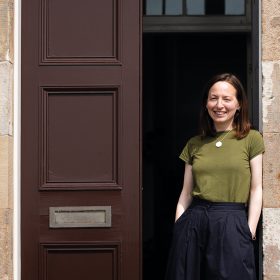
Andrew Lamb (b.1978) is recognised as one of the leading contemporary jewellers of his generation, celebrated for work that combines technical precision, optical complexity and extraordinary delicacy of construction.

A graduate of Edinburgh College of Art in 2000, Lamb was regarded as one of Dorothy Hogg’s most gifted and accomplished students, absorbing her emphasis on drawing, structure and rigorous material understanding while developing a visual language entirely his own. He later completed his Masters at the Royal College of Art in 2004, further refining the innovative approach that has since earned him international acclaim.

Lamb’s jewellery is distinguished by its remarkable ability to create movement and illusion through line, repetition and light. Drawing inspiration from Optical Art, woven structures and patterns found in the natural world, he constructs intricate sculptural forms from fine strands of 18ct gold and silver wire. Layered, twisted and meticulously arranged, these delicate linear elements generate rippling surfaces and shifting visual rhythms that appear to vibrate and transform as the eye moves across them. The resulting works possess a mesmerising sense of depth and fluidity, balancing mathematical precision with organic elegance.

Despite the extraordinary complexity behind their making, Lamb’s pieces retain an effortless lightness and refinement. His jewellery engages dynamically with both body and space, responding to movement, shadow and changing perspectives. Fine tonal variations between gold and silver subtly animate the surface, while the open structures allow light to pass through and around the forms, creating constantly changing visual effects. There is a quiet theatricality to the work, where perception itself becomes part of the experience of wearing and viewing the piece.

At the heart of Lamb’s practice is an exceptional level of craftsmanship. Each work demands immense patience, control and technical skill, with countless individual wires manipulated and assembled into precisely balanced compositions. Yet beyond this virtuosity lies a deep sensitivity to rhythm, proportion and material, qualities that place his work firmly within the lineage of the most innovative contemporary studio jewellery.

Andrew Lamb’s jewellery has been exhibited internationally and is held in major public and private collections including the Victoria & Albert Museum, London; National Museums Scotland, Edinburgh; the Crafts Council Collection, London; Birmingham Museum and Art Gallery; The Goldsmiths’ Company, London; Galerie Marzee, The Netherlands; the Royal College of Art Collection; and the V&A Wedgwood Collection.

About Ruth Leslie

Ruth Leslie
Born: 1993
Place of Birth: Edinburgh

Ruth Leslie (b.1993, Edinburgh) is one of the most exciting voices in contemporary Scottish jewellery, celebrated for work that combines sculptural elegance, technical precision and a distinctive sense of playfulness. Since establishing her practice in 2016, Leslie has developed an instantly recognisable visual language built around finely twisted wire structures and refined architectural forms.

Working predominantly in recycled silver and gold from her Edinburgh studio, she creates jewellery that is both delicately engineered and deeply tactile, balancing movement, rhythm and lightness with exceptional craftsmanship.

Textiles and textile machinery lie at the heart of Leslie’s practice. Inspired equally by the subtle details of woven fabrics and the intricate mechanics hidden within looms and industrial machinery, she transforms fine strands of precious metal into sculptural constructions that appear almost suspended in space. Using an old-fashioned hand drill, Leslie painstakingly twists wire before cutting, shaping and wrapping it around precisely constructed frames. This labour-intensive process creates her signature linear surfaces, where tiny repeated elements catch the light and generate a remarkable sense of texture and movement.

What distinguishes Leslie’s work is the way it merges engineering with softness. Her jewellery possesses an architectural clarity, yet never feels rigid or static. Earrings sway like kinetic structures, rings and necklaces curve fluidly around the body, and the intricate wirework introduces an almost textile-like sensitivity to each piece. Despite the complexity of their construction, the works retain an effortless elegance and wearability, revealing a maker with an exceptional understanding of balance, proportion and material.

Leslie’s collections are characterised by clean, contemporary forms that transcend seasonal trends, combining bold sculptural presence with quiet refinement. There is also an inherent joy within the work. The repeated twists, loops and rhythmic structures create jewellery that feels energetic and alive, inviting both movement and close looking.

Over the past decade, Ruth Leslie has established a significant and highly respected relationship with The Scottish Gallery, becoming one of the defining emerging jewellery voices associated with the Gallery’s contemporary programme. In June 2026, The Scottish Gallery will present a major solo exhibition celebrating ten years of exhibiting with the Gallery, marking an important milestone in Leslie’s evolving career and recognising the strength, originality and growing maturity of her practice.

Photograph by Nico Utuk

About Grant McCaig

Grant McCaig
Born: 1974

Grant McCaig (b.1974) is one of the UK’s most respected contemporary silversmiths, celebrated for work that combines technical mastery, sculptural presence and a deeply expressive understanding of silver as a material.

A graduate of Glasgow School of Art, where he received First Class Honours in Jewellery and Silversmithing in 1998, McCaig later completed an MA in Goldsmithing, Silversmithing, Metalwork and Jewellery at the Royal College of Art in 2011, supported by both a Queen Elizabeth Scholarship Trust Award and the Windle Charitable Trust.

McCaig’s practice spans both silversmithing and jewellery, exploring the relationship between functionality, movement and sculptural form. His vessels and objects are rooted in the traditions of hand raising and forging, yet are continually reinterpreted through a contemporary lens. Hammered and pleated surfaces catch and manipulate light with remarkable vitality, while crisp edges and fluid curves reveal his fascination with the physical and expressive possibilities of metal. Whether creating ceremonial silver, domestic vessels or wearable forms, McCaig approaches silver as a living material capable of both precision and spontaneity.

His work often explores contrasts between utility and abstraction, softness and structure, weight and movement. Despite the technical complexity behind each piece, there is an immediacy and honesty to the work that reflects the hand of the maker. McCaig’s objects invite use and interaction, continuing the silversmithing tradition while expanding its contemporary relevance.

Alongside his studio practice, McCaig has played an important role in contemporary craft education for over two decades. He worked as a lecturer at Edinburgh College of Art alongside Professor Dorothy Hogg MBE before joining the University for the Creative Arts in Farnham in 2013, where he became Senior Lecturer in Silversmithing, Goldsmithing and Jewellery. He has also taught and lectured internationally, including specialist silversmithing programmes in Bogotá, Colombia, and has mentored emerging makers through initiatives such as the Crafts Council’s Hothouse programme and the Incorporation of Goldsmiths of Edinburgh awards. His commitment to teaching and knowledge-sharing has made him an influential figure within contemporary metalwork education in Britain.

McCaig’s work is held in major public and private collections including National Museums Scotland, The Goldsmiths’ Company Collection, Birmingham Museums and Art Gallery, Aberdeen Art Gallery, the Bute House Collection and the Incorporation of Goldsmiths of Edinburgh.

Working in silver is inspiring and creative, technical and expressive. Using the traditional techniques of the silversmith as my foundation, I build pieces that explore the relationship between functionality and self-expression. I want my work to be individual in design and concept and give pleasure to the user. There is something magical about silver. When it arrives in the brown paper and cardboard packaging, which is promptly unwrapped and examined, a voyage of discovery begins. I have never once looked at a sheet of silver and thought nothing of it. My mind skips to the possibilities and the ideas that I originally purchased the metal for tend to pale in the face of the endless possibilities that lie before me. Soft and rounded, or crisp with sharp edges and plain bold surfaces. Silver, you will find, can do it all. – Grant McCaig

About Heather McDermott

Heather McDermott
Born: 1989
Place of Birth: Isle of Skye

Heather McDermott (b.1989, Isle of Skye) is a contemporary jeweller whose bold, sculptural work is deeply rooted in the dramatic coastline and tidal landscape of the Isle of Skye.

After studying Jewellery and Silversmithing at Edinburgh College of Art and completing her MA in 2011, McDermott returned to her home village of Aird on Skye, before settling in Callander, Perthshire.

The Skye coastline acts as both inspiration and material archive. Weathered fragments of rope, driftwood, fishing debris and sea-worn plastics washed ashore by Atlantic tides become starting points for her jewellery, transformed through abstraction into striking contemporary forms. McDermott is fascinated by the way natural forces reshape discarded objects over time, softening edges, fading colours and creating unexpected sculptural beauty through erosion and movement. Her work captures this tension between rawness and refinement, permanence and change. The island’s elemental landscape, exposed coastline and changing weather conditions continue to inform her evolving practice, giving the work an authenticity and immediacy rooted in lived experience. Her jewellery reflects both the beauty and fragility of coastal environments, transforming the language of erosion, tide and debris into powerful contemporary forms.

Working predominantly in silver and incorporating vibrant colour and layered surfaces, McDermott creates jewellery that is unapologetically sculptural in scale and presence. Neckpieces, brooches and earrings unfold like miniature constructions or fragments of weathered coastal architecture, balancing sharp geometry with fluid movement and tactile surfaces. Her compositions often echo tidal patterns, fishing equipment and shifting marine debris, while retaining an elegant contemporary clarity.

What distinguishes McDermott’s practice is her ability to elevate overlooked materials and transient coastal moments into jewellery of remarkable confidence and individuality. Her pieces are expressive and dynamic, designed not simply as adornment but as wearable sculpture that engages actively with the body and space around it. Colour plays an important role within the work, reflecting the constantly changing tones of sea, sky and shoreline under Hebridean light.

About Jacqueline Mina

Jacqueline Mina
OBE
Born: 1942
Place of Birth: Buckinghamshire

Jacqueline Mina OBE (b.1942, Buckinghamshire) is widely regarded as one of the most important and intellectually rigorous jewellers working in Britain today. For more than five decades, Mina has redefined the possibilities of precious metal jewellery through an extraordinary combination of technical innovation, sculptural sensitivity and conceptual depth.

Her work occupies a unique position between jewellery, drawing and abstract sculpture, celebrated internationally for its quiet power, refined surfaces and deeply contemplative presence.

At the heart of Mina’s practice is an exceptional understanding of gold as both material and language. Rather than treating precious metals as static or decorative, she transforms them into surfaces alive with texture, movement and light. Through processes of scoring, oxidising, fusing and hammering, Mina creates richly nuanced forms where subtle shifts in tone and reflection become central to the experience of the work. Her jewellery often appears deceptively minimal, yet beneath this restraint lies immense technical complexity and a profound sensitivity to form, proportion and touch.

Mina’s work explores tensions between inner and outer space, control and spontaneity, geometry and organic form. Curves, folds and angular planes interact with finely worked surfaces that trap and release light, creating jewellery that changes constantly in response to movement and the body. Inspiration is drawn from a wide range of sources including abstraction in art, the human figure, natural forms and the sumptuous textile interiors of Palazzo Fortuny in Venice, whose layered velvets and etched patterns resonate strongly within her treatment of metal surfaces.

What distinguishes Mina’s work is the extraordinary balance she achieves between intellectual rigour and sensuality. Her pieces possess a meditative stillness while remaining intensely tactile and wearable. They reward close looking, revealing subtle dialogues between polished and matte surfaces, hard edges and soft curves, structure and chance.

Alongside her studio practice, Mina made a profound contribution to jewellery education. From 1972 until 1994 she taught at the Royal College of Art, where she inspired generations of students, many of whom went on to become leading contemporary jewellers in their own right. Her influence on the field of contemporary jewellery extends far beyond her own remarkable body of work.

In recognition of her contribution to contemporary jewellery, Mina received the Jerwood Applied Arts Prize for Jewellery in 2000 for “consistent innovation and a significant contribution to contemporary jewellery… for subverting and taking precious metal techniques to the extreme.” She was awarded an OBE for Services to Art in 2012. In 2011, The Worshipful Company of Goldsmiths honoured her career with the major retrospective Dialogues in Gold, later followed by the touring exhibition Touching Gold, both of which confirmed her status as one of the defining figures in modern jewellery.

The Scottish Gallery has shared a long and significant relationship with Jacqueline Mina and has proudly championed her work since the 80s with numerous solo presentations. We are delighted to be planning a major solo presentation of her jewellery during the Edinburgh Festival in 2026, celebrating an artist whose work continues to shape and elevate the language of contemporary gold jewellery.

Her work is held in major international public collections including: National Museums Scotland, Edinburgh; the Victoria & Albert Museum, London; Cooper Hewitt, Smithsonian Design Museum, New York; the Crafts Council Collection, London; The Goldsmiths’ Company, London; and Leeds Museums and Galleries.

I aim to achieve an aesthetic result that obscures the technical rigours of its production. I am preoccupied mainly with the surfaces of precious metals (which I always affect in some way before construction begins) and with form – juxtaposing the play of light, reflection, lustre with characteristic angle, curve and line – inspired by an abstraction of nature and art, and particularly of the human form. I am intrigued, too, by the potential for dialogue between inner and outer planes, with random patterns imprisoned within strictly delineated edges, the inclusion of chance, and the visual tension created by the contrast and harmony of all these factors. – Jacqueline Mina

Photograph by Paul Read

About Harry Morgan

Harry Morgan
Born: 1990

Originally from Manchester, Harry Morgan gained a 1st Class BA (Hons) degree in Glass from Edinburgh College of Art in 2014. Since graduating, Harry has exhibited at the 2015 British Glass Biennale in Stourbridge, where he was awarded the London Glassblowing Award for Emerging Talent. Harry currently works from his studio within Custom House Leith, Edinburgh.

Interested in the intrinsic ‘personalities’ of materials and their capacity to represent ideas, Harry’s current work explores the conflicting relationship between concrete and glass:

“Despite being composed of the same elements, glass and concrete appear as conflicting materials. With unclear borders and internal dimension, glass reflects ambiguity and intangibility. In sharp contrast, concrete is brutally physical; the word itself is used to describe absolutes and certainties. Both materials have strong social, cultural and polarised connotations; from the sumptuous history of Venetian glass to the Utopian concrete of post-war Brutalism. The use of glass in my work draws inspiration from the ancient Venetian glassblowing technique, murrine; where each rod or thread of glass is individually pulled by hand from a furnace. The glass is then arranged into a sequential structure and cast within concrete or precious metal, which binds them as one object. I’m interested in applying these traditional skills in alternative directions.” – Harry Morgan, 2017.

Harry was shortlisted and highly commended for the LOEWE Craft Prize 2019.

Harry Morgan‘s work featured in a group exhibition in September 2019 – Convergence.

About Cara Murphy

Cara Murphy
Born: 1969
Place of Birth: Northern Ireland

Cara Murphy trained at Glasgow School of Art and the Royal College of Art, London. She applies traditional silversmithing techniques to craft innovative and sculptural functional silver tableware, which is inspired by the natural environment, creating a silver landscape for the dining table.

“Using traditional silversmithing techniques the work addresses the concept of a silver landscape that challenges the boundaries of functional silver tableware. The sculptural silver forms aim to challenge the users’ established knowledge of silverware by not alwayshaving an obvious function and questions the user’s perception of function.The use of silver evokes a sense of ritual and ceremony. Functionality has always been a fundamental aspect of the work and for several pieces this is the driving force behind it. Working with a variety of materials, predominately silver, the work investigates the organic grown form.” Cara Murphy

Public Collections include:

Aberdeen Art Gallery, Arts Council an Chomhairle Ealaion, Arts Council of Northern Ireland, National Museum of Ireland, Queens University Collection Belfast, St. Anne’s Cathedral Belfast, The Silver Trust Collection at 10 Downing Street, Ulster Museum Belfast, Shipley Art Gallery and the Irish Embassy Collection.

About Jacqueline Ryan

Jacqueline Ryan
Born: 1966
Place of Birth: London

Jacqueline Ryan spent time at the Fachhochschule in Dusseldorf and after graduating from the Royal College of Art, London in 1991, she moved to Padua, Italy and shared a workshop with Giovanni Corvaja. Jacqueline works exclusively in gold and precious materials to create organic forms characterised by intricate arrangements of repeated elements, bringing to the field a unique voice grounded in the Italian tradition of architecture and design. Jacqueline now has her own workshop in Todi, Italy.

‘Most of my pieces are preceded by studies derived from living organisms, marine plants, flowers, or seeds and other found objects with the occasional aid of macrophotography that capture some of the finer-scale qualities more difficult to perceive with the naked eye. Repetition, naturally occurring in nature, is a recurrent theme that runs through much of my work as well as movement in which the composite shapes and forms from which my work is constructed move and sway with the body and sometimes jingle and rattle – quietly giving the work a pleasant tactile dimension and interacting with the wearer so that the piece may be animated and alive. I feel that my work has completed its cycle when it has found its wearer.’ – Jacqueline Ryan

Public Collections include:

Aberdeen Art Gallery & Museums, Aberdeen; National Museums Scotland, Edinburgh; The Worshipful Company of Goldsmiths, London; Victoria & Albert Museum, London; Musée des Arts Décoratifs, Paris, France; Museum für Künst und Gewerbe,Hamburg, Germany; Museo degli Argenti, Florence, Italy; and The Metropolitan Museum of Art, New York, USA.

View and purchase a copy of On The Surface here. This is the publication that accompanied Jacqueline’s solo exhibition in August 2019.

About Paul Scott

Paul Scott
Born: 1953

Paul Scott lives and works in rural Cumbria. He has been a professional artist for over thirty years and is best known for his research into ceramics and print. He creates individual pieces that are exacting and critical, blurring the boundaries between fine art and design. A leading proponent of ceramics and print, he has been instrumental in demonstrating the contemporary creative potential of a combination used in industry for hundreds of years to mass-produce decorative wares and tiles. In 2010, he designed thirty linear metres of the record breaking Hanoi Mosaic Mural in Vietnam. Confected, Borrowed and Blue… an Installation by Paul Scott toured throughout 2015 – 2016 at various locations throughout the UK.

‘Over the years, my artworks have commemorated and examined a range of issues, from the Foot and Mouth crisis to the impact of energy extraction and production on our environment… I have inserted nuclear and coal fired power stations as well as wind turbines into pastoral landscapes, exploratory oil rigs in pristine arctic locations – and placed landscapes with fracking rigs onto cracked platters. In March 2011, the Fukushima Daiichi nuclear power plant in Japan was enveloped by tidal waves following the Tōhoku earthquake and tsunami. The ensuing events cut power to water-cooling pumps and nuclear fuel rods melted down, creating the largest nuclear disaster since Chernobyl in 1986. Scott’s Cumbrian Blue(s) Fukushima series commemorates the event. All works have been made on Willow pattern platters made in Japan. Although the Willow Pattern was originally made in late eighteenth century Staffordshire to imitate Chinese porcelain wares, it is a jumbled confection of designs with decorative details incorporating elements not only of Chinese porcelain but also Japanese Imari ware. It has been produced all over the world. I collaged an erased piece of an old English Willow pattern platter (c.1840) into the scene. I removed the original print and replaced it with an in-glaze print after Katsushika Hokusai’s woodblock print The Great Wave off Kanagawa (c.1830). The nuclear power plant can be seen behind garden buildings.’ – Paul Scott, 2016

Public and Private Collections include:

Victoria & Albert Museum, London; National Museums Scotland, Edinburgh; Government Art Collection, UK; New York Historical Society, USA; National Museum of Wales, Cardiff; The National Museum Stockholm, Sweden; The National Decorative Arts Museum, Norway; Carnegie Museum of Art, Pittsburgh, USA; Tullie House Carlisle Museum and Art Gallery.

Paul Scott presents a solo exhibition, Scenery, Samplers & Souvenirs, in May 2021. This exhibition presents new artworks which update historical transferwares for the 21st century, including a selection from his New American Scenery series. The exhibition also features work made as a result of his Gardens of Lyra collaboration with Spode and Fortnum & Mason and also presents new works from his Cuttings Series.

About Jane Short

Jane Short
Born: 1954

Jane Short has had training both as a jeweller and silversmith, graduating from the Royal college of Art in 1979. She has been enamelling since 1974, using the traditional techniques of champlevé and basse-taille. These individually designed pieces may be richly coloured or make more subtle use of the wide range of colours available to the enameller, and are a painterly and evocative exploration of colour and imagery. Jane also collaborates with other silversmiths and makers to interpret their colour designs into enamel and received an MBE for services to the Craft of Enamelling in 2016.

‘I am endlessly fascinated with the vitality, subtlety and beauty of enamel on silver, and each of my pieces is an exploration into it’s possibilities.’ – Jane Short

Public collections include: The Goldsmiths’ Collection, London; The Victoria & Albert Museum, London; Crafts Council Collection, London; The Ashmolean Museum, Oxford; The Fitzwilliam Museum, Cambridge; National Museum of Scotland; Hove Museum, South East Arts Collection.

About Etsuko Sonobe

Etsuko Sonobe
Born: 1955

Etsuko Sonobe is an established Japanese jewellery artist who trained at Musashino Art University in Tokyo. Over the past twenty years, her striking understated gold jewellery has been exhibited and is collected internationally. There is a formal strength and invention to her pieces, as she says: ‘the form, the material and the structure must relate to one another: I am always aware of this necessity when I am making a piece’.

Please contact the gallery for available work.

About Joanne Thompson

Joanne Thompson
Born: 1971
Place of Birth: Annan, Dumfries & Galloway

Joanne Thompson (b.1971, Annan, Dumfries & Galloway) is one of Scotland’s most accomplished contemporary jewellers, celebrated for jewellery that combines sculptural presence with extraordinary fluidity, tactility and wearability. Since graduating from Edinburgh College of Art in 1993, Thompson has developed a distinctive and highly recognisable visual language rooted in repetition, movement and meticulous craftsmanship.

She was regarded as one of Dorothy Hogg’s most gifted students, absorbing the discipline, technical rigour and sensitivity to form that characterised Hogg’s celebrated teaching while forging a powerful aesthetic entirely her own.

Following Edinburgh College of Art, Thompson completed an MA in Jewellery at the Royal College of Art, London, in 1995, where she further refined the chain-based constructions that have become central to her practice. Since graduating, The Scottish Gallery has represented Joanne Thompson continuously, supporting and championing her work from the very beginning of her career. Over the past three decades, she has held several important solo exhibitions with the Gallery and remains one of the defining contemporary jewellers associated with its programme.

Thompson’s jewellery is remarkable for the way it transforms hard precious metal into forms of exceptional softness and movement. Drawing inspiration from ancient chain maille techniques, she painstakingly constructs necklaces, bracelets and earrings from thousands of individually formed, soldered and finished silver links. Through subtle variations in scale, density and structure, she creates sculptural works that drape and flow across the body with an almost textile-like fluidity.

Her signature palette of oxidised silver and deep matte black gives the work a quiet drama and sophistication. Despite their visual complexity and sculptural volume, Thompson’s pieces remain astonishingly light, comfortable and durable, designed to move naturally with the wearer. Elegant movement is not incidental but fundamental to the work itself; each piece shifts gently in response to the body, creating constantly changing surfaces and rhythms.

What distinguishes Thompson’s practice is the balance she achieves between technical precision and sensuality. The repetitive process of constructing each individual link becomes almost meditative, resulting in jewellery that carries both structural clarity and emotional intimacy. Her works possess an understated confidence and timelessness, transcending fashion while remaining unmistakably contemporary.

Today, Joanne Thompson is recognised as one of the leading figures in British contemporary jewellery, admired for her mastery of material, her innovative reinterpretation of historical techniques and her enduring commitment to making jewellery that is both sculptural and profoundly wearable.


About Jessica Turrell

Jessica Turrell
Born: 1964
Place of Birth: Bristol

Jessica trained in jewellery and enamel at Central School of Art, London. Upon graduation, she set up her own studio in her home city of Bristol. Over recent years she has undertaken a sustained period of research into mark-making using non-traditional enamel techniques. Jessica’s current studio practice includes the production of both jewellery and larger scale enamel work.

“I have developed an approach by which I seek to create work that moves away from traditional enamel practice in order to achieve a more ambiguous and expressive material quality. In both my jewellery and my larger scale work I strive to obtain a tactile delicacy whilst making pieces that reward the wearer’s close attention with an intricate and detailed surface.”

Public Collections include:
Crafts Council Permanent Collection; Fondazione Cominelli Permanent Collection

About Tim Willey

Tim Willey

Tim Willey is a sculptor, craftsman and applied ecologist. He established his own practice in the North Norfolk countryside, where he manages 12 acres of mixed woodland. This provides him with a continuous supply of sustainable materials and a perfect working environment, which he happily shares with numerous species of birds, mammals and insects. Tim is an active researcher in adaptive construction, open-fired ceramics and experimental archaeology and runs regular practical workshops, often in collaboration with the Norfolk Wildlife Trust, where he can share his knowledge and enthusiasm with others.

‘It is important that my work reacts to the material situation at hand, rather than being the result of an inwardly conceived idea. I like to follow a cyclical and rather seasonal pattern of working; from the planting of trees to the harvesting and processing of timber, and finally through to constructing, which might involve, cleaving, turning, carving, or indeed any action which seems appropriate.’ – Tim Willey

Tim was part of our group exhibition, In the Grain, in April 2021 at The Scottish Gallery.

About Misun Won

Misun Won
Born: 1979

Misun Won (b.1979) is a contemporary jeweller whose intricate and highly refined work brings together Korean textile traditions, mathematical structure and exceptional craftsmanship. Originally from Korea and now based in Scotland, Won graduated with an MA from Edinburgh College of Art in 2008, where she developed the distinctive visual language that continues to define her practice today.

Working predominantly in precious metals, Won creates jewellery of remarkable delicacy and complexity, often characterised by finely repeated geometric units that unfold into dynamic sculptural forms. Her work draws deeply from the traditions of Korean patchwork, particularly bojagi, the historic textile practice of piecing together fragments of cloth into harmonious compositions. Rather than directly replicating these traditions, Won reinterprets them through a contemporary lens, combining their rhythmic structures and subtle asymmetries with influences from Western fractal geometry and mathematical repetition.

The resulting jewellery possesses an extraordinary balance between precision and softness. Layered patterns, intricate lattices and interconnected forms create pieces that appear simultaneously architectural and textile-like, rigid yet fluid. Light moves delicately across surfaces and through open structures, giving the work a sense of movement and quiet luminosity. Despite their complexity, Won’s pieces retain an elegance and restraint that reflects her deep sensitivity to balance, rhythm and proportion.

Central to Won’s practice is the experience of inhabiting two cultures. Having lived and worked extensively in both Korea and Britain, she describes herself as occupying a “neutral territory”, a position that allows her to view both Eastern and Western traditions with fresh perspective. This cultural dialogue lies at the heart of her jewellery, where ancient handcraft traditions meet contemporary abstraction and innovation.

Won’s work is also distinguished by its exceptional technical refinement. Every component is meticulously handcrafted, revealing a maker of immense patience, discipline and material understanding. Her jewellery rewards close looking, revealing increasingly subtle details and spatial relationships over time.

In 2019, Won received a commendation at Goldsmiths’ Fair for her innovative and highly accomplished collection, further establishing her reputation as one of the most thoughtful and technically accomplished contemporary jewellers working today.

About Yusuke Yamamoto

Yusuke Yamamoto
Born: 1979
Place of Birth: Kanagawa, Japan

Yusuke Yamamoto (b.1979, Kanagawa, Japan) lives and works in North Wales. He trained in silversmithing at the renowned Musashino Art University, Tokyo. In 2011 Yusuke met Anna Gordon (currently the Head of the Silversmithing and Jewellery at Glasgow School of Art) and she invited him to take up an academic research position at GSA in 2012. In 2011 he visited Musashino Art University in Tokyo which has a world class reputation for metalwork, headed by Professor Hiroshi Suzuki.

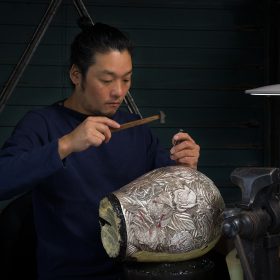
Yamamoto shapes metal by hammer raising and chasing techniques and draws inspiration from the natural world. With each stroke of the hammer, he tries to evoke an expression, atmosphere and emotion.

Public Collections include:
Victoria and Albert Museum, London; National Museum Wales; The Clothworkers’ Company, London; The Goldsmiths’ Company, London; New College, Oxford

In August 2025, The Scottish Gallery will host a solo exhibition from Yusuke Yamamoto as part of the Edinburgh Art Festival – The Dappled Garden.

Photograph by Stephen Heaton
Gift Card

Struggling to find that perfect gift? We have the solution! A Scottish Gallery Gift Voucher is the perfect gift for friends, family, customers and colleagues.

Own Art

Own Art is a national initiative that makes buying contemporary art and craft affordable by providing interest-free credit for the purchase of original work.


Join our mailing list

Sign up to receive the latest art news from The Scottish Gallery including forthcoming exhibitions, films, podcasts, blogs, events and more.