Various Artists

The New Baroque

31 October 2024 - 23 November 2024

The New Baroque celebrates contemporary jewellery design which emphasises aspects of opulence, drama, and intricate narrative detailing, blending classical richness with modern innovation. Included are statement pieces that feel both timeless and theatrical, evoking the grandeur of the Baroque era while aligning with bold, expressive trends. There is a sense of the ornamental blended with artistic flair and individuality.

With examples by Malcolm Appleby, Rachel Larkins, Grainne Morton and Guy Royle, The New Baroque brings together individuality, creativity, and a deep appreciation for craftsmanship.

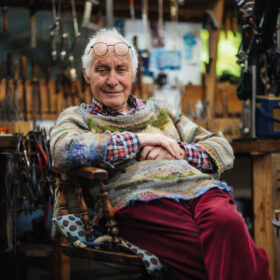
About Malcolm Appleby

Malcolm Appleby
MBE
Born: 1946
Place of Birth: West Wickham, London

Malcolm Appleby was born in 1946. He studied at Central School of Art, Sir John Cass and the Royal College of Art in London before establishing his studio in Scotland in 1969. A silversmith and metal engraver, known for his imaginative use of line and form, he considers gold “just another lovely material to work with.”

The Scottish Gallery has been associated with Malcolm Appleby since the 1970s; the many facets of his work have brought joy to many, each piece sold marking the beginning of a journey of discovery around this senior artist. The Gallery honoured Malcolm Appleby’s seventieth birthday in January 2016, which marked over fifty years of a creative tour de force. Malcolm Appleby has dedicated his artistic practice primarily to engraving and pushing the boundaries of metalwork; constant experimentation has made him a master of his craft and in 2014 he received an MBE for his outstanding contribution to the arts.

2019 marked fifty years since Malcolm Appleby first set up his studio in Scotland and the exhibition 50 Golden Years in Scotland, featuring both jewellery and silversmithing, recognised his unique contribution to the arts. Malcolm’s infectious enthusiasm for his craft, his willingness to work with other artists and his pleasure in sharing his skills is characteristic of his generosity and pre-eminence. The natural world that surrounds Malcolm’s studio informs every piece; the artist’s inspiration unlimited in the abundance of the world around him.

Public Collections include:
The Victoria & Albert Museum, London; The Goldsmiths’ Company, London; British Museum, London; Royal Armouries, Tower of London; Ashmolean Museum, Oxford; Aberdeen Art Gallery & Museums; The Fitzwilliam Museum, Cambridge; National Museums Scotland, Edinburgh; and Perth Museum & Art Gallery

Malcolm’s jewellery collection can be viewed here.

In August 2021 we celebrated Malcolm Appleby’s 75th birthday with Malcolm Appleby & Friends. Previous exhibitions include 50 Golden Years in Scotland in March 2019 and The Gallery also hosted a special exhibition in January 2016 to celebrate Malcolm Appleby’s 70th birthday.

About Rachel Larkins

Rachel Larkins
Born: 1974

Rachel Larkins (b.1974) is a British designer-maker whose deeply evocative jewellery and sculptural objects inhabit a world somewhere between folklore, memory and dream.

Based near the New Forest in southern England, Larkins creates wearable works that draw on the intimacy of miniature storytelling, blending hand-modelled figures, resin, brass, wood and found materials into pieces rich with atmosphere and narrative.

Larkins has long been fascinated by objects preserved behind glass: mourning jewellery containing hair, ships in bottles, taxidermy beneath bell jars, dioramas and treasured domestic curiosities. These preserved fragments of lives and stories form the emotional core of her practice. Her jewellery often feels like a relic from an imagined history or a fragment from an unwritten fairy tale, inviting the viewer into intimate worlds filled with symbolism, melancholy and wonder.

Originally trained in Textile Art, Larkins later completed an MA in Sequential Design & Illustration at the University of Brighton in 2013, an experience that deepened the narrative and cinematic qualities within her work. Drawing remains central to her practice, allowing ideas, characters and atmospheres to emerge instinctively before finding their way into sculptural form. Her influences range widely, from Scottish folk tales and maritime superstitions to Victorian mourning jewellery, magical realism, Jan Švankmajer animations and the uncanny poetry of found objects.

What distinguishes Larkins’ work is its ability to balance delicacy with unease, beauty with strangeness. Tiny painted faces, whales, seabirds, sailors, ghosts and symbolic animals recur throughout her pieces, appearing within resin like preserved memories or half-remembered dreams. The sea is a persistent presence within her work, not simply as landscape but as metaphor: a place of mystery, absence, transformation and hidden histories.

Larkins often speaks of “raising ghosts” through objects and materials, revealing her fascination with the emotional residue carried by antiques, keepsakes and inherited artefacts. She creates jewellery that feels deeply personal yet open-ended, leaving space for the viewer’s own interpretation and imagination. Each work becomes a small theatre of memory and narrative, meticulously handcrafted and emotionally charged.

For over two decades, Larkins has exhibited widely throughout the UK and internationally, with work held in both private and public collections. Her practice has received recognition from the British Toymakers Guild and Arts Council England, and in 2020 she was invited to contribute to the award-winning Created for Charleston collection at Charleston Farmhouse.

In 2025, The Scottish Gallery presented Raising Ghosts, an immersive multidisciplinary exhibition which placed jewellery at its heart while expanding into drawing, installation and storytelling. The exhibition marked the launch of the Gallery’s new Room of Dreams series and confirmed Rachel Larkins as one of the most imaginative and distinctive narrative makers working today.

I have always been drawn to objects behind glass, perhaps in recognition that someone from the past has preserved those things considered precious and ephemeral; mourning jewellery holding hair; bell jars holding birds, insects or dolls; dioramas and ships in bottles. The wearable pieces I make are influenced by the intimacy and hidden stories of small scale miniatures as well as by folklore and fairy tales. – Rachel Larkins


About Grainne Morton

Grainne Morton
Born: 1970
Place of Birth: Lurgan, Northern Ireland

Grainne Morton (b.1970, Lurgan, Northern Ireland) is one of the most distinctive and celebrated jewellers working in Britain today, internationally recognised for jewellery that transforms found objects, antiques and personal ephemera into richly narrative wearable works of art.

Born and raised in Northern Ireland, Morton grew up surrounded by traditional craft, folklore, storytelling and music, influences that continue to permeate her practice with a sense of memory, enchantment and emotional resonance. Her jewellery occupies a unique space where past and present, precious and ordinary, nostalgia and contemporary design coexist in beautifully balanced tension.

Morton moved to Edinburgh in the late 1980s to study at Edinburgh College of Art, a formative period that also sparked her lifelong fascination with collecting. Visits to antique fairs and auctions with her parents, who dealt in antiques in Northern Ireland, became an essential part of her creative education. Buttons, broken jewellery, ribbons, stones, charms, tiny portraits, beads and fragments of forgotten objects gradually formed an ever-growing archive of materials and stories. Over time, these collections became both the inspiration and foundation of her practice.

At the heart of Morton’s work is an instinctive gift for juxtaposition and storytelling. Her pieces are carefully composed assemblages where unrelated objects are choreographed into unexpected and emotionally charged relationships. Vintage trinkets sit alongside semi-precious stones, found objects and handmade elements, creating jewellery that feels deeply personal yet universally evocative. Each work carries traces of memory and history, inviting the viewer to imagine the lives, journeys and meanings embedded within the materials themselves.

Despite the apparent spontaneity of the work, Morton’s compositions are highly sophisticated and finely balanced. Colour, scale, texture and symbolism are orchestrated with remarkable sensitivity, resulting in jewellery that is simultaneously playful, poignant and visually complex. Her pieces often blur the boundaries between jewellery, collage and miniature sculpture, reflecting an artist deeply engaged with narrative, collecting and emotional connection.

Since graduating from Edinburgh College of Art, Grainne Morton has established a long standing relationship with The Scottish Gallery. The Gallery has presented several solo exhibitions of her work and included her in numerous thematic and interdisciplinary exhibitions, recognising her as one of the defining contemporary jewellery voices associated with the Gallery’s programme. Her exhibitions have consistently captivated audiences through their immersive storytelling, vibrant colour and extraordinary sense of imagination.

Morton’s work has been exhibited extensively throughout the UK and internationally and in 2007 she was shortlisted for the prestigious Jerwood Applied Arts Prize. Her jewellery is held in major public collections including National Museums Scotland, Edinburgh; the Crafts Council Collection, London; the Montreal Museum of Fine Arts, Canada; and the Ulster Museum, Belfast.

About Guy Royle

Guy Royle
Born: 1954
Place of Birth: Devon

Guy Royle (b.1954, Devon) is a multidisciplinary British artist whose practice moves seamlessly between jewellery, sculpture, weaving and printmaking, each discipline forming part of a singular and deeply coherent visual language.

Based for over three decades in West Cornwall, Royle has developed a body of work grounded in material, rhythm and process, creating objects that feel timeless, tactile and profoundly connected to the landscape and traditions of making that surround him.

Royle’s work resists easy categorisation. Jewellery, textiles, sculpture and prints are not separate strands within his practice, but different expressions of the same sensibility. Line becomes structure, structure becomes rhythm, and materials themselves become carriers of meaning. Whether working in silver, gold, stone, wool or ink, Royle approaches making with remarkable consistency and clarity, guided by the belief that understanding comes through the hand: through repetition, touch, experimentation and patience.

Although largely self-taught, Royle’s formative artistic education came through life drawing at Morley College in London and, crucially, through his long association with the St Ives artist Breon O’Casey. Beginning in 1989, what started as a single day of weaving developed into a deeply influential collaboration that shaped Royle’s approach to materials, structure and the permeability between disciplines. Like O’Casey, Royle has always understood making as something cumulative and lived rather than academic, where craft, drawing, sculpture and daily labour exist in continuous dialogue.

Royle is perhaps best known for his sculptural jewellery in silver and gold, often incorporating hand-shaped stones and semi-precious materials sourced or selected for their natural tonal restraint. Unlike highly polished contemporary jewellery, Royle’s works retain the trace of the hand and the physicality of their making. Hammered surfaces, carved forms and carefully balanced structures reveal an artist deeply attentive to weight, movement and touch. His necklaces and brooches possess an ancient yet contemporary quality, balancing geometry and organic form with remarkable elegance and wearability.

Nature and landscape remain central to his practice. The subdued colours of the Cornish coastline, weathered stone, sea-worn textures and shifting light all find their way into his materials and palette. Birds, leaves and abstracted natural forms recur across jewellery, prints and sculpture, not as direct representations but as rhythmic motifs that move fluidly between media. His woven works and woodblock prints echo the same concerns found in the jewellery: repetition, balance, structure and the quiet poetry of handmade marks.

What distinguishes Royle’s work is its extraordinary sense of integrity and cohesion. Across every medium there is an absence of excess or ornament for its own sake. Instead, his works possess a calm authority born from decades of looking, making and refining. Objects are created to be lived with, worn and handled, carrying forward the traces of use and time.

The Scottish Gallery is delighted to present Spring Song in May 2026 as part of its Room of Dreams series, bringing together jewellery, sculpture, weaving and printmaking in a rare and immersive presentation of Royle’s multidisciplinary practice. The exhibition reveals the remarkable breadth of an artist whose work continues to evolve while remaining deeply rooted in material understanding, place and the quiet discipline of making by hand.
Gift Card

Struggling to find that perfect gift? We have the solution! A Scottish Gallery Gift Voucher is the perfect gift for friends, family, customers and colleagues.

Own Art

Own Art is a national initiative that makes buying contemporary art and craft affordable by providing interest-free credit for the purchase of original work.


Join our mailing list

Sign up to receive the latest art news from The Scottish Gallery including forthcoming exhibitions, films, podcasts, blogs, events and more.