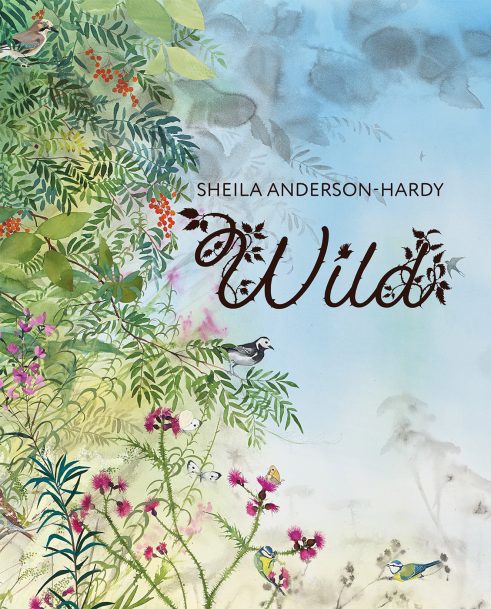
- Various Artists
Amongst The Trees, 2024
Exhibition catalogue accompanying our exhibition Amongst The Trees. The exhibition is on display in The Gallery June-July 2024. Amongst the Trees is a celebration of creativity and the diverse ways in which artists engage with their natural and man-made surroundings.
About Sheila Anderson-Hardy
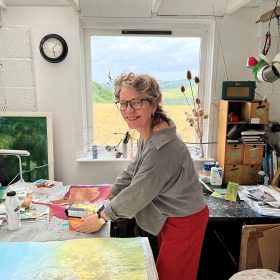
Sheila Anderson-Hardy is a painter based in the Scottish Borders. Born in Portpatrick in 1956, she studied at The Glasgow School of Art, graduating with a Diploma of Art in 1979. Her work is inspired by close observation of hedgerows, field margins and woodland edges, where she studies the flora and wildlife that inhabit these overlooked spaces. Working with Sumi-e ink washes, watercolour and collage, she builds densely layered, delicately drawn compositions that focus on the small details that shape the wider landscape. Anderson-Hardy has exhibited widely in solo and group exhibitions and her work is regularly selected for national open exhibitions. She is a member of The Scottish Wildlife Trust and was elected a member of the Royal Scottish Society of Painters in Watercolour in 2024.
About Ash & Plumb

Ash & Plumb was created by design duo Barnaby Ash and Dru Plumb, born of a desire to honour naturally sustainable materials; crafting unique and functional works that breathe life into the living spaces they inhabit.
About Reinhard Behrens
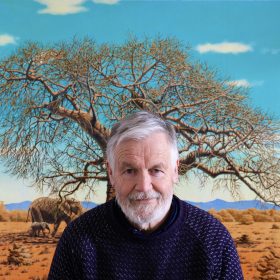
Reinhard Behrens is a German-born artist who has lived and worked in Scotland since the late 1970s. He studied Drawing and Painting at Hamburg College of Art from 1971–78 before receiving a German Academic Exchange Grant to undertake postgraduate studies in Drawing and Painting at Edinburgh College of Art in 1979. Between 1982 and 1986, he lectured part-time at Edinburgh College of Art, Glasgow School of Art and Gray’s School of Art in Aberdeen.
About Kirstie Behrens
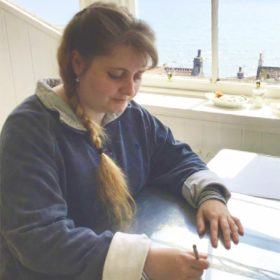
Kirstie Behrens (b.1991) is an award-winning artist and printmaker based in Pittenweem, Fife. A graduate of Duncan of Jordanstone College of Art and Design in 2019, she has quickly established herself as one of the most distinctive young voices in contemporary Scottish printmaking. In 2021, she received the Roy Wood Prize for Printmaking, the Art in Healthcare Award and the W Gordon Smith & Jay Gordon Smith Award from the Royal Scottish Academy.
About Margaret Smyth (Behrens)

I hope that my paintings elicit curiosity, allowing the viewer to fill them with their own narratives, with their own memories real or imagined, like fairy tales. My aim is to try to evoke that moment of anticipation in a theatre, when the curtain lifts on the stage and reality is suspended.
About Stephen Bird

Stephen Bird (b.1964, Stoke-on-Trent) has lived in Australia since 1999 after graduating from Duncan of Jordanstone College of Art in Dundee. Making his home and a significant international reputation from New South Wales, Australia, he works with both paint and clay.
About Philip Braham
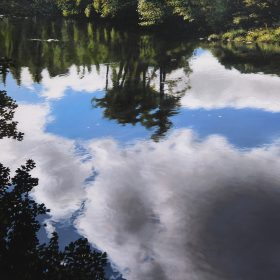
A graduate of Duncan of Jordanstone College of Art and Design, Philip Braham first came to prominence in the 1980s with the rise of figurative painting in Scotland, which culminated in The Vigorous Imagination, an exhibition at the Scottish National Gallery of Modern Art in 1987. His career includes 27 solo exhibitions to date; in addition to numerous group shows both nationally and internationally.
About Colin Brown
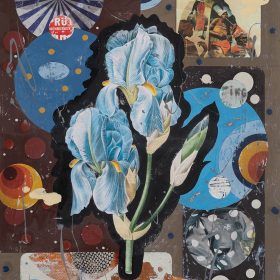
Colin Brown is a fine artist and former graduate of Duncan of Jordanstone, Dundee. After graduating, a John Kinross Scholarship awarded by the Royal Scottish Academy enabled him to spend four months in Florence. In 1988 he established a studio in Glasgow, where he began practicing as a full-time artist. He also spent four years in Dusseldorf painting and exhibiting with several German galleries. He is now based in Stonehaven in northeast Scotland.
About Doug Cocker

Doug Cocker was brought up in rural Perthshire and comes from a long line of farmers and blacksmiths. He taught sculpture at Nene College, Northampton and Gray’s School of Art, Aberdeen and over a period of twenty years he was visiting lecturer at Edinburgh University, Edinburgh College of Art, The Glasgow School of Art, Duncan of Jordanstone College of Art, Dundee, Tyler University, Philadelphia, Georgian College, Ontario and Newcastle Polytechnic from 1992–1998. He was elected to the Royal Scottish Academy in 1984. Cocker has undertaken many public sculpture commissions including the Ben Lomond Memorial at Rowardennan and the Glasgow Bouquet in the Merchant City, Glasgow. Doug Cocker’s sculpture is the artist’s response to the landscape and natural environment around him. Working predominately in wood, his studio in Lundie, outside Dundee, is a magnificent thinking space where the walls are littered with evolving ideas.
About Kate Downie

Born in North Carolina, Kate Downie is one of Scotland’s most respected contemporary painters, celebrated for a practice that moves fluidly between painting, drawing, printmaking and installation. After studying at Gray’s School of Art in Aberdeen, Downie travelled extensively, undertaking residencies and projects in the United States, England, Amsterdam and Paris. Over the past three decades she has built a distinctive body of work rooted in direct engagement with place, landscape and industry, responding intuitively to environments through colour, gesture and mark-making.
About Andrea Geile
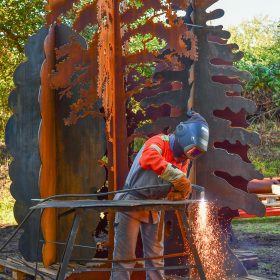
Edinburgh based artist Andrea Geile (b.1961) studied Visual Art in Hanover, Germany, and has held residencies in Orkney, Germany, France and Australia. She has been working from her Scottish studio since 1996 and has realised many public and private art commissions.
About Martin Greenland

Martin Greenland was born in Yorkshire and studied at Exeter College of Art. He has lived and worked in Cumbria since 1985. In 2006, Greenland was awarded first prize at the prestigious John Moores Painting Prize, the UK’s largest contemporary painting exhibition held at the Walker Art Gallery, Liverpool. Martin Greenland is primarily a realist painter; his subject is embedded in the North British Landscape, at first familiar yet entirely imagined – in Greenland’s work, a subtle narrative about contemporary Britain quietly emerges.
About Derrick Guild

Born in 1963 in Perth, Scotland, Derrick Guild has been the recipient of many awards for his unique work. Guild’s paintings and objects reference European still life of the 15th to 19th centuries. The drama, allegory and naturalism inherent in this period of painting speak to Guild of ever-present dilemmas of the human condition. His works are classical, formal and at the same time contemporary in their sense of dislocation and ambiguity.
About Earl Haig

Earl Haig OBE RSA (1918–2009) was one of Scotland’s most distinctive landscape painters, celebrated for a lifetime devoted to painting directly from nature. Working for more than six decades, he developed a highly personal visual language in which observation, memory and abstraction coexist in perfect balance.
About Claire Harkess
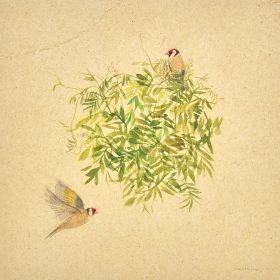
Claire Harkess (b.1970, Ayr) is a Scottish painter whose watercolour practice explores some of the world’s most fragile environments. A graduate of Glasgow School of Art in the early 1990s, Harkess has developed a distinctive practice centred on wildlife, ecology and the delicate balance between survival and vulnerability in the natural world. Through journeys to Antarctica, the Arctic Circle, Outback Australia, St Kilda and the Galápagos Islands, she has immersed herself in landscapes where life exists at the edge, translating these encounters into paintings of extraordinary sensitivity and atmosphere.
About Euan Heng

My studio practice originates, not from an idea, but an imaginative engagement with reality. The paper-cut collages and paintings, selected from a current body of works, exhibit the characteristics and the trajectory of an evolving artistic production. At the moment of assembly, paper-cut collages give shape to and advance the corresponding paintings and small sculptures. To the classical principles and conventions that continue to inform my studio practice, one can add abstraction or, to be precise — abstracting from. This method of construction initiates new opportunities in the representation of the motif in both shape and colour.
About Michael McVeigh
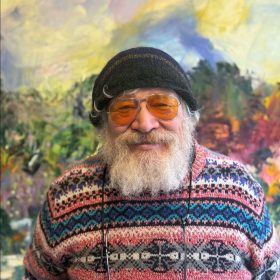
Michael McVeigh was born in 1957 in the post-war council estate of Lochee, Dundee located on the north west of the city, one of five children. He left school with no formal qualifications; however he wanted to be an artist and so began, unannounced, going to classes at Duncan of Jordanstone College of Art & Design, his presence being challenged eventually. James Morrison, then one of the lecturers, formalised his position and accepted him as a full-time student based only on his outstanding drawings and painting.
About James Morrison

Born in Glasgow in 1932, James Morrison was one of the most significant Scottish landscape painters of the post-war period. He studied at Glasgow School of Art from 1950–54, developing the rigorous observational practice and draughtsmanship that would underpin a career spanning more than six decades. While his early paintings focused on the streets and tenements of Glasgow, his move to Catterline in 1958 marked a decisive shift towards landscape and established many of the themes that would define his mature work.
About Ula Paine
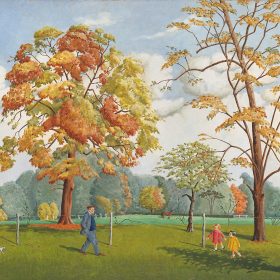
Ula Paine was a painter of rare talents and originality whose work remains largely in the dark. Her early precocity was nurtured within a liberated, artistic household: her grandfather was the Victorian painter George Hilditch, but art school and the hard realities of professional necessity crushed her vitality and she had to wait until after the War for her métier to be allowed to flourish. London’s leafy suburbs and parks, its quiet corners, gardens and canals, peopled by a reemergent middleclass gave her her subject and a pitch perfect atmosphere of ‘other’. The optimism of The Festival of Britain in 1951, the expansion of art publishing, magazines, the homemaking impulse, aspirational interior design, television and advertising all created a milieu in which her beautifully composed urban landscape and poised, enigmatic still life found their place. For Paine, trees are as much the landmarks of the urban as the architecture; trees judiciously planted, listed and looked after made a resurgent London a place of calm, as much survivors of The Blitz as the people walking their dogs and wheeling their kids in prams in the sunshine and shade. She lived a long and productive life and her show at London’s Grosvenor Gallery in 1991 at eightyone earned her an interview with Micheal Parkinson: a character; feisty, a survivor. But we must look at Paine’s work to recognise her talent. Guy Peploe
About David Rae

David Rae, like any good modernist, will not provide a key to interpret his work. He chooses a subject which can be described as landscape, but which owes as much to Magritte as to Claude or Constable.
About Paul Reid

Paul’s ongoing body of mythologically inspired paintings have worked so well because of his powers to instil a potent sense of reality. It is not an arcane or unreachable reality but something timeless and tangible. Characteristic of his subsequent works is his ability to impart a vast amount of information without confusing or distracting the viewer. His paintings overflow with visual material: images of fruit and vegetables, costume, portraiture, human form in action, metamorphosis, landscape, architectural details and still life. All of these elements play a part in his highly orchestrated compositions. Derrick Guild
About Pascale Rentsch

I am always moved when painting in nature because wherever I look I feel hope – the skylarks singing high in the sky despite the stormy weather and the light sparkling like gold dust on the shoreline. I carry my art materials in my trusty trolley, weathered by big hills, rocks, sand and even snow. It keeps all my materials together in one place and saves my back from a heavy rucksack.
About Adam Bruce Thomson

Bruce Thomson – or ‘Adam B’, as he was often called – was a painter of great integrity whose long, productive life tells the story of Scottish painting for the first three quarters the twentieth century. Thomson was born in 1885, attending first the Trustees Academy and then the newly established Edinburgh College of Art where he received diplomas in both Drawing and Painting, and Architecture before scholarships took him abroad to Spain and then Paris.