Various Artists

Past & Present Print Masters

28 October 2021 - 27 November 2021

This November we have brought together several vintage and contemporary artists for whom printmaking has been or is vital to their studio practice.

Artists include: Wilhelmina Barns-Graham, John Bellany, Elizabeth Blackadder, Robert Colquhoun, Victoria Crowe, Kate Downie, Ian Fleming, Peter Green, John Houston, Calum McClure, Michael McVeigh, James Morrison, Frances Walker and Adrian Wiszniewski.

About Wilhelmina Barns-Graham

Wilhelmina Barns-Graham
CBE, HRSA,HRWA, HRSW
Born: 1912
Place of Birth: St Andrews
Died: 2004

Wilhelmina Barns-Graham (1912–2004) was a leading member of the St Ives group of artists and made an outstanding contribution to the advancement of post-war British art. Wilhelmina Barns-Graham, known as Willie, was born in St Andrews, Fife, on 8 June 1912. Determining while at school that she wanted to be an artist, she set her sights on Edinburgh College of Art, where she enrolled in 1932 and graduated with her diploma in 1937. At the suggestion of the College’s principal, Hubert Wellington, she moved to St Ives in 1940.

Early on she met Borlase Smart, Alfred Wallis and Bernard Leach, as well as Ben Nicholson, Barbara Hepworth and Naum Gabo who were living locally at Carbis Bay. Her peers in St Ives include, among others, Patrick Heron, Terry Frost, Roger Hilton, and John Wells. Barns-Graham’s history is bound up with St Ives, where she lived throughout her life. In 1951 she won the Painting Prize in the Penwith Society of Arts in Cornwall Festival of Britain Exhibition and went on to have her first London solo exhibition at the Redfern Gallery in 1952. She was included in many of the important exhibitions on pioneering British abstract art that took place in the 1950s. In 1960, Barns-Graham inherited Balmungo House near St Andrews, which initiated a new phase in her life. From this moment she divided her time between the two coastal communities, establishing herself as a Scottish artist as much as a St Ives one. Wilhelmina Barns-Graham was represented by The Scottish Gallery throughout her career. Important exhibitions of her work at the Tate St Ives in 1999/2000 and 2005, and the publication of the first monograph on her life and work, Lynne Green’s W. Barns-Graham: A Studio Life, 2001, confirmed her as one of the key contributors of the St Ives School, and as a significant British modernist. She died in St Andrews on 26 January 2004.

The Scottish Gallery exhibitions: 1956, 1960, 1981 (Festival), 1989 (London), 2016, 2019, 2022

Please click here to view paintings by the artist.

About John Bellany

John Bellany
CBE, RA, HRSA
Born: 1942
Place of Birth: Port Seton
Died: 2013

John Bellany was born in 1942 in the Scottish fishing village of Port Seton. He attended ECA from 1960 to 1965 and RCA 1965 to 1968. His early work in Northern European Expressionist-Realist tradition allied to personal symbolism and iconography often drawn from his family’s sea-faring past. His work is often highly challenging and at times autobiographical as epitomised by a series of brutally unflinching self portraits produced in hospital following a major operation in the 1980s. He is considered an artist of international standing with works in both MOMA and Metropolitan Museum in New York as well as the Tate Gallery, London and SNGMA. He was elected RA in 1991.

Please click here to view paintings by the artist

About Elizabeth Blackadder

Elizabeth Blackadder
DBE, RA, RSA, RSW, RGI
Born: 1931
Place of Birth: Falkirk
Died: 2021

Dame Elizabeth Blackadder (1931–2021) stands as one of the most important figures in modern Scottish art. Born in Falkirk, she studied at Edinburgh College of Art from 1949–1954 under influential teachers including William Gillies and Robert Henderson Blyth, graduating into what would become one of the most remarkable artistic careers of the twentieth century. Early travelling scholarships to southern Europe and Italy introduced Blackadder to the light, architecture and visual cultures that would profoundly shape her work for decades to come.

Working across painting, watercolour, drawing, printmaking and tapestry, Blackadder developed a singular visual language distinguished by exquisite draughtsmanship, subtle colour relationships and an extraordinary sensitivity to observation. Flowers, cats, Japanese objects, interiors, gardens and landscapes became recurring motifs within compositions that balanced intimacy with formal sophistication. Whether depicting an iris from her Edinburgh garden, a Venetian lagoon or a still life assembled from treasured objects gathered on her travels, Blackadder transformed everyday subjects into meditations on beauty, balance and quiet contemplation.

Although often associated with the Edinburgh School through her connection to William Gillies, Blackadder consistently expanded beyond its traditions. Her work absorbed influences from European modernism, Japanese aesthetics and botanical illustration while remaining unmistakably personal. The influence of Japan became especially significant from the 1980s onwards, inspiring her use of flattened space, decorative pattern, gold leaf and carefully orchestrated compositions. Her paintings possess an unmistakable elegance and restraint, yet beneath their delicacy lies immense technical control and formal intelligence.

Alongside her own studio practice, Blackadder played a vital role within Scottish art through teaching at Edinburgh College of Art from 1962 until her retirement in 1986. Generations of students benefitted from her quiet encouragement and example, recognising in her a painter wholly committed to “the good practice” of making art every day.

Blackadder achieved numerous historic distinctions during her lifetime. In 1972 she was elected to the Royal Scottish Academy and in 1976 became the first woman elected to both the Royal Scottish Academy and the Royal Academy in London. In 2001 she was appointed Her Majesty the Queen’s Painter and Limner in Scotland, the first woman to hold the role. A major retrospective at the Scottish National Gallery of Modern Art in 2011 confirmed her position as one of Britain’s most admired post-war artists. Her work is held in major collections worldwide including Tate, the Museum of Modern Art in New York, the Yale Centre for British Art and the National Galleries of Scotland.

The Scottish Gallery shared an exceptionally close and enduring relationship with Elizabeth Blackadder spanning more than six decades. As Christina Jansen reflected, the relationship was “both professional and personal: based on mutual respect, hard work, nurture and trust.” Blackadder exhibited regularly with The Gallery throughout her career, and her exhibitions became defining moments within the Edinburgh Festival calendar. Over this long partnership, The Scottish Gallery presented sixteen solo exhibitions alongside numerous mixed and thematic exhibitions, helping place her work in important public and private collections internationally.

Selected solo exhibitions with The Scottish Gallery include: 1961, 1966, 1972, 1974 Festival Exhibition, 1985 Edinburgh Festival Exhibition. 1994 Festival Exhibition, 1998, 2003, 2004, 2008, 2010, 2011, 2013, 2015, 2016, 2020, Elizabeth Blackadder: A Celebration, Festival Exhibition, 2023

Few artist-gallery relationships in Scottish art history have been as longstanding, collaborative or significant. Elizabeth Blackadder’s legacy remains one of extraordinary generosity, refinement and dedication to the act of looking closely at the world.

To view paintings by Elizabeth Blackadder please click here

About Robert Colquhoun

Robert Colquhoun
Born: 1914
Place of Birth: Kilmarnock
Died: 1962

Robert Colquhoun was born in 1914 to working class parents from Kilmarnock, Ayrshire. His art teacher, James Lyle, helped him win a scholarship to Glasgow School of Art (1933-1937), subsequently winning a travelling scholarship to France and Italy with his lifelong friend, lover and companion, Robert MacBryde; with whom he is largely associated. Solo exhibitions under the guidance of Duncan MacDonald at the Lefevre Gallery on Bond Street were sell out sensations and the phrase ‘The Golden Boys of Bond Street’ was coined. During this high period, Colquhoun and MacBryde showed in The Scottish Gallery, 1944, British & French Artists. He later became a master of the monotype technique as he slowly moved away from the canvas. Following this success – post 1951 saw The Roberts, as they were known to their friends, fall in a sharp decline into a life of poverty. Robert Colquhoun died in 1962.

The Scottish Gallery exhibitions: 1944 Colquhoun & MacBryde participate in Paintings by British and French Artists, Lefevre Gallery, London and which also tours to Aitken Dott & Son (The Scottish Gallery), Edinburgh. The Roberts, 2010 Golden Years, 2014 The Roberts, Revisited, 2017

Click here to see original works by Robert Colquhoun.

About Victoria Crowe

Victoria Crowe
OBE, DHC, FRSE, MA(RCA), RSA, RSW
Born: 1945

Victoria Crowe studied at Kingston School of Art from 1961-65 and at the Royal College of Art, London, from 1965-68. At her postgraduate show, she was invited by Sir Robin Philipson to teach at Edinburgh College of Art. For thirty years she worked as a part-time lecturer in the School of Drawing and Painting while developing her own artistic practice. She lives and works in West Linton, Edinburgh, and Venice. Her first one-person exhibition, after leaving the Royal College of Art, was in London and she has subsequently gone on to have over fifty solo shows.

Victoria Crowe’s first solo exhibition at The Scottish Gallery was in 1970. In August 2018, we held a major exhibition of paintings at The Scottish Gallery. This coincided with The Scottish National Portrait Gallery’s retrospective of Victoria Crowe’s portraits. In 2019 The City Art Centre held a retrospective entitled 50 Years of Painting. This exhibition embraced every aspect of Crowe’s practice and featured over 150 pieces. The Gallery hosted a complementary exhibition in September 2019 50 Years: Drawing & Thinking, which focussed on her studio life.

Victoria Crowe is a member of the Royal Scottish Academy (RSA) and the Royal Scottish Society of Painters in Watercolours (RSW). She has exhibited nationally and internationally and undertaken many important portrait commissions, including RD Laing, Peter Higgs and Jocelyn Bell Burnell. She has received many bursaries and research awards and her work is held in numerous public and private collections worldwide.

In 2000, her exhibition A Shepherd’s Life, consisting of work selected from the 1970s and 80s, was one of the National Galleries of Scotland’s Millennium exhibitions. It received great critical acclaim. The exhibition toured Scotland and was re-gathered in 2009 for a three-month exhibition at the Fleming Collection, London. Victoria was awarded an OBE for Services to Art in 2004 and from 2004-2007, she was appointed Senior Visiting Scholar at St. Catherine’s College, Cambridge. The resulting work, Plant Memory, was exhibited at the Royal Scottish Academy in 2007 and subsequently toured Scotland. In 2009 she received an Honorary Degree from The University of Aberdeen and in 2010 was elected a Fellow of the Royal Society of Edinburgh.

In 2013, Dovecot Studios wove a large-scale tapestry of Victoria’s painting Large Tree Group. This collaborative tapestry was acquired for the National Museums Scotland. In 2015, Victoria was an invited artist at Dumfries House and in 2016 a group of work by the artist was acquired by the National Galleries of Scotland. Victoria was commissioned by the Worshipful Company of Leathersellers’ in 2014, to design a forty-metre tapestry for their new hall in the city of London, which took over three years to weave and was installed in January 2017. Dovecot worked Victoria Crowe to produce a new tapestry inspired by a detail from her painting Twilight, Venice, 2014. The new tapestry, Richer Twilight, Venice was completed and unveiled at the end of September 2019. Following a residency in Orkney in 2022, the Pier Art Centre in Stromness held a major exhibition of new work, Touching the Surface from August to November 2024, in which she looked specifically at the contrasting light around the summer and winter solstices.

In 2022 Victoria Crowe made two trips to Orkney as part of her Royal Scottish Academy/Pier Arts Centre Residency award. This exhibition will showcase some of the work Crowe made during her residency, as well as works created in response to her time spent in Orkney.


The Scottish Gallery exhibitions: 1970, 1973, 1977, 1982, 1995, 1998, 2001 (Festival), 2004, 2006, 2008, 2010 (Festival), 2012, 2014 (Festival), 2016, 2018 (Festival), 2019, 2021, 2023, 2025 (Fesitval, 80th)

To view Victoria Crowe’s paintings please click here

About Kate Downie

Kate Downie
RSA, PPSSA
Born: 1958

Born in North Carolina, Kate Downie studied at Grays School of Art in Aberdeen before travel and residencies took her to the United States, England, Amsterdam and Paris. Over the past two decades Downie has established herself as one of Scotland’s most prominent artists. Her skill not restricted to painting alone, she works across a diverse range of artistic medium. One recent project for Pittenweem Arts Festival saw Kate juxtapose large colour-field prints with architectural charcoal drawings with extraordinary results. The majority of her work is defined by geography, and the artist’s response to the landscape or subject in front of her. Kate’s constant search for new challenges and inspirations has seen her set up studios in such diverse places as a brewery, an oil rig, and for her most recent show an abandoned Hydroponicum. Her work is held in many public collections including Glasgow Gallery of Modern Art; Kelvingrove, Art Gallery: Reitveld Kunst Academie, Amsterdam; the BBC and Edinburgh Council. Downie has enjoyed ten solo exhibitions at The Scottish Gallery. She is currently exhibiting at the Glasgow Women’s Library with Conversations with Joan. An exhibition based around Downie’s creative journey to complete a version of Joan Eardley’s painting Two Children left unfinished on her Townhead Studio easel at the time of her death in 1963.


Click here to see paintings by the artist

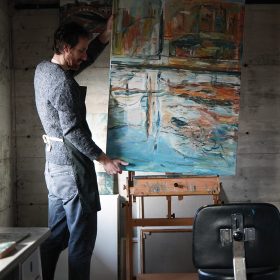
One of my creative concerns is to define these spaces between buildings rather than the buildings themselves. The object lesson for me is the witnessing and the drawing of these nonplaces which are also, by definition, public arenas of cumulative activity. My job as an artist is to accommodate these actions in our contemporary lives, and to find the poetry within.

Photograph by Alicia Bruce

About Ian Fleming

Ian Fleming
RSA, RSW
Born: 1906
Died: 1994

Ian Fleming was born in Glasgow in 1906 and studied at Glasgow School of Art during the 1920s. He began printmaking at art school, where his skill was quickly noticed, with Glasgow Art Gallery purchasing two of his prints while he was still a student. He joined the staff at Glasgow School of Art in 1931 and soon met the Edinburgh-based printmaker William Wilson through their mutual acquaintance Adam Bruce Thomson.

Wilson and Fleming struck up an important friendship, sharing views on printmaking technique and subjects, their influence on each other was of mutual benefit to both their practices. During his time at Glasgow School of Art Fleming painted a portrait of the two Roberts – Colquhoun and Macbryde – who were his students at the time (alongside a young Joan Eardley). During the War, Fleming served first as a reserve policeman before joining the Pioneer Corps seeing action in France, the Low Countries and Germany. He left the Army in 1946 as an Acting Major and returned briefly to Glasgow before taking up the position of Warden at Hospitalfield, Arbroath, succeeding the artist, James Cowie. The fishing towns of Angus and Kincardineshire were to be his inspiration for many paintings of this period in which he celebrated the colour, forms and architecture of the working harbour communities. In 1954, he relocated to Aberdeen as Principal of Gray’s School of Art but continued to pursue his painting practice alongside his academic commitments. He was elected a full Academician of the Royal Scottish Academy in 1956, and by the time of his death was the longest-established member. After retiring in 1971, he became one of the founding members of Peacock Printmakers in Aberdeen, alongside Frances Walker.

The Scottish Gallery exhibitions: 1947, 1987

About Peter Green

Peter Green
OBE
Born: 1933
Died: 2023

Peter Green studied at Brighton College of Art and the Institute of Education University of London. Having qualified as a teacher, he initially taught at a secondary school in East London where he established a thriving school printing press, producing small books and original prints. During this time he developed his own work as a printmaker and was elected to membership of the Royal Society of Painter-Printmakers in 1958. In the early 1960s, the director of London Graphics Arts (also known as The London Arts Group), Eugene Schuster, recruited Peter, who joined an impressive list of young printmakers. Schuster held an extensive range of prints by European Modern masters (including Picasso and Matisse) and commissioned new editions from young contemporary artists for placing primarily in public buildings across Europe and North America. Peter produced a number of large plywood block prints, printed without a press, with most of the colour being applied directly using paper stencils – a method that the artist used throughout his career.

About John Houston

John Houston
OBE, RSA, RSW, RGI
Born: 1930
Died: 2008

John Houston RSA OBE (1930–2008) was one of the most important Scottish artists of his generation, celebrated for the energy, freedom and expressive power of his work across painting, drawing and printmaking.  Raised in Buckhaven, Fife, Houston developed an early affinity with the coastal landscape, changing light and working communities of Scotland’s east coast. He studied at Edinburgh College of Art under William Gillies, whose influence encouraged a lifelong commitment to working directly from observation while developing a highly individual and expressive visual language.

Printmaking occupied an important place within Houston’s practice. Whether working in etching, lithography or screenprint, he approached the medium with the same vigour and spontaneity that characterise his paintings. His prints reveal an artist fascinated by the essential structures of landscape, architecture and still life, using line, colour and texture to convey atmosphere, movement and emotion. Rather than reproducing painted compositions, Houston embraced the unique possibilities of printmaking, creating works that balance bold graphic invention with a profound sense of place.

Travel was a constant source of inspiration throughout his career. Journeys across Europe, Japan and America, often undertaken with his wife and fellow artist Elizabeth Blackadder, enriched his imagery and broadened his visual vocabulary. Yet whether depicting the harbours of Fife, the fields of East Lothian, the landscapes of France or the streets of Venice, Houston’s work remained rooted in direct experience and a deep engagement with the world around him.

Represented by The Scottish Gallery from the late 1950s, Houston enjoyed a longstanding and significant relationship with the Gallery and was a ten-time solo exhibitor during the Edinburgh International Festival between 1961 and 2008. In 2005 he was honoured with a major retrospective at the Scottish National Gallery of Modern Art, recognising a career that placed him among the leading figures of post-war Scottish art.

Houston’s prints, like his paintings, are distinguished by their confidence, vitality and unmistakable sense of authorship. They demonstrate the ability of a master printmaker to transform familiar subjects into images of enduring freshness and expressive power.

The Scottish Gallery exhibitions: 1960, 1962 (Festival), 1965, 1967 (Festival), 1971 (Festival), 1975, 1980, 1990, 1993, 1997, 2003 (Festival), 2008 (Festival).

Click here to view paintings by John Houston

About Private: Calum McClure

Private: Calum McClure
Born: 1987

Calum McClure was born in 1987 and graduated in Drawing and Painting from Edinburgh College of Art in 2010. He was the winner of the 2011 Jolomo Painting Award, has had five successful exhibitions with The Scottish Gallery and was an invited artist at the Annual Exhibition of the Royal Academy in London in 2012. Recently he has been included in an exhibition of prints at the Royal Academy, London; had work in the major Scottish art societies’ annual exhibitions; had work exhibited at the RA Summer Exhibition; won a prize at the inaugural W Gordon Smith Award for painting; and most recently exhibited two pieces with Flowers Gallery, London.

McClure is a painter who immerses himself in the landscape and in the artistic process of representing it. He understands how paint can convey the poetry of suggestion and is absorbed in the infinite possibilities of the medium. His work evokes atmospheres, especially through the representation of light, shadow and reflections. Some of his images are almost abstract, others quite clearly representational, produced from intense scrutiny of details in the landscape and vistas, views from particular vantage points all with their possibility for further imaginative exploration. He is an artist who dreams as he sees and concentrates deeply as he paints, enabling others who view his work to be transported in a similar way. The images are positive, beautiful and lyrical, those of a precious environment to be nurtured and celebrated.


About Michael McVeigh

Michael McVeigh
Born: 1957
Place of Birth: Dundee

Michael McVeigh was born in 1957 in the post-war council estate of Lochee, Dundee located on the north west of the city, one of five children. He left school with no formal qualifications; however he wanted to be an artist and so began, unannounced, going to classes at Duncan of Jordanstone Art College, his presence being challenged eventually. James Morrison, then one of the lecturers, formalised his position and accepted him as a full-time student based only on his drawings and painting.

Since moving to Edinburgh in 1982 McVeigh has become a familiar figure seen regularly working in the city and until recently, had a stall on Rose Street selling his ‘lizard’ prints. ‘Lizard’ is his spelling of ‘laser’– colour copies of his original works, for sale at an affordable price. Life as a street artist has brought a certain amount of unwanted celebrity status, especially in recent years, becoming a cult figure sought out by the city’s stag and hen parties, eventually having to limit tourists to ‘one photo only’. His works are held in both public and private collections including town halls, pubs, fishmongers and a number of municipal and national institutions.

To view original works by Michael McVeigh please click here

About James Morrison

James Morrison
RSA, RSW
Born: 1932
Place of Birth: Glasgow
Died: 2020

James Morrison sadly passed away in 2020. He was a great painter and a huge part of The Scottish Gallery for more than sixty years, the last thirty under an exclusive arrangement. His kindness, generosity and loyalty made him a hugely rewarding friend, and it has been a privilege to represent one of Scotland’s most distinctive and brilliant painters.

Born in Glasgow in 1932, Morrison studied at Glasgow School of Art from 1950-4. After a brief spell in Catterline in the early 1960s, Morrison settled in Montrose in 1965, joining the staff of Duncan of Jordanstone College of Art in Dundee the same year. He resigned from Duncan of Jordanstone in 1987 to paint full-time and since then his work has been exclusively available through The Scottish Gallery. Whole-heartedly a landscape painter, his main working areas are the lush, highly-managed farmland around his home in Angus and the rugged wildness of west coast Assynt. As well as Scotland, Morrison has had extended painting trips to Africa, France, and Canada, including three trips to the Arctic in the 1990s. A suite of his Arctic paintings were acquired and exhibited as part of a major exhibition, Among the Polar Ice at The McManus in Dundee (September 2019 – March 2020).

James Morrison first exhibited with The Gallery in the fifties, and over the course of his career, he enjoyed over twenty-five solo exhibitions with The Gallery, which also organised several one man shows elsewhere in the UK and internationally. In June 2022, The Scottish Gallery celebrated the life and work of one of Scotland’s most-loved artists in a major retrospective show James Morrison A Celebration 1932 – 2020. The exhibition, held two years after his death, presented work from the entirety of his artistic career which spanned seven decades.

About Frances Walker

Frances Walker
RSA, RSW, CBE
Born: 1930
Place of Birth: Kirkcaldy

Frances Walker is recognised not only as one of Scotland’s most important painters of landscape, but also as an outstanding printmaker whose graphic work has formed a vital part of her practice for more than six decades. A founding member of Peacock Printmakers in Aberdeen in 1974, Walker has consistently explored the expressive possibilities of etching, lithography, screenprint and other print processes alongside her painting and drawing practice.

Printmaking has allowed Walker to distil the essential structure, rhythm and atmosphere of the remote landscapes that have inspired her throughout her career. Coastal reaches, tidal sands, weather-worn cliffs and island shorelines recur throughout her prints, particularly those rooted in the Hebrides, Orkney and Shetland. Rather than simply reproducing paintings, her prints possess their own distinct visual language, balancing close observation with abstraction, texture and tonal subtlety. Works such as Low Tide at the Brough (1983) and Birsay Shore and Brough (1983) demonstrate her ability to translate the shifting forms of rock, sea and weather into compositions of remarkable clarity and emotional depth.

Walker’s printmaking practice has always been grounded in direct experience of landscape. Sketchbooks made on location form the foundation of her work, recording geological structures, tidal patterns, seaweed, stone and changing light with extraordinary attentiveness. During a two-month Scottish Arts Council bursary to Orkney in 1981, Walker produced a significant body of work that later formed exhibitions at the Pier Arts Centre and Peacock Printmakers in Aberdeen. Reflecting on this period, writer Erlend Brown described how “cliff, rock, sand, seaweed, stone and the many greens of grass and weed were noted in sketch form or as finished drawings.”

Today, Frances Walker’s prints are held in major public collections including the Tate, the British Museum, the National Galleries of Scotland and the Victoria & Albert Museum. Her contribution to Scottish printmaking remains profound, combining technical accomplishment with a lifelong commitment to observation, landscape and place.

Click here to see paintings by the artist

About Adrian Wiszniewski

Adrian Wiszniewski
Born: 1958
Place of Birth: Glasgow

Adrian Wiszniewski is one of the members of the ‘New Glasgow Boys’ a group of artists who emerged from Glasgow School of Art and led the resurgence of Scottish figurative painting in 1980s. Other members of this group included Steven Campbell, Peter Howson and Ken Currie. His work, which is rich in symbolism, lies within the romantic tradition of British art. His work is held in public collections across the globe including the Metropolitan Museum, New York and Tate Britain, London.

Gift Card

Struggling to find that perfect gift? We have the solution! A Scottish Gallery Gift Voucher is the perfect gift for friends, family, customers and colleagues.

Own Art

Own Art is a national initiative that makes buying contemporary art and craft affordable by providing interest-free credit for the purchase of original work.


Join our mailing list

Sign up to receive the latest art news from The Scottish Gallery including forthcoming exhibitions, films, podcasts, blogs, events and more.