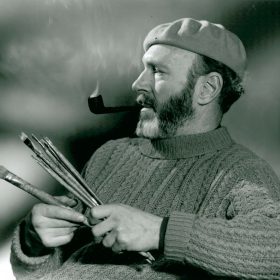
William Crosbie RSA (1915–1999) was one of the most inventive, restless and independent figures in twentieth-century Scottish art. Painter, muralist, illustrator, designer and teacher, Crosbie refused to be confined by a single style or movement, instead building a body of work remarkable for its imagination, technical fluency and extraordinary breadth of subject matter. Throughout a career spanning more than six decades, he moved effortlessly between still life, portraiture, landscape, surrealism, religious painting and mural design, always driven by a belief that painting should remain alive, exploratory and in constant renewal. As he reflected in 1974: “Once you have mastered a technique or perfected a style, that’s the time to stop. Each piece of work should be a fresh beginning as far as possible.”
Born in Hankow, China in 1915 to Scottish parents, Crosbie returned to Glasgow with his family in 1926. He studied at Glasgow School of Art from 1932–1935 under the enlightened leadership of William Oliphant Hutchison, winning several scholarships including the prestigious Haldane Travelling Scholarship and the Fra Newbery Medal. A major travelling award then took him to Paris, where he enrolled in the atelier of Fernand Léger rather than the more conservative École des Beaux-Arts. Léger’s influence proved transformative, sharpening Crosbie’s instinct for structure, flattened form and bold compositional rhythm. During this period he also attended classes at the Sorbonne and studied drawing with Aristide Maillol, immersing himself fully within European modernism.
Returning to Scotland on the eve of the Second World War, Crosbie became part of what Guy Peploe later described as “a little local Renaissance” in wartime Glasgow. He moved within a vibrant circle of artists, writers and composers including Hugh MacDiarmid, Sorley MacLean, J.D. Fergusson and Margaret Morris, collaborating widely across literature, theatre, ballet and public art. In 1942 he illustrated Dain do Eimhir, Sorley MacLean’s landmark volume of poetry, while his sets and costume designs for Margaret Morris’s Celtic Ballet demonstrated the breadth of his artistic imagination.
Crosbie’s reputation during the 1940s and 1950s was built equally upon his easel paintings and his pioneering mural work. He became one of Scotland’s most important muralists, producing ambitious commissions for civic buildings, exhibitions and churches across Britain, including work for the Festival of Britain in 1951 and the celebrated fluorescent mural Atomic for the Exhibition of Industrial Power at Kelvin Hall. Although many of these works have since been lost, they reveal Crosbie’s extraordinary gift for composition, narrative and scale.
His paintings remain impossible to categorise neatly. Surrealist imagery, modern still life, theatrical interiors, lyrical landscapes and richly symbolic figure paintings coexist across his oeuvre. Influences ranging from Picasso, Léger and Delvaux to Scottish colourism and religious art are absorbed into a visual language entirely his own. At the heart of his work lies a continual tension between observation and invention, structure and spontaneity. Whether depicting flowers, musical instruments, clowns, nudes or dreamlike symbolic scenes, Crosbie painted with immense vitality, humour and formal intelligence. As James Bridie observed in 1947, beneath the variety of subject matter remained “constants of strong and confident draughtsmanship and the highly individual use of colour.”
Despite his importance within Scottish modernism, Crosbie remained fiercely independent throughout his life, choosing not to align himself fully with institutions or fashionable trends. This independence, combined with his commitment to living and working largely in Scotland, perhaps limited wider commercial recognition during his lifetime, but it also allowed him complete artistic freedom. He continued to paint, travel, sail and teach throughout later life, maintaining an extraordinary creative energy well into his eighties.
The Scottish Gallery has enjoyed a long and significant relationship with William Crosbie, first exhibiting his work in 1948 under the direction of Beatrice Proudfoot. Over subsequent decades the Gallery continued to champion his work, recognising the originality and importance of his contribution to modern Scottish art. In 1980 The Scottish Gallery presented a major retrospective exhibition, and in 2015 marked the centenary of his birth with William Crosbie: Centenary Exhibition.
Selected exhibitions with The Scottish Gallery include: 1948, 1950, 1944 Edinburgh Group Exhibition, 1952 Eight Young British Painters, 1980 William Crosbie Retrospective Exhibition, 2015 William Crosbie: Centenary Exhibition
Today, Crosbie is recognised as one of the great individualists of Scottish painting: a profoundly cultured and endlessly inventive artist whose work resists categorisation while rewarding continual rediscovery.