Various Artists

Sun, Sea & Stars

3 November 2022 - 26 November 2022

Come with us on a beautiful journey as we bring together several artists who have woven a timeless tale in jewellery which together tells a story of Sun, Sea & Stars. Featuring collections from: Malcolm Appleby, Michelle Currie, Kyosun Jung, Jane Moore, Grainne Morton, Paul Preston and Wendy Ramshaw.

Malcolm Appleby and Paul Preston are both highly inventive, albeit very different, creators of narrative jewellery using techniques including engraving and chasing. Michelle Currie works with iron oxide, iron shards and ferrofluid (a substance engineered by NASA), and her practice explores the unseen forces and laws that govern and shape our world. Both Kyosun Jung and Jane Moore have developed outstanding enamel techniques, achieving beautifully rendered surfaces with a deep lustre and depth of colour. Grainne Morton creates carefully choreographed jewellery with found objects which reference a historical language of jewellery. Wendy Ramshaw’s iconic ringsets are wearable sculptures; each carefully selected precious or semi-precious stone hinting at narratives when placed alongside geometric forms.

About Malcolm Appleby

Malcolm Appleby
MBE
Born: 1946
Place of Birth: West Wickham, London

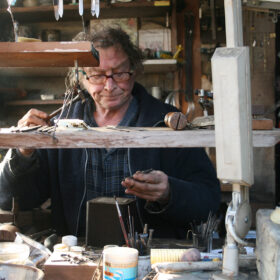
Malcolm Appleby (b.1946, London) is one of Britain’s most distinguished silversmiths and engravers, celebrated for his inventive approach to line, form and surface. He studied at the Central School of Art, Sir John Cass School of Art, and the Royal College of Art in London before establishing his studio in Scotland in 1969, where he continues to work.

Renowned for pushing the expressive possibilities of metal, Appleby has built a career defined by technical mastery and restless experimentation. While best known for his engraving, his practice spans silver, gold and mixed materials, approached with the same curiosity and precision. As he has remarked, gold is simply “another lovely material to work with.”

I’m passionate about the amount of energy and power that springs from the ancient craft of engraving. Works of art should be made for everyone to enjoy. Engraving is central to my design and art; it is from engraving that my other skills have evolved. – Malcolm Appleby

The Scottish Gallery has worked closely with Malcolm Appleby since the 1970s, presenting the breadth and evolution of his practice over several decades. Each work reflects a deeply personal visual language, inviting collectors into an ongoing journey of discovery with a major figure in contemporary metalwork.

In January 2016, the Gallery celebrated Appleby’s seventieth birthday, marking more than fifty years of remarkable creative achievement. In recognition of his outstanding contribution to the arts, he was awarded an MBE in 2014. In 2026, The Gallery is celebrating Malcolm’s 80th year with a major solo exhibition in September 2026.

Public Collections include: Victoria & Albert Museum, London; The Goldsmiths’ Company, London; the British Museum, London; the Royal Armouries, Tower of London; the Ashmolean Museum, Oxford; Aberdeen Art Gallery & Museums; the Fitzwilliam Museum, Cambridge; National Museums Scotland, Edinburgh; and Perth Museum & Art Gallery.

Photograph by Philippa Swann

About Michelle Currie

Michelle Currie
Born: 1985
Place of Birth: Vale of Leven, Scotland

Michelle Currie is currently Artist in Residence at The Glasgow School of Art Silversmithing and Jewellery Department after graduating with a First-Class Honours degree in 2020. Her unique practice combines traditional Silversmithing techniques with her love of Science and Astronomy. For her recent collection, Michelle visited the Physics and Astronomy Laboratories at The University of Glasgow, learning from Technicians and Scientists about their world leading research into Black Holes and Gravitational Waves. This unique collection is the result of an exploration into the unseen forces that govern and shape our world. By combining silver and precious stones with ferromagnetic materials containing iron particles, Michelle captures the exciting variety of textures and movement created when exposing iron particles to neodymium magnets. She creates her own mixtures of iron particles that are sculpted directly onto magnetic field lines using the invisible structure as a canvas to capture the explosive moments as static ominous wearable sculptures.

‘I am ever captivated and inspired by the beauty of the intrinsically interwoven nature of ‘Science and Art,’ sharing the pursuit of knowledge and an understanding of our place in the universe. Although often communicated in different ways, the fields are deeply connected by curiosity and the need to explore the unexplored, making sense of our observations and experiences.’

Michelle’s has received multiple industry awards such as a Goldsmiths’ Craft and Design Council Award, Goldsmiths’ Centre Precious Metal Bursary Award 2020 and received a prestigious ceremonial mace commission by The University of Glasgow to be unveiled in 2021. Michelle’s graduate work has also been awarded both the Fife Contemporary New Maker Award 2020 and the Incorporation of Goldsmiths Graduate Award 2020.

About Kyosun Jung

Kyosun Jung
Born: 1984
Place of Birth: Seoul, South Korea

Kyosun Jung’s work exudes a striking combination and contrast of simple forms with expressive decoration. Her designs are well considered, thoroughly developed and beautifully crafted with inspiration drawn from nature informing the surface patterns. Kyosun completed a BA Hons Silversmithing, Goldsmithing & Jewellery course at the University for the Creative Arts in Rochester in 2014. She is currently working from the workshop of the internationally renowned silversmith Clive Burr at the Goldsmiths’ Centre in London.

‘Research, original design and decorative features made to the highest standards is fundamental to my work. My technical work requires focused concentration and skill. I am always extending my technical learning and manufacturing capabilities and I am very interested in reviving traditional techniques in combination with technology i.e. Puk welding. This combination of old and new creates a different visual identity and the main techniques I use at present are; wire applications, hand engraving, puk welding, engine turning and enamelling. I find and utilise inspiring research from nature and geometry with its infinite creations for patterns and textures. For example, observing the linear qualities of water provide plenty of material for the decorative detailing in my designs and I also incorporate aspects of Korean and European aesthetics. My designs start as freehand drawings that are then taken into 3D forms with models and maquettes that are subsequently transferred onto the computer. I work well using both hand and machine technical skills to realise my designs and concepts. With my recent work, I have taken my enamel pieces inspiration from the night sky, sunset and sunrise. I love the sky’s different colours – it’s always changing; days and night, seasons.’

Public Collections include:
Worshipful Company of Goldsmiths, London; Victoria & Albert Museum, London; The British Museum, London; The Worshipful Company of Gold and Silver Wyre Drawers

About Jane Moore

Jane Moore
Born: 1952
Place of Birth: North Wales, Hawarden

Jane Moore creates bright, colourful enamelled jewellery. Her inspiration comes from the simple silhouettes of traditional Japanese artefacts and textiles embellished with tiny, floral motifs. She also recalls vivid memories of her mother’s intricate embroidery. Ideas begin as drawings in her sketch book. Only when she arrives at a pleasing image does she begin to consider whether it is technically possible. While enamelling is rooted in traditional techniques Jane also embraces more modern, industrial methods, such as photo etching, laser cutting, or the application of fine enamel transfers.

Throughout her career Jane has exhibited both nationally and internationally, including regular appearances at The New York Gift Fair, EUNIQUE Karlsruhe Germany and SIERAAD Amsterdam. In 2006 Jane received the prestigious Kayman Award from the National Association of Jewellers (formerly the British Jewellers Association).

About Grainne Morton

Grainne Morton
Born: 1970
Place of Birth: Lurgan, Northern Ireland

Grainne Morton (b.1970, Lurgan, Northern Ireland) is one of the most distinctive and celebrated jewellers working in Britain today, internationally recognised for jewellery that transforms found objects, antiques and personal ephemera into richly narrative wearable works of art.

Born and raised in Northern Ireland, Morton grew up surrounded by traditional craft, folklore, storytelling and music, influences that continue to permeate her practice with a sense of memory, enchantment and emotional resonance. Her jewellery occupies a unique space where past and present, precious and ordinary, nostalgia and contemporary design coexist in beautifully balanced tension.

Morton moved to Edinburgh in the late 1980s to study at Edinburgh College of Art, a formative period that also sparked her lifelong fascination with collecting. Visits to antique fairs and auctions with her parents, who dealt in antiques in Northern Ireland, became an essential part of her creative education. Buttons, broken jewellery, ribbons, stones, charms, tiny portraits, beads and fragments of forgotten objects gradually formed an ever-growing archive of materials and stories. Over time, these collections became both the inspiration and foundation of her practice.

At the heart of Morton’s work is an instinctive gift for juxtaposition and storytelling. Her pieces are carefully composed assemblages where unrelated objects are choreographed into unexpected and emotionally charged relationships. Vintage trinkets sit alongside semi-precious stones, found objects and handmade elements, creating jewellery that feels deeply personal yet universally evocative. Each work carries traces of memory and history, inviting the viewer to imagine the lives, journeys and meanings embedded within the materials themselves.

Despite the apparent spontaneity of the work, Morton’s compositions are highly sophisticated and finely balanced. Colour, scale, texture and symbolism are orchestrated with remarkable sensitivity, resulting in jewellery that is simultaneously playful, poignant and visually complex. Her pieces often blur the boundaries between jewellery, collage and miniature sculpture, reflecting an artist deeply engaged with narrative, collecting and emotional connection.

Since graduating from Edinburgh College of Art, Grainne Morton has established a long standing relationship with The Scottish Gallery. The Gallery has presented several solo exhibitions of her work and included her in numerous thematic and interdisciplinary exhibitions, recognising her as one of the defining contemporary jewellery voices associated with the Gallery’s programme. Her exhibitions have consistently captivated audiences through their immersive storytelling, vibrant colour and extraordinary sense of imagination.

Morton’s work has been exhibited extensively throughout the UK and internationally and in 2007 she was shortlisted for the prestigious Jerwood Applied Arts Prize. Her jewellery is held in major public collections including National Museums Scotland, Edinburgh; the Crafts Council Collection, London; the Montreal Museum of Fine Arts, Canada; and the Ulster Museum, Belfast.

About Paul Preston

Paul Preston
Born: 1943
Place of Birth: Leeds

Paul Preston (b.1943, Leeds), also known as the Red Mole. is one of the most distinctive and imaginative figures in contemporary British jewellery. Originally trained and briefly employed as an architect, Preston abandoned conventional practice after just two years in favour of a far more unconventional life, diving the waters around Land’s End for crawfish and salvaging non-ferrous metals from shipwrecks.

This spirit of independence, adventure and curiosity continues to define both his life and his extraordinary body of work.

Entirely self-taught as a jeweller, Preston was first inspired after encountering the work of artist and sculptor Breon O’Casey, whose influence encouraged him to pursue a more instinctive, poetic approach to making. From these beginnings, Preston developed a highly individual visual language that combines exceptional craftsmanship with humour, fantasy and storytelling. His jewellery and small-scale objects occupy a world somewhere between sculpture, folk art and narrative illustration, populated by birds, fish, mythical creatures and curious hybrid forms.

Nature lies at the heart of Preston’s practice. Seabirds, fish and marine life recur throughout his work, reflecting his deep connection to the coast and natural world. Yet these are never straightforward representations. Instead, they emerge transformed through imagination and memory, infused with wit, whimsy and an almost childlike sense of wonder. Influences from cartoons, fables, poetry and illustrated storybooks mingle freely with observations from nature, creating pieces that feel timeless, eccentric and deeply personal.

What distinguishes Preston’s work is the remarkable balance between spontaneity and technical control. His jewellery possesses a handmade immediacy and warmth, yet beneath this apparent playfulness lies immense skill and understanding of material. Gold, silver and found materials are manipulated with sensitivity and inventiveness, resulting in objects that feel both ancient and contemporary, humorous yet poetic.

Working from his studio in West Wales, Preston has built a career defined by originality and independence, remaining outside conventional trends while establishing a devoted international following. His work is held in numerous important public and private collections including the Victoria & Albert Museum, London, and is widely regarded as a significant contribution to the development of contemporary British studio jewellery.

The Scottish Gallery has enjoyed a longstanding relationship with Paul Preston and was delighted to present his major solo exhibition The Impartial Observer in August 2024, celebrating the wit, invention and enduring originality of one of Britain’s most singular jewellers.

About Wendy Ramshaw

Wendy Ramshaw
CBE, RDI
Born: 1939
Died: 2018

Wendy Ramshaw CBE RDI (1939–2018) was one of the most important and influential figures in contemporary jewellery and design, internationally celebrated for transforming jewellery into an art form of conceptual, sculptural and theatrical ambition.

A true pioneer, Ramshaw redefined the possibilities of adornment through work that moved fluidly between jewellery, architecture, sculpture, installation and design, creating a visual language that was entirely her own.

Ramshaw is perhaps best known for her iconic Ringsets, revolutionary compositions of multiple rings displayed on sculptural vertical stands that transformed jewellery from something merely worn into an immersive sculptural experience. Elegant, architectural and endlessly inventive, the Ringsets remain among the most important contributions to twentieth-century jewellery design and are represented in more than seventy public collections worldwide. Her work consistently challenged traditional distinctions between jewellery, object and sculpture, opening new directions for generations of makers who followed.

Throughout her career, Ramshaw approached jewellery as a total creative environment. Scale, movement, colour, light and narrative all played central roles within her practice. While exquisitely wearable, her pieces often possessed the conceptual richness and spatial awareness of architecture or stage design. Beyond jewellery, her extraordinary range encompassed textiles, gates, public sculpture, screens and large-scale installations, revealing a restless imagination and remarkable versatility.

The Scottish Gallery shared a uniquely close and significant relationship with Wendy Ramshaw over several decades, presenting some of the most ambitious and important exhibitions of her career. Landmark exhibitions including Picasso’s Ladies (1989), Room of Dreams (2002), Prospero’s Table (2004) and A Journey Through Glass (2007) demonstrated Ramshaw’s exceptional ability to create complete visual worlds around her jewellery and objects. Particularly influential was Room of Dreams, conceived as a theatrical installation in which jewellery, furniture, objects and architecture merged into a poetic immersive environment. The exhibition became a defining moment both within Ramshaw’s career and within The Scottish Gallery’s own commitment to innovative and interdisciplinary exhibition-making.

Ramshaw’s influence extended far beyond her own remarkable body of work. Through her fearless experimentation and refusal to recognise boundaries between disciplines, she fundamentally altered the international perception of contemporary jewellery. Her work remains celebrated for its originality, intellectual curiosity, elegance and visionary spirit.

Her work is held in many of the world’s leading museum collections including the Victoria & Albert Museum, London; British Museum, London; Metropolitan Museum of Art, New York; Museum of Fine Arts, Houston; National Museums Scotland, Edinburgh; National Gallery of Australia; and the National Museum of Modern Art, Kyoto.

In August 2023, The Scottish Gallery proudly presented Wendy Ramshaw – The Early Years as part of the Festival exhibition Wonder Women, celebrating the formative ideas and radical creativity that established her as one of the defining artistic voices of her generation.

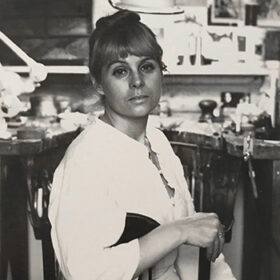
Photograph by David Watkins
Gift Card

Struggling to find that perfect gift? We have the solution! A Scottish Gallery Gift Voucher is the perfect gift for friends, family, customers and colleagues.

Own Art

Own Art is a national initiative that makes buying contemporary art and craft affordable by providing interest-free credit for the purchase of original work.


Join our mailing list

Sign up to receive the latest art news from The Scottish Gallery including forthcoming exhibitions, films, podcasts, blogs, events and more.