This December we bring together a fantastic, colourful range of jewellery from: Malcolm Appleby, Disa Allsopp, Rachel Larkins, Grainne Morton, Guy Royle, Joanne Thompson and Misun Won.
About Malcolm Appleby
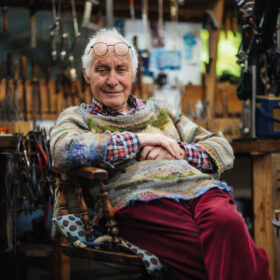
Malcolm Appleby was born in 1946. He studied at Central School of Art, Sir John Cass and the Royal College of Art in London before establishing his studio in Scotland in 1969. A silversmith and metal engraver, known for his imaginative use of line and form, he considers gold “just another lovely material to work with.”
The Scottish Gallery has been associated with Malcolm Appleby since the 1970s; the many facets of his work have brought joy to many, each piece sold marking the beginning of a journey of discovery around this senior artist. The Gallery honoured Malcolm Appleby’s seventieth birthday in January 2016, which marked over fifty years of a creative tour de force. Malcolm Appleby has dedicated his artistic practice primarily to engraving and pushing the boundaries of metalwork; constant experimentation has made him a master of his craft and in 2014 he received an MBE for his outstanding contribution to the arts.
2019 marked fifty years since Malcolm Appleby first set up his studio in Scotland and the exhibition 50 Golden Years in Scotland, featuring both jewellery and silversmithing, recognised his unique contribution to the arts. Malcolm’s infectious enthusiasm for his craft, his willingness to work with other artists and his pleasure in sharing his skills is characteristic of his generosity and pre-eminence. The natural world that surrounds Malcolm’s studio informs every piece; the artist’s inspiration unlimited in the abundance of the world around him.
Public Collections include:
The Victoria & Albert Museum, London; The Goldsmiths’ Company, London; British Museum, London; Royal Armouries, Tower of London; Ashmolean Museum, Oxford; Aberdeen Art Gallery & Museums; The Fitzwilliam Museum, Cambridge; National Museums Scotland, Edinburgh; and Perth Museum & Art Gallery
Malcolm’s jewellery collection can be viewed here.
In August 2021 we celebrated Malcolm Appleby’s 75th birthday with Malcolm Appleby & Friends. Previous exhibitions include 50 Golden Years in Scotland in March 2019 and The Gallery also hosted a special exhibition in January 2016 to celebrate Malcolm Appleby’s 70th birthday.
About Disa Allsopp

Disa was born in London and grew up in Barbados. This special island really influenced her jewellery designs, visible in her use of colourful gemstones. Disa personally selects each stone such as golden citrines, warm garnets, rubies, sapphires and morganites.
White and coloured diamonds are set on unique bands while rough and rare cut gemstones make Disa’s work contemporary and current, maintaining a timeless charm.
Disa exhibits internationally throughout the UK, United States, Japan and France. All work is individually handmade in Disa’s London studio.
About Rachel Larkins

Rachel Larkins (b.1974) is a British designer-maker whose deeply evocative jewellery and sculptural objects inhabit a world somewhere between folklore, memory and dream.
About Grainne Morton

Grainne Morton (b.1970, Lurgan, Northern Ireland) is one of the most distinctive and celebrated jewellers working in Britain today, internationally recognised for jewellery that transforms found objects, antiques and personal ephemera into richly narrative wearable works of art.
Born and raised in Northern Ireland, Morton grew up surrounded by traditional craft, folklore, storytelling and music, influences that continue to permeate her practice with a sense of memory, enchantment and emotional resonance. Her jewellery occupies a unique space where past and present, precious and ordinary, nostalgia and contemporary design coexist in beautifully balanced tension.
About Guy Royle

Guy Royle (b.1954, Devon) is a multidisciplinary British artist whose practice moves seamlessly between jewellery, sculpture, weaving and printmaking, each discipline forming part of a singular and deeply coherent visual language.
Based for over three decades in West Cornwall, Royle has developed a body of work grounded in material, rhythm and process, creating objects that feel timeless, tactile and profoundly connected to the landscape and traditions of making that surround him.
Royle’s work resists easy categorisation. Jewellery, textiles, sculpture and prints are not separate strands within his practice, but different expressions of the same sensibility. Line becomes structure, structure becomes rhythm, and materials themselves become carriers of meaning. Whether working in silver, gold, stone, wool or ink, Royle approaches making with remarkable consistency and clarity, guided by the belief that understanding comes through the hand: through repetition, touch, experimentation and patience.
Although largely self-taught, Royle’s formative artistic education came through life drawing at Morley College in London and, crucially, through his long association with the St Ives artist Breon O’Casey. Beginning in 1989, what started as a single day of weaving developed into a deeply influential collaboration that shaped Royle’s approach to materials, structure and the permeability between disciplines. Like O’Casey, Royle has always understood making as something cumulative and lived rather than academic, where craft, drawing, sculpture and daily labour exist in continuous dialogue.
Royle is perhaps best known for his sculptural jewellery in silver and gold, often incorporating hand-shaped stones and semi-precious materials sourced or selected for their natural tonal restraint. Unlike highly polished contemporary jewellery, Royle’s works retain the trace of the hand and the physicality of their making. Hammered surfaces, carved forms and carefully balanced structures reveal an artist deeply attentive to weight, movement and touch. His necklaces and brooches possess an ancient yet contemporary quality, balancing geometry and organic form with remarkable elegance and wearability.
Nature and landscape remain central to his practice. The subdued colours of the Cornish coastline, weathered stone, sea-worn textures and shifting light all find their way into his materials and palette. Birds, leaves and abstracted natural forms recur across jewellery, prints and sculpture, not as direct representations but as rhythmic motifs that move fluidly between media. His woven works and woodblock prints echo the same concerns found in the jewellery: repetition, balance, structure and the quiet poetry of handmade marks.
What distinguishes Royle’s work is its extraordinary sense of integrity and cohesion. Across every medium there is an absence of excess or ornament for its own sake. Instead, his works possess a calm authority born from decades of looking, making and refining. Objects are created to be lived with, worn and handled, carrying forward the traces of use and time.
The Scottish Gallery is delighted to present Spring Song in May 2026 as part of its Room of Dreams series, bringing together jewellery, sculpture, weaving and printmaking in a rare and immersive presentation of Royle’s multidisciplinary practice. The exhibition reveals the remarkable breadth of an artist whose work continues to evolve while remaining deeply rooted in material understanding, place and the quiet discipline of making by hand.
About Joanne Thompson

Joanne Thompson (b.1971, Annan, Dumfries & Galloway) is one of Scotland’s most accomplished contemporary jewellers, celebrated for jewellery that combines sculptural presence with extraordinary fluidity, tactility and wearability. Since graduating from Edinburgh College of Art in 1993, Thompson has developed a distinctive and highly recognisable visual language rooted in repetition, movement and meticulous craftsmanship.
She was regarded as one of Dorothy Hogg’s most gifted students, absorbing the discipline, technical rigour and sensitivity to form that characterised Hogg’s celebrated teaching while forging a powerful aesthetic entirely her own.
Following Edinburgh College of Art, Thompson completed an MA in Jewellery at the Royal College of Art, London, in 1995, where she further refined the chain-based constructions that have become central to her practice. Since graduating, The Scottish Gallery has represented Joanne Thompson continuously, supporting and championing her work from the very beginning of her career. Over the past three decades, she has held several important solo exhibitions with the Gallery and remains one of the defining contemporary jewellers associated with its programme.
Thompson’s jewellery is remarkable for the way it transforms hard precious metal into forms of exceptional softness and movement. Drawing inspiration from ancient chain maille techniques, she painstakingly constructs necklaces, bracelets and earrings from thousands of individually formed, soldered and finished silver links. Through subtle variations in scale, density and structure, she creates sculptural works that drape and flow across the body with an almost textile-like fluidity.
Her signature palette of oxidised silver and deep matte black gives the work a quiet drama and sophistication. Despite their visual complexity and sculptural volume, Thompson’s pieces remain astonishingly light, comfortable and durable, designed to move naturally with the wearer. Elegant movement is not incidental but fundamental to the work itself; each piece shifts gently in response to the body, creating constantly changing surfaces and rhythms.
What distinguishes Thompson’s practice is the balance she achieves between technical precision and sensuality. The repetitive process of constructing each individual link becomes almost meditative, resulting in jewellery that carries both structural clarity and emotional intimacy. Her works possess an understated confidence and timelessness, transcending fashion while remaining unmistakably contemporary.
Today, Joanne Thompson is recognised as one of the leading figures in British contemporary jewellery, admired for her mastery of material, her innovative reinterpretation of historical techniques and her enduring commitment to making jewellery that is both sculptural and profoundly wearable.
About Misun Won

Misun Won (b.1979) is a contemporary jeweller whose intricate and highly refined work brings together Korean textile traditions, mathematical structure and exceptional craftsmanship. Originally from Korea and now based in Scotland, Won graduated with an MA from Edinburgh College of Art in 2008, where she developed the distinctive visual language that continues to define her practice today.
Working predominantly in precious metals, Won creates jewellery of remarkable delicacy and complexity, often characterised by finely repeated geometric units that unfold into dynamic sculptural forms. Her work draws deeply from the traditions of Korean patchwork, particularly bojagi, the historic textile practice of piecing together fragments of cloth into harmonious compositions. Rather than directly replicating these traditions, Won reinterprets them through a contemporary lens, combining their rhythmic structures and subtle asymmetries with influences from Western fractal geometry and mathematical repetition.
The resulting jewellery possesses an extraordinary balance between precision and softness. Layered patterns, intricate lattices and interconnected forms create pieces that appear simultaneously architectural and textile-like, rigid yet fluid. Light moves delicately across surfaces and through open structures, giving the work a sense of movement and quiet luminosity. Despite their complexity, Won’s pieces retain an elegance and restraint that reflects her deep sensitivity to balance, rhythm and proportion.
Central to Won’s practice is the experience of inhabiting two cultures. Having lived and worked extensively in both Korea and Britain, she describes herself as occupying a “neutral territory”, a position that allows her to view both Eastern and Western traditions with fresh perspective. This cultural dialogue lies at the heart of her jewellery, where ancient handcraft traditions meet contemporary abstraction and innovation.
Won’s work is also distinguished by its exceptional technical refinement. Every component is meticulously handcrafted, revealing a maker of immense patience, discipline and material understanding. Her jewellery rewards close looking, revealing increasingly subtle details and spatial relationships over time.
In 2019, Won received a commendation at Goldsmiths’ Fair for her innovative and highly accomplished collection, further establishing her reputation as one of the most thoughtful and technically accomplished contemporary jewellers working today.

