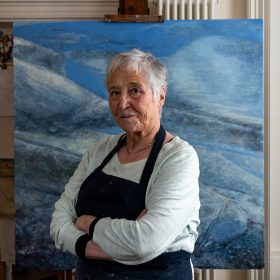
Dame Elizabeth Blackadder (1931–2021) stands as one of the most important figures in modern Scottish art. Born in Falkirk, she studied at Edinburgh College of Art from 1949–1954 under influential teachers including William Gillies and Robert Henderson Blyth, graduating into what would become one of the most remarkable artistic careers of the twentieth century. Early travelling scholarships to southern Europe and Italy introduced Blackadder to the light, architecture and visual cultures that would profoundly shape her work for decades to come.
Working across painting, watercolour, drawing, printmaking and tapestry, Blackadder developed a singular visual language distinguished by exquisite draughtsmanship, subtle colour relationships and an extraordinary sensitivity to observation. Flowers, cats, Japanese objects, interiors, gardens and landscapes became recurring motifs within compositions that balanced intimacy with formal sophistication. Whether depicting an iris from her Edinburgh garden, a Venetian lagoon or a still life assembled from treasured objects gathered on her travels, Blackadder transformed everyday subjects into meditations on beauty, balance and quiet contemplation.
Although often associated with the Edinburgh School through her connection to William Gillies, Blackadder consistently expanded beyond its traditions. Her work absorbed influences from European modernism, Japanese aesthetics and botanical illustration while remaining unmistakably personal. The influence of Japan became especially significant from the 1980s onwards, inspiring her use of flattened space, decorative pattern, gold leaf and carefully orchestrated compositions. Her paintings possess an unmistakable elegance and restraint, yet beneath their delicacy lies immense technical control and formal intelligence.
Alongside her own studio practice, Blackadder played a vital role within Scottish art through teaching at Edinburgh College of Art from 1962 until her retirement in 1986. Generations of students benefitted from her quiet encouragement and example, recognising in her a painter wholly committed to “the good practice” of making art every day.
Blackadder achieved numerous historic distinctions during her lifetime. In 1972 she was elected to the Royal Scottish Academy and in 1976 became the first woman elected to both the Royal Scottish Academy and the Royal Academy in London. In 2001 she was appointed Her Majesty the Queen’s Painter and Limner in Scotland, the first woman to hold the role. A major retrospective at the Scottish National Gallery of Modern Art in 2011 confirmed her position as one of Britain’s most admired post-war artists. Her work is held in major collections worldwide including Tate, the Museum of Modern Art in New York, the Yale Centre for British Art and the National Galleries of Scotland.
The Scottish Gallery shared an exceptionally close and enduring relationship with Elizabeth Blackadder spanning more than six decades. As Christina Jansen reflected, the relationship was “both professional and personal: based on mutual respect, hard work, nurture and trust.” Blackadder exhibited regularly with The Gallery throughout her career, and her exhibitions became defining moments within the Edinburgh Festival calendar. Over this long partnership, The Scottish Gallery presented sixteen solo exhibitions alongside numerous mixed and thematic exhibitions, helping place her work in important public and private collections internationally.
Selected solo exhibitions with The Scottish Gallery include: 1961, 1966, 1972, 1974 Festival Exhibition, 1985 Edinburgh Festival Exhibition. 1994 Festival Exhibition, 1998, 2003, 2004, 2008, 2010, 2011, 2013, 2015, 2016, 2020, Elizabeth Blackadder: A Celebration, Festival Exhibition, 2023
Few artist-gallery relationships in Scottish art history have been as longstanding, collaborative or significant. Elizabeth Blackadder’s legacy remains one of extraordinary generosity, refinement and dedication to the act of looking closely at the world.
To view prints by Elizabeth Blackadder please click here