Various Artists

The Northern Isles | Part II

5 February 2026 - 28 February 2026

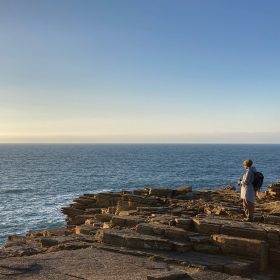
The Northern Isles continues this February. Orkney, Shetland and Skye offer rich territory for artistic response. Their landscapes, shaped by light, weather, and deep time, hold a quiet intensity that rewards close attention. Cast into the North Atlantic, these islands are defined by shifting light, ancient histories, and a delicate balance between endurance and tranquillity. Each archipelago carries its own rhythm: Orkney’s calm and continuity contrast with Shetland’s raw, volatile energy.

In this second chapter, The Northern Isles offers a concentrated encounter with these remarkable environments. The works on view reflect enduring connections to place, whether through lived experience, repeated return, or sustained study. Together they speak of the rhythms of island life and to traditions of making that balance resilience with sensitivity.

About Megumi Barrington-Uenoyama

Megumi Barrington-Uenoyama
Born: 1979
Place of Birth: Osaka, Japan

I am a Japanese artist who is based in Orkney, my work reflects both my Japanese heritage and my interest in the landscape and natural history of Orkney.
“The essence of Orkney’s magic is silence, loneliness, and the deep marvellous rhythms of sea and land, darkness and light” George Mackay Brown (1921-1996).

This quote encapsulates the unique atmosphere of Orkney, emphasizing the powerful interplay of natural elements and a sense of isolation that contributes to its captivating character.

My work explores the everyday rhythms of daily life and nature, exerting their influence on Orkney’s landscape, taking inspiration from the seasonal changes in the flora and fauna. I often apply gold leaf to my work to represent my memories, respect for and reflections about Japan. Gazing at the beautiful moon and water in Orkney, I quietly recall and think of Japan with a sense of calm nostalgia. When I first moved to the UK, I was immersed in my new culture, but over time I have come to acknowledge and respect all the different aspects of my life, and to bring them in harmony. I am also trying to do this in my work. Curiosity and enthusiasm are my main motivations to explore my creative practice. I begin by enjoying rhythmic mark making, line drawing, Japanese calligraphy and photographing moments that captivate me during everyday life in Orkney.

Printmaking is currently the most important element of my creative practice. Each printmaking process needs patience, technical attention and concentration in balance together so that I calm my excitement and work with a steady focus in a positive manner. But printmaking processes also allow me to experiment and to embrace unexpected results, capturing my respect for the rhythm, atmosphere, and motifs of each theme.

Photograph by Tom Johnson for Highland Park

About Anne Bevan

Anne Bevan
Born: 1965
Place of Birth: Orkney

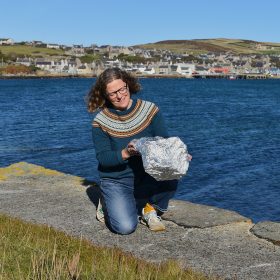
Anne Bevan often makes work connected to the sea – thinking about things we cannot see – underwater, submerged, hidden, stories and histories. She develops her ideas through a range of media and including sculpture, photography and video. Her interest in interdisciplinary and collaborative practices has seen her working with many people from different specialisms, including archaeology, anthropology, geology, marine science, creative writing, film and music. This dialogue brings new connections and conversations, along with new ways of understanding our relationship to place and the environment.

She has developed several collaborative works with the writer Janice Galloway, composers Pete Stollery and Gemma McGregor, marine scientist Kate Darling from University of Edinburgh and archaeologist Mark Edmonds.

She is currently collaborating with archaeologist Mark Edmonds on a project – Light Erratic – which focuses on a haul of labradorite boulders, brought to Orkney as ballast in the late 19th century. Named for the Canadian coast on which it is found, labradorite has a spectacular iridescence, an effect that evokes the Aurora Borealis. These boulders are a point of departure for exploring connections: between land, sea and sky, and between people on either side of the Atlantic.

Anne Bevan was born in 1965 in Orkney where she now lives and works. She studied Fine Art and Sculpture at Edinburgh University and Edinburgh College of Art and has undertaken numerous national and international exhibitions, residencies and commissions. This includes solo exhibitions at the Fruitmarket Gallery, Edinburgh (2000), Hunterian Museum, Glasgow (2004) and the Pier Arts Centre, Orkney (1997, 2017); group exhibitions include Ocean Imaginaries at RMIT Melbourne, Australia (2017); Here and Now, Scottish Art 1990 – 2001, Aberdeen Art Gallery and Dundee Contemporary Arts (2001).

Residencies include the IAAB International Artists Residency Programme in Basel (2000), Hoherweg Studios Dusseldorf (2004) and RSA residencies for Scotland in Shetland (2010) and Edinburgh Sculpture Workshop (2025). Public art commissions include Source, Pier Art Centre (2001), Moon Pool, Tyrebagger Forrest, Aberdeen (2002), and Tang, Stromness Primary School (2015). She is Academician of the Royal Scottish Academy.


About Ruth Brownlee

Ruth Brownlee
SSA
Born: 1972

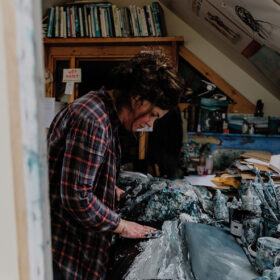
Ruth Brownlee is one of Shetland’s foremost contemporary painters, known for her expressive depictions of the island’s elemental landscape. Her paintings capture the dramatic weather, shifting light and restless sea that define life at the northern edge of Scotland. Born in Edinburgh and trained at Edinburgh College of Art, Brownlee has lived and worked in Shetland for over two decades. From her studio in South Mainland, she paints the ever-changing moods of the Atlantic, transforming raw experience into paintings that are both personal and profoundly rooted in place.

Shetland’s wildness lies at the heart of her practice. The island’s long horizons, sudden storms and fleeting bursts of sunlight are subjects she returns to again and again. Brownlee often works outdoors, sketching and painting directly in the landscape before developing larger works in her studio. Her painterly language is instinctive and physical, using layered acrylic and mixed media to evoke the texture of land and sea. Brushstrokes, scrapes and glazes echo the weather’s force; paint is pushed and pulled across the surface much as wind and tide shape the islands themselves.

Living in Shetland offers a constant reminder of nature’s power and fragility. The sea can be tranquil or threatening within moments, and Brownlee’s paintings hold this duality, moments of serenity framed by turbulence. The intimacy of her response to place has led many to describe her work as both contemporary landscape and personal diary. Each painting is a reflection of time spent outdoors, an attempt to translate the sensory experience of salt air, cold rain and sudden light into colour and form. Brownlee’s palette often mirrors the muted tones of the northern environment: greys, umbers and deep blues, offset by the sudden brilliance of sunlit gold or silver. Her compositions balance abstraction and observation; some verge on pure atmosphere, others retain the outline of cliffs or the line of a breaking wave. The results are paintings that feel alive, moving between stillness and storm.

Although Shetland remains her primary subject, Brownlee’s work speaks to a bigger audience. Her exhibitions across Scotland and beyond reveal an artist whose themes of isolation, endurance and renewal resonate universally. To viewers from elsewhere, her paintings offer a window into a place where human life feels small against the scale of sea and sky. For Shetlanders, they hold something more intimate, a recognition of home and belonging rendered with honesty and respect.

Ruth Brownlee’s paintings celebrate Shetland’s powerful contrasts: light and dark, calm and chaos, permanence and change. Her work affirms the continuing importance of the Northern Isles in Scotland’s visual culture, not as a remote periphery but as a vital centre of creative energy. For those who know Shetland, her paintings speak directly of its presence. For those who do not, they offer a vivid introduction to a landscape where the where the elemental and the human meet.

Having lived by the sea since visiting Shetland to teach a painting workshop 24 years ago, my work continues to be inspired by this archipelago in the North Sea. Shetland is a rugged environment with an intense visual drama of constant changing elements. As I love walking and walk whenever I can; I watch the weather, and read the mood of the sea which filters into my studio practice. Capturing the intense atmosphere of this wild place is more important to me than trying to include the details of the coastal landscape.

Photograph by Susan Molloy

About Ingrid Budge

Ingrid Budge
Born: 1967
Place of Birth: Orkney

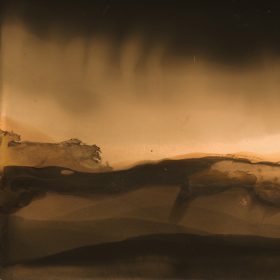
Ingrid Budge (b.1967, Orkney) is an Orcadian artist working with alternative photographic processes to create atmospheric and deeply evocative studies of landscape, memory and place. Rooted in the elemental environment of Orkney, her practice explores the shifting relationship between land, sea and sky through experimental, camera-less techniques that embrace unpredictability, chemistry and chance.

Born and educated in Orkney, Budge first developed an interest in photography during her studies in the 1980s, where early experiments with gum and salt printing sparked a lifelong fascination with historical and analogue photographic methods. Although she spent time studying in Edinburgh, the pull of Orkney’s dramatic coastline and ever-changing weather brought her back to the islands, where she continues to live and work today.

Budge works across a wide range of alternative processes including lumen printing, cyanotype, wet-plate collodion, chemigrams, pinhole photography and photoetching. Using expired photographic paper, hand-mixed chemicals and direct exposure to the elements, she creates works that feel both ancient and contemporary, images that hover between photography, painting and abstraction. Her process-led approach allows the landscape itself to become an active collaborator, with light, moisture and chemical reaction leaving traces that mirror the unpredictability of Orkney’s environment.

The coastlines, cliffs and skies of Orkney are central to her work, not as documentary subjects but as emotional and sensory experiences. Mist, salt air, erosion and shifting weather patterns dissolve familiar landmarks into poetic, alchemical surfaces that evoke memory, atmosphere and geological time. Her photographs possess a haunting, timeless quality, reflecting both the fragility and endurance of island life.

Alongside her solo practice, Budge has collaborated with poets, printmakers and sound artists on immersive projects exploring Scotland’s coastal landscapes, further extending her interest in place, perception and the experimental possibilities of analogue image-making.

Ingrid was born and educated in Orkney, she spent a year studying in Edinburgh but returned to Orkney where she still lives and works.

About Samantha Clark

Samantha Clark
Born: 1967


Samantha Clark is a visual artist and writer based in the Orkney Islands. Shaped by Orkney’s weather, expansive skies and, above all, water, her recent paintings invite us to notice how water in its many forms permeates everything, as we inhabit a world in constant motion. Originally trained as a tapestry weaver, her thirty-year practice has moved through drawing, installation, video and public commissions, with painting now at the centre of her work. She studied at Edinburgh College of Art, the Belgrade Academy of Fine Arts and the Slade, and holds both an MA in Environmental Philosophy and a PhD in Creative Writing. In 2019, she completed a 30-metre mural for The Balfour Hospital in Kirkwall. Her first book, The Clearing, was published by Little, Brown in 2020, and in 2023 she received the inaugural RSA MacRobert Trust Art Award for Painting.

In her Orkney studio, Clark finds refuge in the quiet rhythm of painting. Her practice centres on being fully present to the unfolding moment: the surface, the paint, and the gradual emergence of form. Working instinctively, she allows each painting to evolve slowly, discovering a different sense of time through the accumulation of marks and gestures. The repetitive, meditative process becomes a way of holding the complexity of the world without seeking to explain or resolve it.

Clark’s paintings exist in direct conversation with the land, water and wind of the Northern Isles. They open outward into the landscape while simultaneously reflecting an interior world, tracing a delicate balance between joy and loss, stillness and motion. Attentive to both beauty and uncertainty, her work searches for moments of calm within the instability of contemporary life. Painting becomes a form of quiet momentum, an ongoing act of attention carried forward into an unknowable future.

Samantha Clark will the be the subject of a major solo exhibition at The Scottish Gallery in October 2027.

Photograph by Thibault Gras

About Victoria Crowe

Victoria Crowe
OBE, DHC, FRSE, MA(RCA), RSA, RSW
Born: 1945

Victoria Crowe studied at Kingston School of Art from 1961-65 and at the Royal College of Art, London, from 1965-68. At her postgraduate show, she was invited by Sir Robin Philipson to teach at Edinburgh College of Art. For thirty years she worked as a part-time lecturer in the School of Drawing and Painting while developing her own artistic practice. She lives and works in West Linton and Edinburgh. Her first one-person exhibition, after leaving the Royal College of Art, was in London and has subsequently held over fifty, one person shows.

Victoria Crowe’s first solo exhibition at The Scottish Gallery was in 1970. In August 2018, The Gallery held a major exhibition of paintings to coincide with The Scottish National Portrait Gallery’s retrospective of Victoria Crowe’s portraits. In 2019 The City Art Centre held a retrospective entitled 50 Years of Painting. This exhibition embraced every aspect of Crowe’s practice and featured over 150 paintings, works on paper and sketchbooks and several films of the artist were commissioned.

Victoria Crowe is a member of the Royal Scottish Academy (RSA) and the Royal Scottish Society of Painters in Watercolours (RSW). Crowe has exhibited nationally and internationally and undertaken many important portrait commissions, including HRH The King, RD Laing, Peter Higgs and Jocelyn Bell Burnell.  Crowe’s work is held in numerous public and private collections worldwide.

In 2000, Crowe’s exhibition A Shepherd’s Life, consisting of work selected from the 1970s and 80s, was curated for the National Galleries of Scotland’s to mark the Millennium. The exhibition toured Scotland and was re-gathered in 2009 for the Fleming Collection, London.

Crowe was awarded an OBE for Services to Art in 2004 and from 2004-2007, she was appointed Senior Visiting Scholar at St. Catherine’s College, Cambridge. The resulting work, Plant Memory, was exhibited at the Royal Scottish Academy in 2007 and subsequently toured Scotland. In 2009 she received an Honorary Degree from The University of Aberdeen and in 2010 was elected a Fellow of the Royal Society of Edinburgh.

In 2013, Dovecot Studios wove a large-scale tapestry of Crowe’s painting Large Tree Group. This collaborative tapestry was acquired for the National Museums Scotland. In 2015, Crowe invited as artist-in-residence at Dumfries House and in 2016 a group of work from the residency was acquired by the National Galleries of Scotland. Crowe was commissioned by the Worshipful Company of Leathersellers’ in 2014, to design a forty-metre tapestry for their new hall in the city of London, which took over three years to weave and was installed in January 2017. Dovecot worked with Victoria Crowe to produce a new tapestry inspired by a detail from her painting Twilight, Venice, 2014. The new tapestry, Richer Twilight, Venice was completed and unveiled at the end of September 2019.

Following a residency in Orkney in 2022, the Pier Art Centre in Stromness held a major exhibition of new work, Touching the Surface from August to November 2024, in which she looked specifically at the contrasting light around the summer and winter solstices.

The Scottish Gallery exhibitions: 1970, 1973, 1977, 1982, 1995, 1998, 2001 (Festival), 2004, 2006, 2008, 2010 (Festival), 2012, 2014 (Festival), 2016, 2018 (Festival), 2019, 2021, 2023, 2025 (Festival, 80th)

To view Victoria Crowe’s prints please click here

About Peter Davis

Peter Davis
Born: 1953

For more than forty years, Peter Davis has pursued a singular vision through the medium of watercolour, exploring the delicate intersection between artistic intent and the elemental forces of nature. His work, deeply rooted in the landscapes of the Northern Isles, conveys not only a sense of place but also an emotional and philosophical engagement with the natural world.

Born in North Shields, Davis studied art and design at Northumberland College of Education, graduating in 1975. After teaching in Cumbria, he moved north to Orkney in 1981, where he established his own gallery and began his lifelong dialogue with the islands’ light and weather. A decade later, he settled in Shetland, where the raw edge of sea and sky became central to his art. Since retiring from teaching in 2013, Davis has devoted himself entirely to painting. His contribution to the medium has been recognised by the Royal Scottish Society of Painters in Watercolour, who awarded him the John Busby Award for excellence in contemporary watercolour, and in 2023 elected him as a member (RSW).

Davis’s career is shaped by both discipline and instinct, qualities essential to mastering watercolour’s mercurial nature. You just go with the flow and learn to handle the mistakes better. In this, Davis acknowledges the impossibility of total control over a medium that mirrors the very conditions he paints: shifting, unpredictable, and alive. For Davis, watercolour is the most natural of all painting media. Comprised simply of pigment, gum arabic, and water, it embodies the same dualities that define the northern landscape, stillness and movement, clarity, and opacity, calm and turbulence. As the water evaporates and leaves pigment on the paper’s surface, the process itself becomes a metaphor for weathering, for the quiet endurance of the land beneath the passage of wind and rain.

Unlike oil or acrylic, which allow correction and reworking, watercolour is a medium of irreversibility. Each wash and brushstroke records a decision, a fleeting moment of perception. In Davis’s hands, this immediacy becomes an act of mindfulness. His paintings capture not just the appearance of a scene but the sensation of being within it; the shifting weight of cloud, the glint of light on wet stone, the vibration of air before a storm.

Although his work is often inspired by specific places in Orkney and Shetland, Davis resists literal representation. He writes of seeking the uncertain balance between abstraction and reality, a phrase that encapsulates his approach. His landscapes hover between recognition and evocation: familiar yet dreamlike, tangible yet dissolving into the atmosphere. The Northern Isles have long offered Davis an inexhaustible source of visual and emotional stimulus. The relationship between land and sea, the mutable skies, and the clarity of light all feed into his work. It is in the northern landscapes where weather, time, and memory converge, that his art feels most at home. His paintings invite contemplation. The viewer senses movement, waves shifting, mist lifting, the slow drift of light, within the stillness of the image. His works remind us that the landscape is never static, that what we see is always in transition.

Davis does not dramatise the northern environment; he listens to it. The restraint of his compositions, the whispering tonal shifts, and the meditative clarity of his approach reveal a painter who has learned from both the discipline of teaching and the freedom of weather. In the subtle interplay of water and pigment, Peter Davis captures something enduring: the spirit of the Northern Isles themselves, poised between stillness and flow.

Peter Davis is the subject of a major solo exhibition at The Scottish Gallery in December 2027.

Photograph by Arabelle Bentley

About Kate Downie

Kate Downie
RSA, PPSSA
Born: 1958
Place of Birth: North Carolina, USA

Born in North Carolina, Kate Downie is one of Scotland’s most respected contemporary painters, celebrated for a practice that moves fluidly between painting, drawing, printmaking and installation. After studying at Gray’s School of Art in Aberdeen, Downie travelled extensively, undertaking residencies and projects in the United States, England, Amsterdam and Paris. Over the past three decades she has built a distinctive body of work rooted in direct engagement with place, landscape and industry, responding intuitively to environments through colour, gesture and mark-making.

Geography lies at the heart of Downie’s practice. Whether working from remote coastlines, industrial sites or urban environments, she approaches each location through immersion and sustained observation. Her work is often created in situ, with temporary studios established in extraordinary settings including a brewery, an offshore oil rig and, more recently, an abandoned hydroponicum on Scotland’s west coast. These immersive experiences allow her to absorb the physical and emotional atmosphere of a place, translating it into paintings and drawings that balance abstraction with vivid sensory memory.

Downie’s work is characterised by its restless experimentation and material energy. Moving between monumental charcoal drawings, luminous colour-field prints and richly layered paintings, she captures the rhythms, structures and weather systems of the landscapes she inhabits. Her compositions frequently hover between representation and abstraction, where fragments of architecture, coastline or machinery emerge through sweeping gestural marks and intense colour relationships.

Alongside her studio practice, Downie has developed an important reputation for ambitious collaborative and research-led projects. Recent work has included Conversations with Joan at Glasgow Women’s Library, an exhibition reflecting on Joan Eardley’s unfinished painting Two Children, left on the artist’s Townhead studio easel at the time of her death in 1963. Through painting, drawing and archival engagement, Downie explored ideas of artistic inheritance, process and creative dialogue across generations of women painters.

Her work is held in numerous public collections including Glasgow Museums, Kelvingrove Art Gallery and Museum, Edinburgh City Art Centre, BBC Scotland and the Rietveld Academie, Amsterdam, among many others. A long-standing artist of The Scottish Gallery, Downie has presented ten solo exhibitions with the Gallery to date.

For the Festival 2026, The Scottish Gallery will present a major solo exhibition of new work by Kate Downie, celebrating one of the most outstanding voices in contemporary Scottish painting.

Please click here to view prints by the artist

Photograph by Alicia Bruce

About Laura Drever

Laura Drever
Born: 1981
Place of Birth: Orkney

Laura Drever is an Orcadian artist whose work arises from a profound engagement with her native landscape, experienced through the act of walking, looking and remembering. Born in Kirkwall, she studied Drawing and Painting at Edinburgh College of Art, graduating in 2003 with First Class Honours. For more than two decades, she has explored Orkney’s shifting light, hills, and coastline, developing an intimate understanding of the islands’ rhythms and their continually changing atmosphere. Her practice begins outdoors, where she spends long periods walking and observing the terrain, the movement of weather, colour and the flight of birds. These experiences are then recalled and reimagined in the studio. Drever rarely works from direct sketches or photographs, preferring to translate memory and sensation into paint through a process that is as meditative as it is physical. Layers of colour are applied and reworked, sometimes veiled and sometimes allowed to gleam through the surface, creating a sense of depth, movement and time within the work. Drever’s paintings are not straightforward depictions of place but reinterpretations that balance recognition and abstraction. Her compositions distil the essence of Orkney’s landscape into fields of tone, rhythm and shifting light. The white of the canvas often plays an active role, suggesting air and distance while inviting the viewer to complete the image through their own perception. The result is work that conveys both the solidity and transience of the northern environment. Many of her titles draw on Orcadian dialect and Norse-derived place names, which anchor her paintings in a strong sense of locality while also introducing an element of poetry and layered meaning. Language and landscape remain intertwined.

Over time, Drever’s work has become more ambitious in both scale and expressive energy. Her larger canvases heighten colour and movement, while smaller works often form sequences or clusters that share a rhythm of line and motif across several pieces. This compositional approach gives her exhibitions a cumulative energy, echoing the experience of walking through the islands and encountering the landscape in motion. Her artistic influences include Sylvia Wishart, a fellow Orcadian painter, whose sensitivity to light and place resonates strongly with Drever’s approach, as well as Wilhelmina Barns-Graham and Bet Low, whose work combines abstraction with the geography of the Scottish islands. In addition to her own practice, Drever plays an active role in Orkney’s creative community, supporting local art initiatives and sharing her experience with other artists. Her paintings, drawings and prints speak of a lifelong relationship with place and the patient observation of light and weather. In the context of The Northern Isles, her work offers a contemporary interpretation of the northern landscape; one that is deeply rooted in the experience of being within it, alive to its changeability, and open to its quiet revelations.

About Roland Fraser

Roland Fraser
Born: 1968
Place of Birth: Bridge of Allan

Roland Fraser creates sculptural furniture and relief panels that merge fine art with traditional craftsmanship. His work is rooted in a profound respect for materials and the histories they contain. Using timber salvaged from old furniture, farm buildings, and found structures, Fraser assembles new forms from fragments marked by time, use, and human presence. Roland is also a musician, comparing his process to composing, balancing rhythm, tension, and harmony. His constructions invite the viewer to read the language of wood not as static matter, but as a living record of use, memory, and transformation.

My wooden constructions are a synthesis of assemblage, collage, and craftsmanship. I choose pieces that bear the traces of past lives, the wear of surfaces, the ghost of a missing hinge or lock, the residue of human touch. These marks give the material an almost totemic quality.

About Kevin Gauld

Kevin Gauld
Born: 1980
Place of Birth: Orkney

Born, raised and educated in Orkney, Kevin Gauld (b.1980) has been working with wood ever since childhood. Growing up, he could always be found in the family garden shed making wooden items. His hobby developed into his passion when he left school in 1996 at the age of 16 to launch his much-desired career as an apprentice with a well-known local furniture maker who held a reputation for high-quality craftsmanship.

Here, he continued to work and expand his skills and techniques for nine years, which eventually lead to him establishing himself as The Orkney Furniture Maker in April of 2007 with the aim of producing traditional furniture as well as his own new designs.

Kevin’s work brings together his passion for local traditional techniques and materials, combining them with innovation and design to create unique pieces with a connection to his island home. Every piece from the collection is individually created by him and his small, dedicated team. Kevin has exhibited locally, nationally and internationally and now has a world-wide customer base.

About Andrea Geile

Andrea Geile
Born: 1961

Edinburgh based artist Andrea Geile (b.1961) studied Visual Art in Hanover, Germany, and has held residencies in Orkney, Germany, France and Australia. She has been working from her Scottish studio since 1996 and has realised many public and private art commissions.

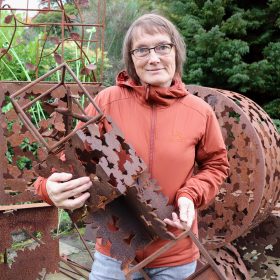
Her outdoor sculptures are made from Corten steel, often grouped with real plants and relating directly to the site environment. They are subtle interventions, merging into the landscape and are often only visible on closer inspection. Among others she has received Awards from the RSA and the RHS Chelsea Flower Show.

Andrea’s sculptures are hand-made from Corten steel; a weatherproof steel that forms a protective layer which stops further corrosion. They therefore have an unlimited life span and do not stain. Andrea fabricates all her sculptures herself. The patterns are first drawn onto sheet metal then hand-cut, assembled like a 3D puzzle and finally welded together. Andrea has worked on several large scale public commissions including Culzean Castle and, most recently, a sculpture commission titled ‘The Chlorophylles’ at the FANK Arts & Heritage site in Lettermore Forest on the Isle of Mull; celebrating the community effort bringing this site back to life.

Orkney has held a special place in my life since my first visit in the early 1990s. What began as a trip to visit friends has grown into a lasting source of fascination that continues each time I return to the islands. In 2024, I was delighted to receive the Stephen Palmer Travel Bursary Fund to undertake a research trip to Orkney Mainland. The aim was to study coastal and marine plant environments. I had the fantastic opportunity to view the Magnus Spence Herbarium Collection at the Stromness Museum, particularly its remarkable collection of 390 seaweed specimens. Local artist friends joined me on coastal walks and foraging trips, and during these visits to the seashores I began to form ideas inspired by the shapes and colours of the tidal zone. Back in the studio, these impressions evolved into a new series of cube sculptures, each block representing an element of the environment, whether natural or human made. Once stacked, they create a complete landscape, a reflection of Orkney’s balance between nature and human presence. My next trip to Orkney is already planned, and I look forward to once again being challenged and inspired by Orkney’s unpredictable, ever-changing conditions.

Public Collections include:
City of Edinburgh Council; The University of Edinburgh; NHS Tayside; City of Albany Art Collection, Australia


About Grace Girvan

Grace Girvan
Born: 1981
Place of Birth: Orkney

The unique landscape of the Orkney Islands provides inspiration for Grace Girvan’s jewellery. She enjoys beach combing and uses the objects that she unearths on her expeditions in her work, combining found objects such as pebbles, driftwood and shell with precious metal and enamel.

Her work is evocative of her inspiration, through a restrained colour palette of soft greys, blues, greens and browns she conveys the washed out, sun bleached colours of the sea and shore.

Public Collections include:
Aberdeen Art Gallery and Museums, Aberdeen

I grew up on South Ronaldsay, the southernmost island in Orkney that is connected to the mainland by the Churchill Barriers. My childhood was spent on a farm, surrounded by open space and the outdoors. My grandparents lived very close by, and if there weren’t cattle in the fields, we would head straight across to visit them. Otherwise, we would take the road, which passed by the beach. That beach became an important place for us; we would often go there to search for Groatie Buckies (arctic cowries), smooth pebbles, and to watch the curious seals basking on the rocks. When I return to Orkney now, what strikes me most is the vastness of the sky. The land is relatively flat and there are very few trees, so the sky feels endless. The special quality of the light, combined with that great sense of space, is something I treasure deeply. The beach I most often return to is Chapel Point, the same one we used to visit on the way to my grandparents’ house. The pebbles there are perfectly formed, flat, smooth, and need no cutting, polishing, or shaping. I use them exactly as I find them, in their natural state.
In my work, I aim to translate the colours, light, and calmness of Orkney into jewellery. I use transparent enamels in soft blues, greens, and greys on silver. The silver beneath creates a luminous glow through the enamel, echoing Orkney’s unique light. By matting the surface of the enamel, the colours take on a watercolour-like softness, reminiscent of the landscapes I love. The pebbles themselves are always left unaltered, flat, smooth, and with naturally regular edges. I feel it is more honest to use them exactly as they are. Recently, I have been embracing their variety, celebrating the different hues and textures that reflect Orkney’s rich geology.

When I am in Orkney now, I am more intentional. I try to slow down, to absorb the landscape, the light, and the colours that inspire me. I take photographs, I collect pebbles, and I let those experiences feed into my designs. Collecting pebbles has also become a family ritual. My parents often join me, and they have an excellent eye for the shapes I am looking for. When I work with certain pebbles, I remember who picked them up, or I recall the exact beach where I found them. That connection to my family, to place, and to memory feels as important as the physical material itself. I am still excited every time I find a new pebble; their beauty never ceases to amaze me. Some of my favourite places to collect include the beach at Chapel Point, Newark or Dingieshowe in Deerness, and the beach at the fourth Churchill Barrier on South Ronaldsay. Each of these places holds its own sense of discovery and connection to home.

About Gail Harvey

Gail Harvey
Born: 1954
Place of Birth: Glasgow

From small water based paintings created outside, to the large, oil-based canvases rendered in her studio, Gail aims to replicate the energy and changing sense of light, space and movement found in the coastal landscapes she uses as her inspiration.

A graduate of the Glasgow School of Art in the 1970s, Gail Harvey has been living and working in Shetland since 1988. She has exhibited her work extensively in the UK over the past twenty years, including group and solo shows in Glasgow, Shetland, Edinburgh, Bath and Cork Street, London.

At the end of my first year at the Glasgow School of Art, I came to Shetland in 1973. I spent the summer packing kippers in a fish factory in Lerwick. On days off, my friend and I would head out of town to explore. We walked and hitched lifts across miles of single-track roads. These narrow and winding routes linked distant corners and turn offs and everywhere felt truly remote. We met so many friendly people. Families took us in, fed us and were so kind. Looking back, my fondest memories are of the people, their open generosity, daft sense of humour, enthusiasm and resourcefulness, all of which I really admired. That summer of 1973 turned out to be one of the last precious glimpses of Shetland before the oil era.

Shetland pulled me back and I returned with my husband Robert to live here in 1988. I have stayed and worked in the same spot for thirty-seven years. It feels like a dream, so many years watching the light and weather shift and play around me. I daydream a lot. I will be watching sea sparkles bouncing into cliff shadows and find myself wondering, can paint convey this smoky quality of inner lit darkness?

Alongside the daydreaming there are daily walks and sometimes swims in the sea. I love this immersion in the weather and waves. It is a constant reminder of the full force and energy of nature. In my studio I am always trying to balance this wilder power with the more delicate, fleeting moments of light. I love paint for its surprises, the way it behaves unexpectedly, much like the light outside can still surprise me after all these years.

The large oil paintings take time. I am always looking for a way in, a sense of where the work wants to go. It can be a real mystery how a direction emerges. At times it begins to take on a personality of its own, and I cannot force it. It is important that the painting echoes the natural world outside and has breathing space.

My aim is always to find a simple, intuitive flow between paint, light, weather and sea.

About Rod Kelly

Rod Kelly
Born: 1956

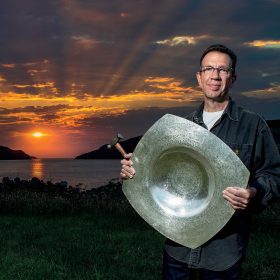
Master silversmith Rod Kelly (b.1956) creates work that carries the quiet rhythm of time and tide. Living and working by the sea in Shetland, he draws daily inspiration from the shifting light, weather, and wilderness around him. It can’t help but feed in, he says, because my studio overlooks the sea and the sea changes every day.

Kelly’s pieces are entirely handmade using traditional silversmithing techniques, the metal chased slowly into form with great patience and precision. His creative process begins with research, drawing, and the study of textures in stone, wood, and nature, gradually building towards a balanced, harmonious design.

A graduate of the Royal College of Art, Rod Kelly has worked for over four decades, creating ecclesiastical and civic silver for institutions such as St Paul’s Cathedral, New College, Oxford, and No. 10 Downing Street. Kelly is a Liveryman of the Worshipful Company of Goldsmiths’, a Freeman of the City of London, and founder of the South House Silver Workshop Trust, which supports and mentors young silversmiths from his studio on Muckle Roe. His practice is about dedication, craft, and place – a lifelong dialogue between the maker, the material, and the elements.

Public collections include: The Victoria & Albert Museum, London; National Museums Scotland; The British Museum, London

About Janette Kerr

Janette Kerr
Born: 1959

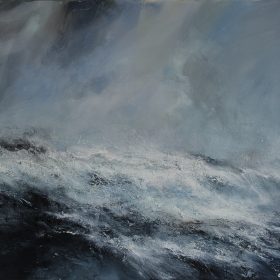
Janette Kerr’s work captures the shifting, transitory nature of the sea and weather. Her paintings are grounded in direct experience, an engagement with the raw, ever-changing forces of nature. Kerr studied fine art (completing a PhD in Fine Art at the University of the West of England in 2005) during which she deepened her thinking around the making of work in extreme and mutable landscapes. She also taught fulltime as a lecturer in painting, printmaking and drawing at the City of Bath College from 1980 to 1993, which helped shape her commitment to process, pedagogy and the dialogue between observation and material. Over the years, Kerr has held roles of institutional leadership (including serving as President of the Royal West of England Academy between 2011-2016) and she remains an Honorary Academician of the RSA, Edinburgh. Described by Brian Fallon, Chief Critic of the Irish Times, as ‘the best painter of the sea in these islands,’ Kerr has long been drawn to the edges of land and sea, to exposed headlands and wind-swept waters. Her process reflects this: My process of making paintings involves extremes and instabilities: peripheries and promontories – places of rapid change and shifts, both physically and meteorologically. Over the past fifteen years Kerr has focused primarily on Shetland and the far north, travelling to remote and weatherworn places including Norway, Svalbard, Iceland and Greenland. Immersion is central to her practice: walking, observing, and making work en plein air as a way of understanding and responding to landscape before returning to the studio.

Janette Kerr divides her time between Shetland and Somerset. She exhibits regularly across the UK, and her work is represented in private and public collections nationally and internationally.

My paintings emerge from responses to sound and silence within the landscape; they explore movement and the rhythms of sea and wind, swelling and breaking waves, the merging of spray with air, advancing rain and mist, glancing sunlight – elements that seem to touch on something intangible.

I have tried to embed myself within the landscape and culture of Shetland, exploring its historical relationship with the sea – through its fishing traditions, stories and lived realities – and to engage with oceanographic ideas through conversations with Norwegian scientists studying the unpredictable nature of waves and wind across shared waters. The landscapes I draw from are full of histories and memories, of people and natural forces, reflecting a continual mutability of place.

About Diana Leslie

Diana Leslie
Born: 1971
Place of Birth: Orkney

Diana Leslie, born in 1971 in Orkney, is an artist whose practice encompasses painting, printmaking and drawing. After completing her studies at the Glasgow School of Art, she continued to refine her skills at The Prince’s Drawing School in London before returning to her native Orkney in 2006 to establish her studio in Stromness. The landscapes, light and weather of the islands have remained her enduring source of inspiration.

Her work is rooted in observation and she often paints outside, responding directly to the conditions of wind and shifting light. These elemental forces animate her compositions, bringing to her paintings an immediacy and vitality that reflect the unique character of the islands. Her imagery often includes local flowers, gardens, townscapes and shorelines, revealing both the human presence within the landscape and the artist’s personal connection to it.

Leslie explores how painting can capture energy and spirit, translating the fleeting qualities of light, motion and atmosphere into enduring images that reflect both place and presence.

I was born in Orkney. I went to the Glasgow School of Art and graduated in Drawing and Painting in 1998. My second subject was printmaking. Orkney stayed with me while I wasn’t here. So I came back in 2006 to live and work as an artist. Landscape has become a big subject for me. I paint Orkney outside. The wind and dynamic light are energies which make me happy; they fly by while the mass is going nowhere. I move between source material depending on the weather, painting flowers, drawing from other artists, drawing from collaborations which make me see things differently. I’m content with the idea that if I represent my here and now it has some currency. And painting has a magical property. It can hold on to energy and strange things like freedom, even when the artist is long gone.


Photograph by Paul Joos

About Bet Low

Bet Low
Born: 1924
Died: 2007

Bet Low was a painter best known for her deceptively simple watercolours of Scottish landscapes. She also produced expressionist drawings of post-war Glasgow, portraits, atmospheric oil paintings and, later, finely detailed and haunting pencil drawings.

Born in Gourock, she developed an early love for landscape and the sea. At Greenock Academy, she showed talent in both art and music, winning the Rankin Art Prize. In 1942, she entered the Glasgow School of Art, where one of her tutors was David Donaldson, later the Queen’s Limner in Scotland. Among her friends were Benno Schotz, Joan Eardley, Stanley Baxter, Jack Gerson and Ian Hamilton Finlay.

After art school, she spent three months at Hospitalfield, Arbroath, under the guidance of James Cowie, who encouraged her interest in literature, drama, poetry, politics and philosophy an intellectual curiosity that remained with her throughout her life. Low briefly attended teacher training college at Jordanhill but found the experience uninspiring. A chance encounter with Stanley Baxter led her to Glasgow’s newly formed Unity Theatre, where she became involved with rehearsals and never returned to teaching. Unity Theatre shared a building with the Refugee Centre, and Low thrived in its cosmopolitan atmosphere, surrounded by actors, writers, folk singers and artists.

Living in a cold room on Sauchiehall Street, she supported herself through odd jobs at Unity Theatre and illustration work for periodicals, while painting portraits of actors and stage crew. In 1946, she joined the Clyde Group of Writers and Artists, whose manifesto was to take art to the people. She helped to organise exhibitions and poetry readings across Glasgow and produced evocative street drawings that now serve as a historical record of the time.

Low exhibited with the Society of Scottish Independent Artists, had paintings accepted by the Royal Glasgow Institute, and took part in shows at the New Art Club, founded by J. D. Fergusson and Margaret Morris. They became friends and mentors, supporting her and other independent artists. In 1956, she joined them in organising the first open-air exhibitions on the railings of Glasgow’s Botanic Gardens.

Low joined the Glasgow Group Society in the mid-1960s and exhibited regularly with them. In 1985, the Third Eye Centre, Glasgow, held a major retrospective exhibition of her work.

Edited extract from Bet Low’s Obituary, The Herald, 2007.

From the late 1960s, Bet Low’s connection with Orkney became central to her life and work. In 1967, she and her husband, the journalist Tom Macdonald, bought a small cottage at Lyness on the island of Hoy. Although she continued to live and work in Glasgow, the landscape of Hoy, with its vast horizons and ever-shifting light, came to define much of her later painting.

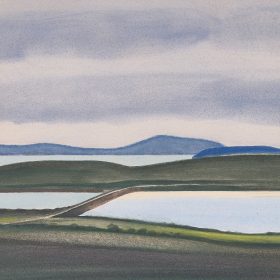
In Orkney, Low’s style evolved towards a language of quiet reduction and poetic clarity. The complex, urban expressionism of her early Glasgow work gave way to a restrained, contemplative approach in which land, sea and sky were distilled into broad tonal fields and simple geometric divisions. The Orkney paintings, often made from sketches and notes developed later in her studio, convey a deep sense of stillness and space.

Her island works reflect an intuitive understanding of the northern light, luminous, spare and at times austere and an emotional connection to place that transcends literal description. Critics have observed that in these works Low achieved a balance between abstraction and observation, creating landscapes that are both profoundly personal and universally resonant.

She spent many summers on Hoy, where her friendship with the poet George Mackay Brown led to a collaborative poster poem: Orkney, the Whale Islands. The Orkney period marked a culmination of her lifelong engagement with landscape, culminating in paintings that remain among the most meditative and distinctive in modern Scottish art.

Her work is widely collected with twelve examples in public collections.
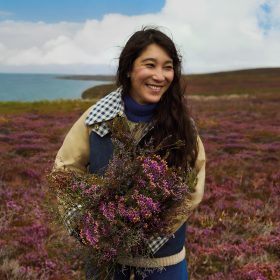
About Alex Malcolmson

Alex Malcolmson
Born: 1955

Alex Malcolmson was born in Shetland in 1955 and studied at Edinburgh College of Art. Over the years, he has worked as a teacher, curator, and gallery owner, and now focuses on exhibiting his work across the UK, from Shetland to Cornwall. His box constructions and sculptures are frequently inspired by the Northern Isles, particularly the birds, the sea, and maritime history. Alongside fine art influences, he is drawn to folk art, including ship dioramas and bird decoys, and often uses found materials in his work.

I grew up in Shetland before the discovery of North Sea oil, at a time when traditional ways of life – crofting, fishing, and seafaring – had remained largely unchanged for generations. Like many Shetlanders, my family came from this background. I was raised in Lerwick, close to the harbour and the constant comings and goings of boats, but I spent as much time as possible with relatives on a croft.

Summer holidays were spent cutting peats, working with sheep, tarring the roof, and making hay. On a croft, very little was wasted, repairing and repurposing materials was a normal part of life. Although in the 1950s and 60s this might not have been so critical, within living memory it had been necessary for survival. That ethic of making do, of finding value in the worn and weathered was ingrained in most Shetlanders, particularly those, like my parents, who grew up on a croft and although much diluted I still carry that sensibility with me to this day.

About Richard Rowland

Richard Rowland
Born: 1944

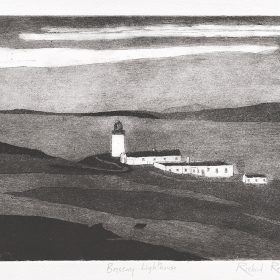
Richard Rowland has worked from his studio on the Westside of Shetland since 1998. He trained in London at the Sir John Cass Art School and the Camden Institute, choosing to specialise in etching in 1986. Since then, he has exhibited regularly in London and Shetland.

Richard works with traditional techniques and materials first used by Rembrandt in the 17th century, enhanced by aquatint, a process later developed to create tone. He works predominantly in monotone, though some recent prints explore the challenge of colour.

His etchings are deeply rooted in the landscape and light of the islands he calls home. The weathered textures, elemental forms, and shifting light of Shetland’s coastline are reflected in his finely balanced compositions. Over the years, the islands’ atmosphere and heritage have become central to his subject matter, inspiring works that balance precision, patience, and sensitivity to place.

It is this shared dedication to material authenticity, place, and process which forms the essence of Richard Rowland’s artistic vision. His work celebrates the craft traditions of Shetland through a medium that demands patience, precision, and a deep engagement with the natural world.

About Ron Sandford

Ron Sandford
ARCE, RDI
Born: 1937
Place of Birth: Greenock

Born in Greenock, Ron Sandford studied at Glasgow School of Art in the late 1950s before continuing at the Royal College of Art, London, specialising in graphics. Renowned for his highly detailed architectural drawings, he worked with leading architects, including Norman Foster, on major commissions such as the Broadgate Centre and Thames Millennium Bridge. His career later took him to Hong Kong before he settled in Yell, Shetland, in 2002 with his wife, illustrator Meilo So. There, he immersed himself in documenting the landscape, people, and maritime traditions.

Ron Sandford draws with unwavering discipline – every single day – as he has done for most of his life. It’s not just a routine, but a way of seeing, of being present, of understanding and honouring the world around him. His presence in Shetland – like his practice – is generous, thoughtful, and quietly profound. This is a celebration of a lifetime of drawing, of looking, of giving shape to the spirit of places we might otherwise never have seen.

About Sigurd Smith

Sigurd Smith
Born: 1991
Place of Birth: Orkney

Sigurd Smith is an artist who was born and currently resides in the Orkney Islands. Sigurd graduated from the Orkney College UHI in 2014 with a BA in Fine Arts and Textiles and since then has been involved in various cultural efforts in Orkney, from contributing to the digitisation of the Gunnie Moberg Archive collection to co-founding the Móti Collective with other Orkney-based art graduates.

Sigurd’s work grows from his inspiration and recollection of the Islands of Orkney and its surrounding landscapes. Capturing his own portrayal on its ever changing elements, landmasses and moody atmosphere through his own personal narrative.

His works as of late have steered towards using a limited palette with metallics with emphasis on using a mixture of different techniques from drawing, painting and printing.

About Patricia Shone

Patricia Shone
Born: 1962
Place of Birth: Greenock

Patricia Shone (b.1962, Greenock) was born in Scotland but grew up in South Devon. After studying ceramics in London, a love of food led her to work as a chef both in London and in Italy, eventually leading her to the Sleat Peninsula on Skye where she returned to potting and where she has remained for over twenty years.

Like artists from Orkney and Shetland, her practice is deeply shaped by the landscape around her. Her work evolves from a strong sense of connection to the land, its people, and the traces they leave across it. Shone’s work is hand formed from solid pieces of clay. Texture and how something feels in the hand is primary; clay is a physical connection with the world, and a visceral process trying to reveal the inexpressible. The mineral nature of clay reflecting the formation and weathering of land as well as the passage of humans across the surface. Her work is grounded by the controlled forms of functional vessels, liberated from those constraints by broken, textured surfaces. Referencing the land, climate and communities of the Highlands, her work seeks to express tension and balance between the container and its contents.

My work is informed by the powerful landscape around me on the Isle of Skye. It develops in response to the feeling of connection with its inhabitants and their passage across the land. By walking the paths of predecessors I contribute to the formation of the paths at the same time as obliterating previous footsteps; as an incomer to this community I absorb and am changed by its culture whilst altering it by my presence here. The nuances of contradiction in the human experience of life are very visible here, but the community survives, just as the surfaces of the land are eroded but the substance of it remains constant and immutable.

I make mostly functional forms, boxes, bowls, jars, rather than direct representation of the landscape, because they are innately human vessels; they represent the human condition of surface and content. The natural textures produced by clay reflect the formation and erosion in the geology of the land. The techniques I use to make my pots encourage the development of these textures on the surface of a tight and formal vessel. It has taken many years for me to begin to understand this path in my work, and that our scars from living can be seen mirrored in the scars on the land. The pieces are made by hand building and throwing, texturing, stretching and carving. Colours are achieved using slips, oxides and glazes but most of all by the firing processes. I use raku firing for soft earthenware blacks and greys; wood firing for warm earth tones and glazed stoneware; saggar firing within the wood kiln for dark greys and glazed stoneware. This gives me a wide range of textures and densities of ceramic surface and body. – Patricia Shone

About Frances Walker

Frances Walker
CBE, RSA, RSW
Born: 1930
Place of Birth: Kirkcaldy

Frances Walker is renowned for her lifelong engagement with remote and elemental landscapes. Born in Kirkcaldy, she studied at Edinburgh College of Art before taking up a post as visiting teacher of art across the Hebrides. Living and working amongst the islands of Harris and North Uist instilled in Walker a profound connection to wild and desolate places, shaping the course of an extraordinary career devoted to the observation of landscape, weather and the passage of time.

Since those formative years in the Western Isles, Walker has continually sought out some of the most remote environments in Scotland and beyond. Coastal reaches, tidal sands, craggy cliffs, sea-worn rocks and vast open skies recur throughout her paintings, drawings and prints. Her work is distinguished by an exceptional sensitivity to atmosphere and geology, balancing close observation with a deeply emotional response to place. Whether working in watercolour, oil, pastel, gouache or printmaking, Walker captures not only the appearance of landscape but its physical and psychological presence.

After moving to Aberdeen, where she has now lived and worked for more than sixty years, Walker joined the staff of Gray’s School of Art, becoming an influential teacher to generations of Scottish artists. Following her retirement in 1985, she devoted herself fully to her practice, dividing her time between Aberdeen and the Hebrides, particularly Tiree, where her thatched cottage became a long-standing base for painting and drawing expeditions.

Travel has remained central to Walker’s artistic life. Alongside her enduring engagement with Scotland’s islands, she has worked extensively in Iceland, Greenland, Norway, the Canadian Arctic, South Georgia and Antarctica. These journeys have expanded her exploration of extreme and fragile environments, resulting in powerful bodies of work shaped by direct experience of ice, weather and isolation. A major suite of Antarctic paintings was recently bequeathed to The McManus: Dundee’s Art Gallery & Museum and featured in the major exhibition Among the Polar Ice (2019–2020), affirming Walker’s importance as one of Britain’s foremost interpreters of remote landscape.

Printmaking has also played a vital role throughout her career. Walker was a founding member of Peacock Printmakers in Aberdeen, helping to establish one of Scotland’s most important print studios, and her etchings, lithographs and screenprints remain an integral part of her practice. Across all media, drawing sits at the heart of her work, her sketchbooks recording decades of sustained looking and attentive engagement with the natural world.

Walker’s remarkable contribution to British art has been recognised through numerous honours and public collections. Her work is held by the Tate, the British Museum, the National Galleries of Scotland, the Victoria & Albert Museum and many other major institutions. In 2021 she was appointed CBE in the Queen’s Birthday Honours for services to art.
To view prints by this artist please click here.

Photograph by John Cumming

About Sylvia Wishart

Sylvia Wishart
RSA
Born: 1936
Place of Birth: Stromness
Died: 2008

Among the artists who shaped twentieth century Scottish art, Sylvia Wishart holds a distinct and enduring position. Her work is inseparable from the Orkney landscape that defined her life and imagination. At a time when many of her contemporaries sought recognition in mainland Scotland or abroad, Wishart remained rooted in Orkney, painting what she knew with a rare and unhurried intimacy. The result is a body of work that stands quietly apart, meditative, luminous and profoundly local, yet resonant far beyond Orkney’s shores.

Born in Stromness in 1936, Wishart attended Stromness Academy, where she was taught by Ian MacInnes, and was encouraged by both him and Stanley Cursiter, the Orcadian painter and former Director of the National Galleries of Scotland, to pursue her artistic talent further. She enrolled at Gray’s School of Art in Aberdeen in 1955. Following postgraduate study, Wishart spent several years teaching art in Orkney, Aberdeenshire and Lewis, before returning to Gray’s as a lecturer. She taught there for almost two decades, dividing her time between the art school and the Orkney landscape that continued to draw her back. During this period, she produced a series of finely observed drawings of the islands for J. & W. Tait Ltd., later published as Orkney Drawings 1968–1977. These works, depicting lighthouses, crofts and harbours, reflect her precision of line and the affectionate observation that marks all her art.

Her friendship with the poet George Mackay Brown was both personal and creatively formative. The two shared a deep connection to Orkney’s landscape, language and history. Through Brown, Wishart encountered a poetic vision of place that affirmed her own instincts, that the landscape and everyday life could open onto the universal. Their conversations on faith, art and daily life in Stromness shaped her sense of purpose.

Wishart’s art is often described in relation to two homes: the house in Stromness that overlooked Hoy Sound, and The North House in Rackwick, Hoy, which she bought and restored in the late 1960s. Each was both a vantage point and a refuge, offering different kinds of solitude and light. In Stromness she painted the harbour, the windows of houses along the pier, and the calm or turbulent sea. In Hoy she found a wilder grandeur, the cliffs, sea spray, and the austere croft at the edge of the land. The paintings made at Rackwick capture the elemental force of the place: weathered stone walls, the shifting greys of sea and cloud, and the warm glow of a lamp against the windowpane.

Wishart’s art offers a vision of the world in which observation and emotion are inseparable. Her paintings hold a deep respect for the physical facts of landscape, stone, water and weather, but they also speak of human presence: of seeing, remembering and belonging. In both Stromness and Hoy she found not only subjects to paint, but the conditions of a life in which art and place became one. Today, her work stands as a testament to the power of attention, to an art that grows out of looking long and lovingly at what is near at hand. In the stillness of her interiors and the soft gleam of her horizons, Sylvia Wishart gave enduring form to the spirit of the islands she called home.

We are currently looking for work by Sylvia Wishart, if you have any works you are interested in selling please contact The Gallery.

Photograph by Keith Allardyce
Gift Card

Struggling to find that perfect gift? We have the solution! A Scottish Gallery Gift Voucher is the perfect gift for friends, family, customers and colleagues.

Own Art

Own Art is a national initiative that makes buying contemporary art and craft affordable by providing interest-free credit for the purchase of original work.


Join our mailing list

Sign up to receive the latest art news from The Scottish Gallery including forthcoming exhibitions, films, podcasts, blogs, events and more.