Aleksander Żyw was one of the most important émigré painters to settle in Scotland during the twentieth century, bringing to post-war Scottish art a distinctive European modernism shaped by war, exile and a lifelong engagement with the Mediterranean world. Born in Lida, Poland, in 1905, he moved to Warsaw as a child and enrolled at the Warsaw School of Fine Arts in 1926, where he received a rigorous academic training grounded in drawing and traditional painting techniques.
A travel bursary awarded in the 1930s transformed the direction of his life and work. Extensive journeys through southern Europe, particularly along the Mediterranean coast, awakened an enduring fascination with colour, light and landscape. By 1934 Żyw had settled in Paris, where he absorbed the influence of Impressionism and the wider currents of European modernism while establishing his own studio practice.
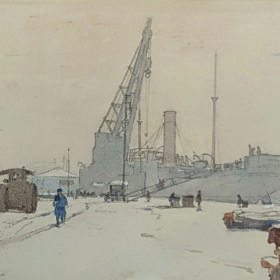
The outbreak of the Second World War dramatically interrupted this promising early career. Stranded in Corsica when war was declared, Żyw returned to mainland France to enlist in the re-forming Polish Army under General Sikorski. Following the collapse of France, he escaped through Spain and Portugal before eventually arriving in Scotland, where Polish forces regrouped during the war years. Appointed an official war artist, he produced powerful sketches and drawings documenting military life, naval convoys, bomber stations and wartime Edinburgh. These works remain among the most compelling artistic records of the Polish wartime experience in Britain.
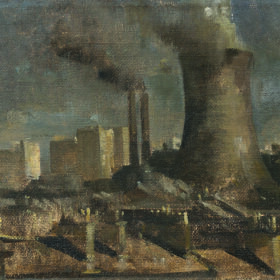
The war proved a decisive catalyst in Żyw’s artistic development. The discipline of continual sketching and direct observation enabled him to move beyond naturalism towards a more subjective and emotionally charged visual language. By the late 1940s and 1950s, his paintings had evolved into richly textured compositions in which figuration, symbolism and abstraction coexist. Works such as Neptune’s Court, Dark Halo and Red Still Life reveal an artist deeply engaged with colour, structure and the expressive possibilities of paint itself.
After the war, Żyw married a Scot and settled in Edinburgh, where he became an influential presence within the city’s artistic life for more than two decades. During this period, he exhibited regularly with The Scottish Gallery, which held his first one-man exhibition in 1945 and continued to champion his work throughout his career. His relationship with The Gallery formed a central part of his Scottish legacy, introducing audiences to a painter whose outlook remained profoundly international while contributing significantly to the development of post-war Scottish modernism.
The Scottish Gallery continued to celebrate Żyw’s achievement through important later exhibitions, including Aleksander Żyw (1905–1995): Paintings and Drawings in 2012 and Before & After in November 2020. His work was also the subject of major retrospectives organised by the Scottish Arts Council in 1972 and the Scottish National Gallery of Modern Art in 1986.
In the 1970s Żyw moved permanently to Tuscany, where he and his wife established an olive farm near Castagneto Carducci. The final decades of his career saw another transformation in his work, as he developed luminous, semi-abstract paintings rooted in close observation of the natural world. Though increasingly abstract in appearance, these late paintings were grounded in an intense study of landscape, light and organic form. He continued to paint until his death in Tuscany in 1995.
Today Aleksander Żyw is recognised as a singular figure within twentieth-century European and Scottish art: a painter whose work bridged cultures, histories and artistic traditions, and whose remarkable career was profoundly shaped by exile, resilience and reinvention.