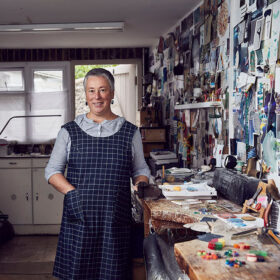
Various Artists

Chain Reaction

6 September 2017 - 30 September 2017

About Jane Adam

Jane Adam
Born: 1954
Place of Birth: London

Jane Adam is a leading British contemporary jeweller, who has an international reputation for her work in aluminium, a field in which she revolutionised contemporary practice and gained many significant awards. Her work in fine metals is gaining her even greater recognition.

‘I experiment with materials to explore their inherent qualities. Rather than imposing my own preconceptions upon them, I then set out conditions in which they will behave in a certain way. This approach gives my work a quality that relates to natural forms and to the way they change and grow. I aim to create pieces that extend traditional jewellery values: beauty, femininity and preciousness. My work explores female sensuality, both in the nature of the forms themselves and in the way they feel when worn. By becoming part of the wearer’s experience and expression of her self, my jewellery is transformed and completed.’ – Jane Adam, 2016.

Public collections include: The Goldsmiths’ Company, London; Victoria & Albert Museum, London

Jane Adam was the subject of solo exhibitions: Beyond The Surface during the Edinburgh International Festival in August 2013, and Duality in May 2018.

About An Alleweireldt

Born in Belgium, An Alleweireldt trained as a product designer and jeweller in Antwerp, before crossing the channel to London. An furthered her studies at the Royal College of Art, winning the prestigious Armourers and Braziers Prize for Innovative Work.

Selling through her own brand, Oxx Jewellery London, An combines traditional metals with more surprising materials – such as LP vinyl inserts.

Born: 1974
Place of Birth: Ostend, Belgium

About Malcolm Appleby

Malcolm Appleby
MBE
Born: 1946
Place of Birth: West Wickham, London

Malcolm Appleby (b.1946, London) is one of Britain’s most distinguished silversmiths and engravers, celebrated for his inventive approach to line, form and surface. He studied at the Central School of Art, Sir John Cass School of Art, and the Royal College of Art in London before establishing his studio in Scotland in 1969, where he continues to work.

Renowned for pushing the expressive possibilities of metal, Appleby has built a career defined by technical mastery and restless experimentation. While best known for his engraving, his practice spans silver, gold and mixed materials, approached with the same curiosity and precision. As he has remarked, gold is simply “another lovely material to work with.”

I’m passionate about the amount of energy and power that springs from the ancient craft of engraving. Works of art should be made for everyone to enjoy. Engraving is central to my design and art; it is from engraving that my other skills have evolved. – Malcolm Appleby

The Scottish Gallery has worked closely with Malcolm Appleby since the 1970s, presenting the breadth and evolution of his practice over several decades. Each work reflects a deeply personal visual language, inviting collectors into an ongoing journey of discovery with a major figure in contemporary metalwork.

In January 2016, the Gallery celebrated Appleby’s seventieth birthday, marking more than fifty years of remarkable creative achievement. In recognition of his outstanding contribution to the arts, he was awarded an MBE in 2014. In 2026, The Gallery is celebrating Malcolm’s 80th year with a major solo exhibition in September 2026.

Public Collections include: Victoria & Albert Museum, London; The Goldsmiths’ Company, London; the British Museum, London; the Royal Armouries, Tower of London; the Ashmolean Museum, Oxford; Aberdeen Art Gallery & Museums; the Fitzwilliam Museum, Cambridge; National Museums Scotland, Edinburgh; and Perth Museum & Art Gallery.

Photograph by Philippa Swann

About Michael Becker

Michael Becker
Born: 1958
Place of Birth: Paderborn, Germany

Michael Becker (b.1958, Paderborn, Germany) is internationally recognised as one of the most refined and intellectually rigorous jewellery artists working today. Renowned for his masterful use of gold, Becker creates exquisitely composed works that balance geometry, texture and colour with remarkable subtlety and restraint.

His jewellery possesses an extraordinary stillness and precision, revealing a deep understanding of both material and form.

Working predominantly in high-carat gold, Becker combines precious metals with carefully selected materials including lapis lazuli, uvarovite garnet, silver and intensely coloured mineral pigments. Through these combinations he creates works that feel simultaneously ancient and contemporary, drawing on the timeless language of ornament while stripping forms back to their essential elements. Surface plays a central role within his practice. Matte gold, finely textured planes and areas of saturated colour interact delicately with light, creating pieces that reward close and prolonged looking.

Becker’s jewellery is often architectural in structure, composed through quiet geometric relationships and subtle asymmetries. Despite their small scale, the works possess a sculptural presence and emotional weight that extends far beyond adornment. There is a contemplative quality to his practice, where every material decision appears deeply considered and nothing unnecessary remains. His use of gold is particularly distinctive, not as a symbol of opulence, but as a material of warmth, depth and history.

A graduate of the Fachhochschule Cologne, Becker belongs to a generation of German makers who transformed contemporary jewellery through conceptual clarity and exceptional craftsmanship. His work demonstrates an ongoing dialogue between modernist reduction, ancient artefacts and the tactile intimacy of wearable objects.

Michael Becker’s jewellery is held in major international museum collections including the Victoria & Albert Museum, London; Schmuckmuseum, Pforzheim; Museum of Fine Arts, Houston; Musée des Arts Décoratifs, Paris; Musée des arts décoratifs de Montréal; Museum für Kunst und Gewerbe, Hamburg; and the Cooper Hewitt, Smithsonian Design Museum, New York.

About Elizabeth Jane Campbell

Elizabeth Jane Campbell
Born: 1989
Place of Birth: Scotland

Elizabeth Jane Campbell graduated from Edinburgh College of Art in 2013, and then spent a year as Artist in Residence at Glasgow School of Art before establishing her own studio in Edinburgh. Elizabeth’s award winning jewellery has been exhibited across the UK and abroad – most recently in Milan, Munich and America.

‘My recent work explores the connection between colour and shape – taking inspiration from colour theory, colour connotations and visual literacy. Using vitreous enamel enables me to achieve fantastic colours which I contrast with simple oxidised silver settings. The surface finish of the enamel is really important, as a gloss or matt finish can really change the quality of the enamel colour. Each piece is hand finished to highlight the vibrancy of the colour.’

Permanent collections include:
The National Museum of Scotland, Edinburgh; The Goldsmiths’ Company, London

Elizabeth was the subject of a solo exhibition in March 2020 – Colour Connections. Read our blog for an insight into her studio and the inspiration behind her work.

About Grace Girvan

Grace Girvan
Born: 1981
Place of Birth: Orkney

The unique landscape of the Orkney Islands provides inspiration for Grace Girvan’s jewellery. She enjoys beach combing and uses the objects that she unearths on her expeditions in her work, combining found objects such as pebbles, driftwood and shell with precious metal and enamel.

Her work is evocative of her inspiration, through a restrained colour palette of soft greys, blues, greens and browns she conveys the washed out, sun bleached colours of the sea and shore.

Public Collections include:
Aberdeen Art Gallery and Museums, Aberdeen

I grew up on South Ronaldsay, the southernmost island in Orkney that is connected to the mainland by the Churchill Barriers. My childhood was spent on a farm, surrounded by open space and the outdoors. My grandparents lived very close by, and if there weren’t cattle in the fields, we would head straight across to visit them. Otherwise, we would take the road, which passed by the beach. That beach became an important place for us; we would often go there to search for Groatie Buckies (arctic cowries), smooth pebbles, and to watch the curious seals basking on the rocks. When I return to Orkney now, what strikes me most is the vastness of the sky. The land is relatively flat and there are very few trees, so the sky feels endless. The special quality of the light, combined with that great sense of space, is something I treasure deeply. The beach I most often return to is Chapel Point, the same one we used to visit on the way to my grandparents’ house. The pebbles there are perfectly formed, flat, smooth, and need no cutting, polishing, or shaping. I use them exactly as I find them, in their natural state.
In my work, I aim to translate the colours, light, and calmness of Orkney into jewellery. I use transparent enamels in soft blues, greens, and greys on silver. The silver beneath creates a luminous glow through the enamel, echoing Orkney’s unique light. By matting the surface of the enamel, the colours take on a watercolour-like softness, reminiscent of the landscapes I love. The pebbles themselves are always left unaltered, flat, smooth, and with naturally regular edges. I feel it is more honest to use them exactly as they are. Recently, I have been embracing their variety, celebrating the different hues and textures that reflect Orkney’s rich geology.

When I am in Orkney now, I am more intentional. I try to slow down, to absorb the landscape, the light, and the colours that inspire me. I take photographs, I collect pebbles, and I let those experiences feed into my designs. Collecting pebbles has also become a family ritual. My parents often join me, and they have an excellent eye for the shapes I am looking for. When I work with certain pebbles, I remember who picked them up, or I recall the exact beach where I found them. That connection to my family, to place, and to memory feels as important as the physical material itself. I am still excited every time I find a new pebble; their beauty never ceases to amaze me. Some of my favourite places to collect include the beach at Chapel Point, Newark or Dingieshowe in Deerness, and the beach at the fourth Churchill Barrier on South Ronaldsay. Each of these places holds its own sense of discovery and connection to home.

About Lucie Gledhill

Lucie Gledhill originally studied at the Royal College of Art and is based in London where she works with predominantly with wire in various precious metals. She often uses the finest available grade and favours techniques such as weaving wire and making chain; both repetitive processes that allow her to fully understand and explore her materials.

‘Over time I have built up a relationship with the materials I work with. This means I can predict what they will do, how they will move. I can push them to their limits. I deliberately use a low-tech approach to making. There is a sensitivity toward the detail in things.’

Born: 1983
Place of Birth: London

About Simon Harrison

Simon Harrison

Since the late 1970s Simon Harrison and his team of designers and craftsmen have made jewellery for some of the most iconic names in fashion, making jewellery and fashion accessories for the designers of the time; Jean Muir, Zandra Rhodes, Bill Gibb, Bruce Oldfield and others. Simon regards Jean Muir as an important mentor who influenced the development of his philosophy of design. ‘She was relentless in negotiating the tiniest detail if she felt it would lead to a technical or aesthetic improvement. I learned that the commercial content of design is critical and must be in balance with the technical and aesthetic content.’

During the 1980s, Simon lectured part-time in jewellery design at the Sir John Cass School of Art in London and worked as a visiting lecturer at a number of colleges and universities in the UK. He then worked as an international product development co-ordinator for Swarovski, before focusing on making fashion jewellery. In the early 1990s he designed customised fashion jewellery ranges for Corocraft, Wedgwood and the famous London store Liberty.

With a body of work which captures pioneering moments in contemporary style, Simon’s team have helped costume jewellery to become the vibrant category it is today. In his Central London studio, he heads up a creative team of highly skilled designers and craftsmen who produce pieces of jewellery with exquisite attention to detail. Simon believes that jewellery should be life-enhancing and an expression of personalty.

About Dominika Kupcova

Dominika Kupcova
Born: 1994
Place of Birth: Slovakia

Dominika Kupcova is a recent graduate of the Glasgow School of Art Silversmithing and Jewellery department, graduating in 2017. As a jewellery designer and maker she aims to create complex, eye-catching structures with an element of optical illusion, carefully constructed using repeated layers of linear pattern. The work is informed by the aesthetic properties of the DNA double helix and DNA testing outcome; inspiration generated through an interest in science and genetics since childhood. A fascination with the intricacies of human genetic make-up, uniformly structured yet individual, is echoed in the unique hand crafted pieces. Complex and detailed drawing as the primary research technique informs the three dimensional structures of the wearable objects. Dominika’s work is created using a combination of hand and manufacturing processes – time-consuming and repetitive skills of metal work and hand cutting paper alongside quicker, modern techniques such as laser cutting. The resulting body of work seamlessly combines precious metals with non-precious materials of paper and card, which are manipulated and transformed through a variety of processes into a material which is flexible and durable. Most recently Dominika won the 2017 Goldsmith’s Company Precious Metal Bursary Award.

About Ruth Leslie

Ruth Leslie
Born: 1993
Place of Birth: Edinburgh

Ruth Leslie (b.1993, Edinburgh) is one of the most exciting voices in contemporary Scottish jewellery, celebrated for work that combines sculptural elegance, technical precision and a distinctive sense of playfulness. Since establishing her practice in 2016, Leslie has developed an instantly recognisable visual language built around finely twisted wire structures and refined architectural forms.

Working predominantly in recycled silver and gold from her Edinburgh studio, she creates jewellery that is both delicately engineered and deeply tactile, balancing movement, rhythm and lightness with exceptional craftsmanship.

Textiles and textile machinery lie at the heart of Leslie’s practice. Inspired equally by the subtle details of woven fabrics and the intricate mechanics hidden within looms and industrial machinery, she transforms fine strands of precious metal into sculptural constructions that appear almost suspended in space. Using an old-fashioned hand drill, Leslie painstakingly twists wire before cutting, shaping and wrapping it around precisely constructed frames. This labour-intensive process creates her signature linear surfaces, where tiny repeated elements catch the light and generate a remarkable sense of texture and movement.

What distinguishes Leslie’s work is the way it merges engineering with softness. Her jewellery possesses an architectural clarity, yet never feels rigid or static. Earrings sway like kinetic structures, rings and necklaces curve fluidly around the body, and the intricate wirework introduces an almost textile-like sensitivity to each piece. Despite the complexity of their construction, the works retain an effortless elegance and wearability, revealing a maker with an exceptional understanding of balance, proportion and material.

Leslie’s collections are characterised by clean, contemporary forms that transcend seasonal trends, combining bold sculptural presence with quiet refinement. There is also an inherent joy within the work. The repeated twists, loops and rhythmic structures create jewellery that feels energetic and alive, inviting both movement and close looking.

Over the past decade, Ruth Leslie has established a significant and highly respected relationship with The Scottish Gallery, becoming one of the defining emerging jewellery voices associated with the Gallery’s contemporary programme. In June 2026, The Scottish Gallery will present a major solo exhibition celebrating ten years of exhibiting with the Gallery, marking an important milestone in Leslie’s evolving career and recognising the strength, originality and growing maturity of her practice.

Photograph by Nico Utuk

About Ann Little

Ann Little
Born: 1973

Ann Little graduated from Edinburgh College of Art in 1996.

“Most of my jewellery incorporates slate or enamel. When I first set up in business I concentrated on hand cutting and filing slate, sometimes inlaying silver and mother-of-pearl. With the purchase of a kiln for enamelling, I began to introduce colour combining enamel with slate, making many pieces reversible to give the wearer a choice of colour. I use enamel powder dry, sprinkling on thin layers of colour, sometimes drawing into the powder enamel or rubbing it back once fired to reveal colours underneath. I also enamel on thin copper shim overheating the enamel to make it burn away from the raised marks that are scored into the metal. My latest work now involves simple, bold shapes.” – Ann Little

Public Collections include:

Aberdeen Art Gallery and Museum; National Museums Scotland, Edinburgh

About Jenny Llewellyn

Jenny Llewellyn is an award winning, contemporary jewellery designer-maker based in London. Originally studying at Leeds College of Art & Design (2003-2004), Jenny then specialised in Jewellery at Middlesex University (2004-2007). Inspired by the luminous colours, shapes and movement of underwater life, Jenny’s work is characterised by handcrafted, organic forms of precious metals combined with vibrant bursts of silicone. Jenny’s practice is driven by experimentation. Experimentation with colour and experimentation with material; combining precious with non-precious to create tactile and fun pieces available in the full spectrum of colours from discreet pops of monochrome to full statement colour-fades. Central to Jenny’s practice is her pioneering use of silicone. Often mistaken for glass or plastic, silicone is surprisingly soft, light and durable, resulting in unique and wearable contemporary jewellery design – a celebration of colour. Jenny exhibits both nationally and internationally and has won numerous awards including the Professional Jeweller Hot 100 in 2014.

About Christa Lühtje

Christa Lühtje was born in Hamburg in 1941. She completed an apprenticeship and then attended the Academy of Visual Arts from 1961 to 1967 in Munich, where she studied with Professor Franz Rickert. The classical harmony, the purity of the forms and the sensitive handling of the materials make it impossible to assign her creations to any specific time or epoch. Christa says making jewellery is her passion. She has won two German state prizes and numerous other commendations, and her artworks are represented in major international collections. Christa regards her work as “the endless attempt to capture traces of life and to find forms and expressions for the jewellery.”

Born: 1941
Place of Birth: Hamburg

About Heather McDermott

Heather McDermott
Born: 1989
Place of Birth: Isle of Skye

Heather McDermott (b.1989, Isle of Skye) is a contemporary jeweller whose bold, sculptural work is deeply rooted in the dramatic coastline and tidal landscape of the Isle of Skye.

After studying Jewellery and Silversmithing at Edinburgh College of Art and completing her MA in 2011, McDermott returned to her home village of Aird on Skye, before settling in Callander, Perthshire.

The Skye coastline acts as both inspiration and material archive. Weathered fragments of rope, driftwood, fishing debris and sea-worn plastics washed ashore by Atlantic tides become starting points for her jewellery, transformed through abstraction into striking contemporary forms. McDermott is fascinated by the way natural forces reshape discarded objects over time, softening edges, fading colours and creating unexpected sculptural beauty through erosion and movement. Her work captures this tension between rawness and refinement, permanence and change. The island’s elemental landscape, exposed coastline and changing weather conditions continue to inform her evolving practice, giving the work an authenticity and immediacy rooted in lived experience. Her jewellery reflects both the beauty and fragility of coastal environments, transforming the language of erosion, tide and debris into powerful contemporary forms.

Working predominantly in silver and incorporating vibrant colour and layered surfaces, McDermott creates jewellery that is unapologetically sculptural in scale and presence. Neckpieces, brooches and earrings unfold like miniature constructions or fragments of weathered coastal architecture, balancing sharp geometry with fluid movement and tactile surfaces. Her compositions often echo tidal patterns, fishing equipment and shifting marine debris, while retaining an elegant contemporary clarity.

What distinguishes McDermott’s practice is her ability to elevate overlooked materials and transient coastal moments into jewellery of remarkable confidence and individuality. Her pieces are expressive and dynamic, designed not simply as adornment but as wearable sculpture that engages actively with the body and space around it. Colour plays an important role within the work, reflecting the constantly changing tones of sea, sky and shoreline under Hebridean light.

About Sheila McDonald

Sheila McDonald was born in Fife and studied Textile Design at Glasgow School of Art, before studying at the Royal College of Art, London. This fascination with textiles is still apparent in her jewellery and silversmithing where she combines precious metals with enamel.

‘Most of my work features transparent enamel on silver, combining bright, rich colour and pattern with fine gold wire and fine gold or silver leaf. I use traditional enamelling techniques such as cloissoné, champlevé and plique-a-jour. I also work in 18ct gold, fabricating small, delicate pieces which incorporate plique-a-jour enamel. My main influences have always been a love of drawing and watercolour painting. I have always had a childlike excitement about colour and drawing ….this has been with me for as long as I can remember.’

Public collections include:
Goldsmiths’ Hall, London; Kelvingrove Museum and Art Gallery, Glasgow; Norwich Castle Museum; Holden Gallery, Manchester; Birmingham City Museum and Art Gallery.

Place of Birth: Crail, Fife

About Grainne Morton

Grainne Morton
Born: 1970
Place of Birth: Lurgan, Northern Ireland

Grainne Morton (b.1970, Lurgan, Northern Ireland) is one of the most distinctive and celebrated jewellers working in Britain today, internationally recognised for jewellery that transforms found objects, antiques and personal ephemera into richly narrative wearable works of art.

Born and raised in Northern Ireland, Morton grew up surrounded by traditional craft, folklore, storytelling and music, influences that continue to permeate her practice with a sense of memory, enchantment and emotional resonance. Her jewellery occupies a unique space where past and present, precious and ordinary, nostalgia and contemporary design coexist in beautifully balanced tension.

Morton moved to Edinburgh in the late 1980s to study at Edinburgh College of Art, a formative period that also sparked her lifelong fascination with collecting. Visits to antique fairs and auctions with her parents, who dealt in antiques in Northern Ireland, became an essential part of her creative education. Buttons, broken jewellery, ribbons, stones, charms, tiny portraits, beads and fragments of forgotten objects gradually formed an ever-growing archive of materials and stories. Over time, these collections became both the inspiration and foundation of her practice.

At the heart of Morton’s work is an instinctive gift for juxtaposition and storytelling. Her pieces are carefully composed assemblages where unrelated objects are choreographed into unexpected and emotionally charged relationships. Vintage trinkets sit alongside semi-precious stones, found objects and handmade elements, creating jewellery that feels deeply personal yet universally evocative. Each work carries traces of memory and history, inviting the viewer to imagine the lives, journeys and meanings embedded within the materials themselves.

Despite the apparent spontaneity of the work, Morton’s compositions are highly sophisticated and finely balanced. Colour, scale, texture and symbolism are orchestrated with remarkable sensitivity, resulting in jewellery that is simultaneously playful, poignant and visually complex. Her pieces often blur the boundaries between jewellery, collage and miniature sculpture, reflecting an artist deeply engaged with narrative, collecting and emotional connection.

Since graduating from Edinburgh College of Art, Grainne Morton has established a long standing relationship with The Scottish Gallery. The Gallery has presented several solo exhibitions of her work and included her in numerous thematic and interdisciplinary exhibitions, recognising her as one of the defining contemporary jewellery voices associated with the Gallery’s programme. Her exhibitions have consistently captivated audiences through their immersive storytelling, vibrant colour and extraordinary sense of imagination.

Morton’s work has been exhibited extensively throughout the UK and internationally and in 2007 she was shortlisted for the prestigious Jerwood Applied Arts Prize. Her jewellery is held in major public collections including National Museums Scotland, Edinburgh; the Crafts Council Collection, London; the Montreal Museum of Fine Arts, Canada; and the Ulster Museum, Belfast.

About Kathie Murphy

Kathie Murphy

Kathie Murphy trained at Middlesex Polytechnic and Glasgow School of Art. She set up her studio in 1992 and specialises in resin jewellery. Inspiration is particularly drawn from the seemingly endless possibilities of colour mixing and colour combinations – each piece has been individually pigmented and then finished by hand which makes the jewellery very tactile.

Kathie is the author of Resin Jewellery and Design and Make Non-Precious Jewellery and her work is in the collections of MIMA, Museum of Scotland and Aberdeen City Art Gallery.

Photograph by Alun Callender

About Joanne Thompson

Joanne Thompson
Born: 1971
Place of Birth: Annan, Dumfries & Galloway

Joanne Thompson (b.1971, Annan, Dumfries & Galloway) is one of Scotland’s most accomplished contemporary jewellers, celebrated for jewellery that combines sculptural presence with extraordinary fluidity, tactility and wearability. Since graduating from Edinburgh College of Art in 1993, Thompson has developed a distinctive and highly recognisable visual language rooted in repetition, movement and meticulous craftsmanship.

She was regarded as one of Dorothy Hogg’s most gifted students, absorbing the discipline, technical rigour and sensitivity to form that characterised Hogg’s celebrated teaching while forging a powerful aesthetic entirely her own.

Following Edinburgh College of Art, Thompson completed an MA in Jewellery at the Royal College of Art, London, in 1995, where she further refined the chain-based constructions that have become central to her practice. Since graduating, The Scottish Gallery has represented Joanne Thompson continuously, supporting and championing her work from the very beginning of her career. Over the past three decades, she has held several important solo exhibitions with the Gallery and remains one of the defining contemporary jewellers associated with its programme.

Thompson’s jewellery is remarkable for the way it transforms hard precious metal into forms of exceptional softness and movement. Drawing inspiration from ancient chain maille techniques, she painstakingly constructs necklaces, bracelets and earrings from thousands of individually formed, soldered and finished silver links. Through subtle variations in scale, density and structure, she creates sculptural works that drape and flow across the body with an almost textile-like fluidity.

Her signature palette of oxidised silver and deep matte black gives the work a quiet drama and sophistication. Despite their visual complexity and sculptural volume, Thompson’s pieces remain astonishingly light, comfortable and durable, designed to move naturally with the wearer. Elegant movement is not incidental but fundamental to the work itself; each piece shifts gently in response to the body, creating constantly changing surfaces and rhythms.

What distinguishes Thompson’s practice is the balance she achieves between technical precision and sensuality. The repetitive process of constructing each individual link becomes almost meditative, resulting in jewellery that carries both structural clarity and emotional intimacy. Her works possess an understated confidence and timelessness, transcending fashion while remaining unmistakably contemporary.

Today, Joanne Thompson is recognised as one of the leading figures in British contemporary jewellery, admired for her mastery of material, her innovative reinterpretation of historical techniques and her enduring commitment to making jewellery that is both sculptural and profoundly wearable.


Gift Card

Struggling to find that perfect gift? We have the solution! A Scottish Gallery Gift Voucher is the perfect gift for friends, family, customers and colleagues.

Own Art

Own Art is a national initiative that makes buying contemporary art and craft affordable by providing interest-free credit for the purchase of original work.


Join our mailing list

Sign up to receive the latest art news from The Scottish Gallery including forthcoming exhibitions, films, podcasts, blogs, events and more.