The Scottish Gallery is proud to celebrate its 175th anniversary in May this year, a continuous period of trade in the art world which marches with the history of Scottish culture. We will be mounting a survey exhibition to coincide with the launch of a special publication which tells the story of our illustrious history and place in the development of Scottish contemporary art.
About William McTaggart

One of Scotland’s most famous landscape painters, William McTaggart’s paintings are typified by loose, energetic brushwork and a deep concern for the effects of light. The Scottish Gallery was McTaggart’s main dealer in his lifetime, selling many of his greatest works to the likes of Robert Wemyss Honeyman and Andrew Carnegie.
About EA Hornel
Shortly after he was born his parents left Australia for Kirkcudbright in Scotland, where he remained for most of his life. He studied for three years at Edinburgh College of Art, and for two years at the Royal Academy of Fine Arts in Antwerp under Professor Verlat. Returning to Scotland in 1885, he met George Henry and associated himself with the Glasgow Boys.
Hornel and Henry collaborated on many projects and in the early 1890’s the two artists spent a year and a half in Japan, where Hornel learned much about decorative design and spacing. Towards the close of the decade, his colours preserving their glow and richness, became more refined and more atmospheric, and his drawing more naturalistic, combining sensuous appeal with emotional and poetic significance. In 1901 he declined election to the Royal Scottish Academy. A member of Glasgow Art Club, Hornel exhibited in the club’s annual exhibitions.
In 1901 he acquired Broughton House, a townhouse and garden in Kirkcudbright, which was his main residence for the rest of his life with his sister Elizabeth. There he made several modifications to the house and designed garden taking inspiration from his travels in Japan. he also made an addition of a gallery for his paintings. On his death the house and library were donated and Broughton House is now administered by the National Trust for Scotland.
About Arthur Melville
Melville who was rightly regarded as the most brilliant watercolourists of his period, developed a stunning and idiosyncratic technique. He attended the RSA schools and from 1878 studied in Paris where he was impressed by the work of the French Realist painters and the Barbizon School. Associated with the Glasgow Boys he was however a restless traveller and soon moved from their Scottish urban and pastoral subjects to more exotic fare from Egypt, Persia and Spain attracted by strong light, brilliant colours, the drama of the bullfight or the bustle of the eastern harbour.
About Victoria Crowe
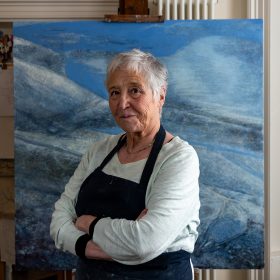
Victoria Crowe studied at Kingston School of Art from 1961-65 and at the Royal College of Art, London, from 1965-68. At her postgraduate show, she was invited by Sir Robin Philipson to teach at Edinburgh College of Art. For thirty years she worked as a part-time lecturer in the School of Drawing and Painting while developing her own artistic practice. She lives and works in West Linton and Edinburgh. Her first one-person exhibition, after leaving the Royal College of Art, was in London and has subsequently held over fifty, one person shows.
Victoria Crowe’s first solo exhibition at The Scottish Gallery was in 1970. In August 2018, The Gallery held a major exhibition of paintings to coincide with The Scottish National Portrait Gallery’s retrospective of Victoria Crowe’s portraits. In 2019 The City Art Centre held a retrospective entitled 50 Years of Painting. This exhibition embraced every aspect of Crowe’s practice and featured over 150 paintings, works on paper and sketchbooks and several films of the artist were commissioned.
Victoria Crowe is a member of the Royal Scottish Academy (RSA) and the Royal Scottish Society of Painters in Watercolours (RSW). Crowe has exhibited nationally and internationally and undertaken many important portrait commissions, including HRH The King, RD Laing, Peter Higgs and Jocelyn Bell Burnell. Crowe’s work is held in numerous public and private collections worldwide.
In 2000, Crowe’s exhibition A Shepherd’s Life, consisting of work selected from the 1970s and 80s, was curated for the National Galleries of Scotland’s to mark the Millennium. The exhibition toured Scotland and was re-gathered in 2009 for the Fleming Collection, London.
Crowe was awarded an OBE for Services to Art in 2004 and from 2004-2007, she was appointed Senior Visiting Scholar at St. Catherine’s College, Cambridge. The resulting work, Plant Memory, was exhibited at the Royal Scottish Academy in 2007 and subsequently toured Scotland. In 2009 she received an Honorary Degree from The University of Aberdeen and in 2010 was elected a Fellow of the Royal Society of Edinburgh.
In 2013, Dovecot Studios wove a large-scale tapestry of Crowe’s painting Large Tree Group. This collaborative tapestry was acquired for the National Museums Scotland. In 2015, Crowe invited as artist-in-residence at Dumfries House and in 2016 a group of work from the residency was acquired by the National Galleries of Scotland. Crowe was commissioned by the Worshipful Company of Leathersellers’ in 2014, to design a forty-metre tapestry for their new hall in the city of London, which took over three years to weave and was installed in January 2017. Dovecot worked with Victoria Crowe to produce a new tapestry inspired by a detail from her painting Twilight, Venice, 2014. The new tapestry, Richer Twilight, Venice was completed and unveiled at the end of September 2019.
Following a residency in Orkney in 2022, the Pier Art Centre in Stromness held a major exhibition of new work, Touching the Surface from August to November 2024, in which she looked specifically at the contrasting light around the summer and winter solstices.
The Scottish Gallery exhibitions: 1970, 1973, 1977, 1982, 1995, 1998, 2001 (Festival), 2004, 2006, 2008, 2010 (Festival), 2012, 2014 (Festival), 2016, 2018 (Festival), 2019, 2021, 2023, 2025 (Festival, 80th)
About Geoff Uglow

Geoff Uglow is a British painter, born in 1978 in Cornwall. He studied at Falmouth and graduated from Glasgow School of Art in 2000. He became a Rome Scholar in 2002 living and working in the illustrious British School at Rome for two years. He remained in Italy for a further two years before returning to his permanent studio on the dramatic coast of the south west peninsula of Cornwall.
He won the prestigious Alastair Salvesen Art Scholarship for painting and travel in 2009 and used his time to journey around the coastline of Scotland in the footsteps of famous eighteenth-century painter William Daniell. This body of work was exhibited at the Royal Scottish Academy in Edinburgh. He has exhibited both in the UK and internationally, has won numerous awards and his paintings are held in both public and private collections worldwide. The artist currently works between his home and studio in Cornwall and in Italy.
Uglow looks to nature for inspiration. Out of the turbulent depths of a life lived, he gives harbour to fleeting moments of perceived beauty, in contemplation of painting. And then, into the eddy and flow of wet on wet colour by way of brush or hand, he emulsifies a fathomless feeling with impressions of light and air and motion. These paintings exude a visceral current, forcing the viewer to experience all six degrees of freedom. There is a warmth and generosity in his approach and his practice holds a message of promise.
The artist often diarises the passing year with painted colour notes expressing the passage of the seasons by pinning the essence of a particular day. Other major projects have included his Quercus series, using the oak tree as a vehicle to chart the changing rhythms, cycles and seasons of the British landscape. Uglow also finds his subject in his rose garden, which he had cultivated from seed. He describes each painting as ‘a handwritten letter, a moment, which can suspend disbelief, a fragment of vanished beauty.’
The Scottish Gallery exhibitions: 2011, 2014, 2016, 2017, 2022, 2024 (Festival)
About Robert Henderson Blyth

Robert Henderson Blyth was a distinctive voice in post-war Scottish painting, known for his expressive treatment of the landscape and his subtle shift towards abstraction. Born in Glasgow, Blyth studied at the Glasgow School of Art from 1934-1939. A painter of considerable sensitivity, he served during the Second World War, an experience that left a lasting impression on the emotional undercurrents of his work.
After The War, Blyth quickly gained recognition, receiving the Guthrie Award from the Royal Scottish Academy in 1945. He began teaching at Edinburgh College of Art from 1946 and later became artist-in-residence at Hospitalfield House, Arbroath a centre known for its vital role in developing post-war Scottish modernism. In 1954, Blyth moved north to take up a post at Gray’s School of Art in Aberdeen, becoming Head of Drawing in 1960, a role he held until his untimely death in 1970.
About Elizabeth Blackadder

Dame Elizabeth Blackadder (1931–2021) stands as one of the most important figures in modern Scottish art. Born in Falkirk, she studied at Edinburgh College of Art from 1949–1954 under influential teachers including William Gillies and Robert Henderson Blyth, graduating into what would become one of the most remarkable artistic careers of the twentieth century. Early travelling scholarships to southern Europe and Italy introduced Blackadder to the light, architecture and visual cultures that would profoundly shape her work for decades to come.
Working across painting, watercolour, drawing, printmaking and tapestry, Blackadder developed a singular visual language distinguished by exquisite draughtsmanship, subtle colour relationships and an extraordinary sensitivity to observation. Flowers, cats, Japanese objects, interiors, gardens and landscapes became recurring motifs within compositions that balanced intimacy with formal sophistication. Whether depicting an iris from her Edinburgh garden, a Venetian lagoon or a still life assembled from treasured objects gathered on her travels, Blackadder transformed everyday subjects into meditations on beauty, balance and quiet contemplation.
Although often associated with the Edinburgh School through her connection to William Gillies, Blackadder consistently expanded beyond its traditions. Her work absorbed influences from European modernism, Japanese aesthetics and botanical illustration while remaining unmistakably personal. The influence of Japan became especially significant from the 1980s onwards, inspiring her use of flattened space, decorative pattern, gold leaf and carefully orchestrated compositions. Her paintings possess an unmistakable elegance and restraint, yet beneath their delicacy lies immense technical control and formal intelligence.
Alongside her own studio practice, Blackadder played a vital role within Scottish art through teaching at Edinburgh College of Art from 1962 until her retirement in 1986. Generations of students benefitted from her quiet encouragement and example, recognising in her a painter wholly committed to “the good practice” of making art every day.
Blackadder achieved numerous historic distinctions during her lifetime. In 1972 she was elected to the Royal Scottish Academy and in 1976 became the first woman elected to both the Royal Scottish Academy and the Royal Academy in London. In 2001 she was appointed Her Majesty the Queen’s Painter and Limner in Scotland, the first woman to hold the role. A major retrospective at the Scottish National Gallery of Modern Art in 2011 confirmed her position as one of Britain’s most admired post-war artists. Her work is held in major collections worldwide including Tate, the Museum of Modern Art in New York, the Yale Centre for British Art and the National Galleries of Scotland.
The Scottish Gallery shared an exceptionally close and enduring relationship with Elizabeth Blackadder spanning more than six decades. As Christina Jansen reflected, the relationship was “both professional and personal: based on mutual respect, hard work, nurture and trust.” Blackadder exhibited regularly with The Gallery throughout her career, and her exhibitions became defining moments within the Edinburgh Festival calendar. Over this long partnership, The Scottish Gallery presented sixteen solo exhibitions alongside numerous mixed and thematic exhibitions, helping place her work in important public and private collections internationally.
Selected solo exhibitions with The Scottish Gallery include: 1961, 1966, 1972, 1974 Festival Exhibition, 1985 Edinburgh Festival Exhibition. 1994 Festival Exhibition, 1998, 2003, 2004, 2008, 2010, 2011, 2013, 2015, 2016, 2020, Elizabeth Blackadder: A Celebration, Festival Exhibition, 2023
Few artist-gallery relationships in Scottish art history have been as longstanding, collaborative or significant. Elizabeth Blackadder’s legacy remains one of extraordinary generosity, refinement and dedication to the act of looking closely at the world.
About Ian Howard

Ian Howard specialises in painting, drawing and printmaking. He is an Academician of the Royal Scottish Academy of Art and Architecture and an Emeritus Professor of the University of Edinburgh. Formerly, he was Dean of Duncan of Jordanstone College of Art, University of Dundee; a member of the Faculty of the British School at Rome; and the former Principal of Edinburgh College of Art.
His particular research interests include art and science, alchemical symbolism, hermeticism, emblems, and medieval and renaissance iconography. He lives and works in France.
“Howard’s work characteristically involves the intuitive interweaving of figurative, abstract and symbolic forms and is inspired by Renaissance and Early Modern imagery of an arcane nature. Such imagery reached the height of its complexity in seventeenth-century illustrations to treatises on alchemy, such as those by Heinrich Khunrath (1527-1604) and John Dee (1527-1608). These illustrations often provided labyrinthine allegories of spiritual transformation, or even hieroglyphic stimulants to revelation, as much as they provided practical instructions for changing base metals into gold. Howard is partly attracted to the enigma of alchemical imagery for its own sake, and the subject of his work is likewise less revealed through straightforward depiction than experienced in the exploration of visual connections. He deconstructs, reconstructs and repeats forms so as to amplify, dissolve and extend their hieroglyphic ‘references’. Through this process and through the notion of physical art as alchemy, Howard relates magical symbolism to modernist practices.”
— Notes from Sorcery, Victoria and Albert Museum Collection.
About William Crosbie

William Crosbie RSA (1915–1999) was one of the most inventive, restless and independent figures in twentieth-century Scottish art. Painter, muralist, illustrator, designer and teacher, Crosbie refused to be confined by a single style or movement, instead building a body of work remarkable for its imagination, technical fluency and extraordinary breadth of subject matter. Throughout a career spanning more than six decades, he moved effortlessly between still life, portraiture, landscape, surrealism, religious painting and mural design, always driven by a belief that painting should remain alive, exploratory and in constant renewal. As he reflected in 1974: “Once you have mastered a technique or perfected a style, that’s the time to stop. Each piece of work should be a fresh beginning as far as possible.”
Born in Hankow, China in 1915 to Scottish parents, Crosbie returned to Glasgow with his family in 1926. He studied at Glasgow School of Art from 1932–1935 under the enlightened leadership of William Oliphant Hutchison, winning several scholarships including the prestigious Haldane Travelling Scholarship and the Fra Newbery Medal. A major travelling award then took him to Paris, where he enrolled in the atelier of Fernand Léger rather than the more conservative École des Beaux-Arts. Léger’s influence proved transformative, sharpening Crosbie’s instinct for structure, flattened form and bold compositional rhythm. During this period he also attended classes at the Sorbonne and studied drawing with Aristide Maillol, immersing himself fully within European modernism.
Returning to Scotland on the eve of the Second World War, Crosbie became part of what Guy Peploe later described as “a little local Renaissance” in wartime Glasgow. He moved within a vibrant circle of artists, writers and composers including Hugh MacDiarmid, Sorley MacLean, J.D. Fergusson and Margaret Morris, collaborating widely across literature, theatre, ballet and public art. In 1942 he illustrated Dain do Eimhir, Sorley MacLean’s landmark volume of poetry, while his sets and costume designs for Margaret Morris’s Celtic Ballet demonstrated the breadth of his artistic imagination.
Crosbie’s reputation during the 1940s and 1950s was built equally upon his easel paintings and his pioneering mural work. He became one of Scotland’s most important muralists, producing ambitious commissions for civic buildings, exhibitions and churches across Britain, including work for the Festival of Britain in 1951 and the celebrated fluorescent mural Atomic for the Exhibition of Industrial Power at Kelvin Hall. Although many of these works have since been lost, they reveal Crosbie’s extraordinary gift for composition, narrative and scale.
His paintings remain impossible to categorise neatly. Surrealist imagery, modern still life, theatrical interiors, lyrical landscapes and richly symbolic figure paintings coexist across his oeuvre. Influences ranging from Picasso, Léger and Delvaux to Scottish colourism and religious art are absorbed into a visual language entirely his own. At the heart of his work lies a continual tension between observation and invention, structure and spontaneity. Whether depicting flowers, musical instruments, clowns, nudes or dreamlike symbolic scenes, Crosbie painted with immense vitality, humour and formal intelligence. As James Bridie observed in 1947, beneath the variety of subject matter remained “constants of strong and confident draughtsmanship and the highly individual use of colour.”
Despite his importance within Scottish modernism, Crosbie remained fiercely independent throughout his life, choosing not to align himself fully with institutions or fashionable trends. This independence, combined with his commitment to living and working largely in Scotland, perhaps limited wider commercial recognition during his lifetime, but it also allowed him complete artistic freedom. He continued to paint, travel, sail and teach throughout later life, maintaining an extraordinary creative energy well into his eighties.
The Scottish Gallery has enjoyed a long and significant relationship with William Crosbie, first exhibiting his work in 1948 under the direction of Beatrice Proudfoot. Over subsequent decades the Gallery continued to champion his work, recognising the originality and importance of his contribution to modern Scottish art. In 1980 The Scottish Gallery presented a major retrospective exhibition, and in 2015 marked the centenary of his birth with William Crosbie: Centenary Exhibition.
Selected exhibitions with The Scottish Gallery include: 1948, 1950, 1944 Edinburgh Group Exhibition, 1952 Eight Young British Painters, 1980 William Crosbie Retrospective Exhibition, 2015 William Crosbie: Centenary Exhibition
Today, Crosbie is recognised as one of the great individualists of Scottish painting: a profoundly cultured and endlessly inventive artist whose work resists categorisation while rewarding continual rediscovery.
About Robert MacBryde

Robert MacBryde was a still life and figurative painter and a theatre set designer. Born in Maybole, he came from a poor working class family and worked in a shoe factory before gaining a place at Glasgow School of Art (1932-37). At art school he met fellow painter Robert Colquhoun, with whom he established a life long relationship and jointly they became known as ‘The Two Roberts’. They moved to London in 1939 and MacBryde had his first solo exhibition at the Reid & Lefevre Gallery in 1943.
Robert Colquhoun died of heart failure in 1962. Soon after MacBryde moved to Ireland, and for a time shared a house with Patrick Kavanagh, Robert MacBryde died in 1966 in Dublin as a result of a street accident.
About John Byrne

John Byrne (1940–2023) was one of Scotland’s most celebrated artists, renowned for his exceptional draughtsmanship, inventive imagination and deeply personal approach to painting. Born and raised in Ferguslie Park, Paisley, he studied at Glasgow School of Art from 1958 to 1963 and went on to establish a career that encompassed painting, drawing, printmaking, theatre design and writing.
A painter of remarkable versatility, Byrne moved effortlessly between realism and invention, creating works that are rich in narrative, character and atmosphere. Much of his imagery draws upon memory and autobiography, frequently referencing the Teddy Boy and rock-and-roll culture of his youth. His paintings are populated by recurring characters, self-portraits, family members and imagined figures, all rendered with the wit, tenderness and psychological insight that became hallmarks of his work.
Byrne’s artistic career was launched in memorable fashion in 1967 when, frustrated by a lack of interest from London galleries, he submitted paintings under the pseudonym “Patrick”, claiming them to be the work of his elderly father. The paintings were enthusiastically received, establishing Byrne’s reputation and revealing the mischievous intelligence that would characterise much of his creative life.
Alongside his success as a visual artist, Byrne achieved international acclaim as the playwright behind The Slab Boys trilogy and the television series Tutti Frutti. His keen eye for observation and gift for storytelling informed both disciplines, lending his paintings a distinctly theatrical quality and a powerful sense of narrative.
Byrne also designed celebrated record sleeves for musicians including Donovan, Gerry Rafferty and Billy Connolly. His work is held in major public and private collections throughout the United Kingdom and internationally, including the National Galleries of Scotland, the Scottish National Portrait Gallery and Kelvingrove Art Gallery and Museum. Represented by The Scottish Gallery for over two decades from the 1980s, Byrne remains one of the most influential and beloved figures in modern Scottish art.
About Alberto Morrocco

Alberto Morrocco OBE, was one of the most charismatic and influential figures in Scottish art during the second half of the twentieth century. Born in Aberdeen to Italian parents, he studied at Gray’s School of Art from the age of fourteen under James Cowie and Robert Sivell, winning both the Carnegie and Brough Travelling Scholarships which enabled him to study and travel in France, Switzerland and later Italy.
Morrocco’s Scottish upbringing and Italian heritage combined to create a unique artistic vision. While his rigorous training instilled a lifelong commitment to drawing, structure and composition, his imagination was fuelled by the colour, warmth and theatricality of Mediterranean life. Throughout his career he returned repeatedly to subjects that became synonymous with his work: bustling Italian beaches, melon sellers, still lifes, domestic interiors, musicians, harlequins and portraits, all rendered with extraordinary vitality and sensual colour.
Following military service during the Second World War, Morrocco completed his travelling scholarship and in 1950 was appointed Head of Painting at Duncan of Jordanstone College of Art in Dundee, a position he held for over thirty years. There he influenced generations of artists while establishing himself as one of Scotland’s most admired painters.
Although renowned as a master draughtsman and colourist throughout his life, the final fifteen years of his career saw an extraordinary creative flowering. Freed from academic responsibilities, he painted with increasing spontaneity and brilliance, producing works of remarkable confidence, exuberance and joie de vivre. As his friend David McClure observed, “Alberto painted as an Italian operatic tenor sings, that is with a passionate theatricality and always con brio.”
A longstanding artist of The Scottish Gallery, Morrocco first exhibited with the Gallery in 1957 and remained one of its most celebrated painters throughout his career. His work is held in major public collections across the United Kingdom, including the National Galleries of Scotland, Dundee Art Galleries and Museums, Aberdeen Art Gallery and the Royal Scottish Academy.
The Scottish Gallery celebrated the centenary of Morrocco’s birth with a major exhibition in 2017.
About Alan Robb
Alan Robb was born in Glasgow and brought up in Aberdeen He graduated Grays School of Art in 1969 and from the RoyalCollege of Art, London in 1972. Robb was appointed assistant art master at Oundle School in Northamptonshire and in 1975, relocated to Cork, Ireland as painting tutor at the Crawford School of Art. In 1980 he became head of Diploma Studies and as well as Painting Printmaking and Sculpture, his remit included Art History, Stained Glass and Violin making. In 1983 he was appointed Head of the School of Fine Art at Duncan of Jordanstone College of Art, Dundee and was awarded a personal chair in 1989. Robb retired as Professor Emeritus of the University of Dundee in 2007. He was elected a member of the Royal Scottish Society of Painters in Watercolour in 2010 and a member of the Royal Scottish Academy in 2011.
“As I review my practice and resulting body of work it seems like a speculative circular journey, based almost wholly on intuitive choices and a growing understanding of what I can do. The motivation and momentum comes from unexpected discoveries and the hundreds of small decisions, which give each work its resolved identity.” — Alan Robb
His collection of work Sacred & Profane is a painterly exploration is made of material gathered from churches and museum collections to market stalls and specialist “magic shops” or the artist’s collection of Christian votive figures, Macumba and Candomble figures in wood, metal or plaster. The resolution of each painting is a combination of reference and invention. There is latitude for interpretation as in all popular iconography and religious art, which is where the real interest lies.
About James Cowie

Born in Aberdeenshire, Cowie studied at Glasgow School of Art. He later taught at Bellshill Academy, near Glasgow, followed by the position of Warden at Hospitalfield House. It was here Cowie taught Joan Eardley, with whom he famously clashed over their different approaches to painting. Cowie’s style of painting was precise and linear. A great admirer of artists like Poussin and the pre-Raphaelite painters, he felt he shared their classical values of self-restraint and objectivity. He had a meticulous way of working and believed that art was a product of thought and reason.
James Cowie was one of the finest draughtsmen of his generation: drawing was the very essence of what he did, but his drawing was never showy, no mere display of virtuosity like the work of Augustus John, for instance, which he loathed. Rather for him drawing was a way of raising something observed into a visual idea that has its own energy and integrity on the page and subsequently, too, on the canvas, for he always worked through drawing to painting. Nor is it fanciful to put it that way, it merely paraphrases his own words; to copy nature, he said, is to me not enough for a picture, which must be an idea, a concept built of much that in its total combination it would never be possible to see and to copy. Such a stern ambition took a great deal of thought and so he worked out his ideas on paper. He made studies for compositions to be painted and of figures and other details that occur in them, but also too of things that simply caught his eye. He did make drawings that are compositions in themselves, especially latterly when he was inspired by the enigmatic work of the surrealists, but even when an idea eventually became a finished watercolour, he made numerous preparatory drawings. Duncan MacMillan, 2015
The Scottish Gallery exhibitions: 1956 (Memorial), 1986 (Retrospective), 2015
About Robbie Bushe
Robbie Bushe is a graduate of Edinburgh College of Art; he subsequently lectured at Aberdeen School of Art and University College Chichester. A painter in oils and mixed media of witty, enigmatic narrative figure paintings. Images which stick in the mind.
About William Johnstone

William Johnstone OBE (1897–1981) was one of the most radical, intellectually adventurous and influential figures in twentieth-century British art. Painter, educator, modernist pioneer and visionary teacher, he stood at the centre of a generation that transformed the direction of British art before and after the Second World War. Born in Denholm in the Scottish Borders, the son of a farmer, Johnstone retained throughout his life a profound connection to the rhythms, structures and elemental forces of the landscape. Though his career carried him to the forefront of avant-garde circles in London and Paris, the memory of Borders farmland, weather and geology remained embedded in his imagination and became the spiritual foundation of his abstract art.
Johnstone’s path to becoming one of Britain’s first truly abstract painters was highly unconventional. Initially destined for farming, he served during the First World War before turning towards art in the early 1920s. He studied briefly at Edinburgh College of Art before travelling to Paris, where he immersed himself in the ferment of European modernism. There he encountered the work of Picasso, Braque, Matisse and the Cubists, absorbing ideas that were almost entirely absent from British artistic culture at the time. These formative years placed him among the earliest British artists to understand abstraction not simply as style, but as a new visual language capable of expressing sensation, structure and emotional truth beyond direct representation.
By the 1930s Johnstone had emerged as one of the leading advocates for abstraction in Britain. His paintings rejected descriptive realism in favour of rhythm, movement and formal relationships, often drawing upon organic structures found in nature. Colour, line and spatial tension became the essential subjects of the work. Yet despite the apparent modernity of his paintings, Johnstone’s art was never detached from the natural world. His abstractions were deeply rooted in landscape, weather and growth, reflecting his lifelong fascination with the underlying energies and patterns of nature.
Alongside his achievements as a painter, Johnstone transformed British art education. His impact on generations of artists is difficult to overstate. In 1938 he became Principal of Camberwell School of Arts and Crafts, before taking up the role of Principal at the Central School of Arts and Crafts in London from 1947 to 1960. At Central he developed and championed the revolutionary Basic Design course, drawing inspiration from Bauhaus teaching methods while encouraging experimentation, intuition and interdisciplinary thinking. Rejecting rigid academic tradition, Johnstone believed art education should awaken visual intelligence and creative freedom rather than enforce technical conformity.
His extraordinary instinct for recognising talent created one of the most dynamic teaching environments in post-war Britain. The staff he assembled at Central reads as a roll call of modern British art: Alan Davie, Patrick Heron, Eduardo Paolozzi, Victor Pasmore, William Turnbull, Gordon Baldwin, Anton Ehrenzweig, John Minton and Earl Haig among many others. Under Johnstone’s leadership, Central became a crucible of modernist thought and artistic experimentation, exerting a profound influence on post-war British visual culture. In recognition of his contribution to art education, he was awarded an OBE in 1954.
In 1960, at the height of his influence within the London art world, Johnstone made the remarkable decision to return to the Scottish Borders to concentrate fully on painting and resume farming life at Marchlands. This return was not a retreat but a renewal. The landscapes, fields and weather systems of the Borders became catalysts for a powerful late body of work in which abstraction and nature achieved complete synthesis. His paintings from this period possess an extraordinary physicality and lyrical freedom, balancing structural discipline with instinctive gesture and atmosphere.
The Scottish Gallery has long recognised William Johnstone as one of the foundational figures of Scottish modernism and has played an important role in reassessing and celebrating his achievement. Curated by Christina Jansen, Marchlands (2012) marked a major reassessment of William Johnstone’s career and legacy. Bringing together important paintings, previously unseen archival photographs and new scholarship, the exhibition shone a light on both Johnstone’s pioneering abstract practice and his transformative contribution to twentieth-century British art and art education. The exhibition also led to significant rediscoveries, including a lost portrait of the artist which subsequently entered The Fleming Collection, while works were also acquired for the permanent collection of the National Galleries of Scotland. The remarkable Johnstone family archive of photographs featured in the exhibition is now held by the National Galleries of Scotland, providing an invaluable record of the artist’s life, work and creative circle.
Today William Johnstone is recognised not only as one of Scotland’s most important modern painters, but also as one of the great reforming forces in British art education. His legacy survives equally through his paintings and through the generations of artists shaped by his ideas, teaching and fearless belief in experimentation. Visionary, uncompromising and intellectually restless, Johnstone helped redefine what modern art could be in Britain.
About F.C.B. Cadell

Cadell was born in Edinburgh in 1883 and from an early age, showed a precocious talent for art and was producing very capable watercolours and drawings in his early teens. Half French, he was taken to France and Munich by his mother for artistic education and some very fine, freely painted farmyard paintings date from this early period. Despite his sophistication, Cadell’s most natural habitat was the west Highlands, Iona in particular, and he made only a few painting trips to France after the War.
He produced some of his most brilliant Colourist works while staying with the Peploes in Cassis in 1924. Very fashion conscious, his work before 1914 had an Edwardian opulence and breadth unique in Scottish painting. By the twenties his work had a hard edge with clear colour, chiming with the jazz-age, and the compositions have a deco stylishness full of sophistication of concept and originality of palette. He is as original and distinctive a voice as any in Scottish painting.
The almost complete lack of ‘angst’ in his work seems to derive from an intense love of life, a sensuous enjoyment of good living and an admiration for men who were masculine and women who were elegant. His subject-matter reflected his hedonism. Guy Peploe
F.C.B. Cadell & The Scottish Gallery
F.C.B. Cadell first exhibited with The Gallery in 1909, and his second in 1910 showcased his Venetian paintings. The visit to Venice had been productive and represented (as with Peploe and Fergusson in Royan in the same year) his full engagement with a personal impressionism in which colour was used for direct expressionist purpose. His was a precocious early career, brilliant in watercolour, encouraged by Arthur Melville. In oil, his earlier work is characterised by rich medium, broad-brush marks and is high in tone, unlike the more sonorous works of Peploe and Fergusson’s early Edinburgh years. His next exhibition with The Scottish Gallery was not until 1932, at a time when picture sales were in decline due to the Great Depression. Cadell had always been comfortable to be his own agent, using the artist-run Society of Eight for many of his exhibitions of new work, and on Iona, where he spent every summer after The Great War. There he set up a daily exhibition of the fruits of his labour, his manservant Charles Oliver acting as sales agent, selling to the many wealthy summer visitors, like David Russell of Markinch and George Service of Cove.
About J.D. Fergusson

Born in Leith in Edinburgh, J.D. Fergusson’s studies took him to Paris in the 1890s where he attended the Académie Colarossi and made broad connections in avant-garde life. He exhibited in London in 1905 and finally settled in Paris in 1907 where he experimented with Fauvist and Cubist styles, became a Sociétaire of the Salon d’Automne and acquaintance of many of the leading figures in the movement, including Picasso and Braque.
He had four works exhibited in Post-Impressionist and Futurist Exhibition in London, 1913. He lived between France and Britain, eventually settling in Glasgow with his life partner and the pioneering dancer Margaret Morris.
[Fergusson] is a poet with an acute sense for the discipline of form. He has an instinct for the rhythm which makes sense out of a picture just as it informs the shape and meaning of a dance. His pictures and his sculptures seem to move with a musical rhythm. – Robins Millar, Glasgow Evening Citizen, May 5th 1948
Everyone in Scotland should refuse to have anything to do with black or dirty and dingy colour, and insist on clean colours in everything. I remember when I was young any colour was considered a sign of vulgarity. Greys and blacks were the only colours for people of taste and refinement. Good pictures had to be black, grey, brown or drab. Well! Let’s forget it, and insist on things in Scotland being of colour that makes for and associates itself with light, hopefulness, health and happiness. – J.D. Fergusson, Modern Scottish Painting, 1943
J.D. Fergusson & The Scottish Gallery
J.D. Fergusson exhibited with The Scottish Gallery in 1923. The exhibition included both small-scale sculpture he had produced over the preceding few years and his Highland series of oil paintings, which represented the artist’s engagement with his native landscape and culture. Twenty years before, he had been one of the purchasers of work from his friend S.J. Peploe’s first exhibition with The Gallery, but in the intervening years he had looked to London and then Paris for his commercial and spiritual existence. It would only be after his second flight from the continent, in the face of WWII, that Scotland would take the central place in his work and thoughts. Fergusson was a paragon of the bohemian life and one of the major contributors to British modernism – uncompromising, Modernist and brilliant. A Memorial exhibition was held for Fergusson at The Scottish Gallery in 1961, and numerous exhibitions have been held since.
About Joan Eardley

There is an enduring fascination for Joan Eardley far beyond her unconventional life and early death at the age of forty-two. Born in 1921 in Sussex, Joan Eardley’s family moved to Scotland in 1939 and a year later she joined the Glasgow School of Art. She found subjects in the shipyards of Clydebank and the slums of Townhead, at first the run-down tenements and buildings and later the children and streetlife around Rottenrow where the character of the people and the place became the vital subject of her work.
Her art education was finished with scholarship visits to Paris and the cities of Renaissance Italy and back in Scotland she ventured with her art school friends to Arran and back to the south of France. By the fifties, Joan Eardley divided her life between her studio in Townhead and the fishing village of Catterline, a place she had discovered in the North East of Scotland. Eardley felt at ease in these two contrasting localities and over the succeeding decade, as if by accident, she created an epic vision of the world from no more than two streets and one small fishing hamlet. The slums of Townhead are no more, the harsh realities memorialised by the honesty of her vision, the spirit of the people invested in its children captured, enduring like no other example in the history of art. Catterline remains unchanged and the village is inevitably a place of pilgrimage for the thousands who admire the artist’s deep-felt engagement with nature on the Kincardineshire coast. The Scottish Gallery held its first Joan Eardley exhibition in 1955 and later her memorial in 1964.
The Scottish Gallery exhibitions:
1955 (Festival), 1958 (Festival), 1961, 1964 (Festival and Memorial), 1981, 1983, 1984, 1988, 1990, 1992, 1996, 2007, 2013, 2015, 2017, 2021 (Centenary)
About Wilhelmina Barns-Graham

Wilhelmina Barns-Graham (1912–2004) was a leading member of the St Ives group of artists and made an outstanding contribution to the advancement of post-war British art. Wilhelmina Barns-Graham, known as Willie, was born in St Andrews, Fife, on 8 June 1912. Determining while at school that she wanted to be an artist, she set her sights on Edinburgh College of Art, where she enrolled in 1932 and graduated with her diploma in 1937.
At the suggestion of the College’s principal, Hubert Wellington, she moved to St Ives in 1940. Early on she met Borlase Smart, Alfred Wallis and Bernard Leach, as well as Ben Nicholson, Barbara Hepworth and Naum Gabo who were living locally at Carbis Bay. Her peers in St Ives include, among others, Patrick Heron, Terry Frost, Roger Hilton, and John Wells. Barns-Graham’s history is bound up with St Ives, where she lived throughout her life. In 1951 she won the Painting Prize in the Penwith Society of Arts in Cornwall Festival of Britain Exhibition and went on to have her first London solo exhibition at the Redfern Gallery in 1952. She was included in many of the important exhibitions on pioneering British abstract art that took place in the 1950s. In 1960, Barns-Graham inherited Balmungo House near St Andrews, which initiated a new phase in her life. From this moment she divided her time between the two coastal communities, establishing herself as a Scottish artist as much as a St Ives one. Wilhelmina Barns-Graham was represented by The Scottish Gallery throughout her career. Important exhibitions of her work at the Tate St Ives in 1999/2000 and 2005, and the publication of the first monograph on her life and work, Lynne Green’s W. Barns-Graham: A Studio Life, 2001, confirmed her as one of the key contributors of the St Ives School, and as a significant British modernist. She died in St Andrews on 26 January 2004.
The Scottish Gallery exhibitions: 1956, 1959, 1960, 1981 (Festival), 1989 (London), 2002, 2016, 2019, 2022, 2026
About S.J. Peploe

Born in 1871 in Edinburgh, S.J. Peploe is the senior of the four artists known as The Scottish Colourists. He lived in Paris from 1910 until 1912, where his work changed radically from paintings reminiscent of Manet and Sargent to brilliant Fauvist works which placed him in the vanguard of British Modernism.
My memories of S. J. Peploe are the memories of our friendship which was wonderful and interesting all the time. Nothing about it was spectacular. It was merely a happy unbroken friendship between two painters who both believed that painting was not just a craft or profession but a sustained attempt at finding a means of expressing reactions to life in the form demanded by each new experience. This is quite different from arriving at a way of doing a thing and continuing to do it in a tradesmanlike manner. By life we meant everything that happened to us; and, as we were curious about life, we painted all sorts of things – men, women, children, landscape, seapieces, flowers, still-life – anything. – Memories of Peploe, J. D. Fergusson, 1945
S.J. Peploe & The Scottish Gallery
In November 1898, the partners of Aitken Dott & Son bought the painting A Gypsy Queen by S.J. Peploe. Two years before, senior partner Peter McOmish Dott had formed The Scottish Gallery to identify the picture dealing part of the firm as distinct from the other businesses – architectural supplies, artist’s materials, framing, gilding and other services – and determined to represent the best of contemporary Scottish painting. The purchase of Peploe’s painting initiated a close relationship between the firm and the artist, then aged twenty-seven. McOmish Dott was a wholehearted admirer of Peploe’s early paintings, and a show was arranged for January 1903, which was a commercial and critical success. Peploe held a second exhibition in 1909, but from then his practice moved towards modernism and Dott struggled to accept the radical expressionist work the artist brought back from Paris after his move in 1910. However, the younger partner of the firm George Proudfoot, and subsequent directors, continued their support for the artist. From the early 1920s The Gallery held a joint contract with Alexander Reid in Glasgow to buy work directly from the artist, an arrangement that allowed Peploe to remove himself from the commercial world and concentrate on his painting, particularly his new subject of Iona and the magnificent rose and tulip paintings of his maturity. Solo exhibitions were held in 1922, 1923, 1924, 1927, 1934, 1936 (Memorial) and The Scottish Gallery has held numerous notable solo exhibitions subsequently including the artist’s 150th anniversary in 2021.
The Scottish Gallery exhibitions: 1903, 1909, 1922, 1923, 1924, 1927, 1934, 1936 (Memorial), 1947, 1985, 1990 (Edinburgh & London), 2012, 2021 (Bicentenary)
About Frances Walker
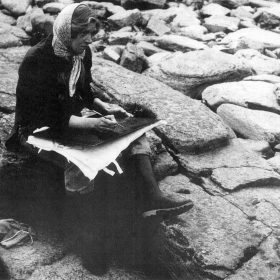
Frances Walker is renowned for her lifelong engagement with remote and elemental landscapes. Born in Kirkcaldy, she studied at Edinburgh College of Art before taking up a post as visiting teacher of art across the Hebrides. Living and working amongst the islands of Harris and North Uist instilled in Walker a profound connection to wild and desolate places, shaping the course of an extraordinary career devoted to the observation of landscape, weather and the passage of time.
Since those formative years in the Western Isles, Walker has continually sought out some of the most remote environments in Scotland and beyond. Coastal reaches, tidal sands, craggy cliffs, sea-worn rocks and vast open skies recur throughout her paintings, drawings and prints. Her work is distinguished by an exceptional sensitivity to atmosphere and geology, balancing close observation with a deeply emotional response to place. Whether working in watercolour, oil, pastel, gouache or printmaking, Walker captures not only the appearance of landscape but its physical and psychological presence.
After moving to Aberdeen, where she has now lived and worked for more than sixty years, Walker joined the staff of Gray’s School of Art, becoming an influential teacher to generations of Scottish artists. Following her retirement in 1985, she devoted herself fully to her practice, dividing her time between Aberdeen and the Hebrides, particularly Tiree, where her thatched cottage became a long-standing base for painting and drawing expeditions.
Travel has remained central to Walker’s artistic life. Alongside her enduring engagement with Scotland’s islands, she has worked extensively in Iceland, Greenland, Norway, the Canadian Arctic, South Georgia and Antarctica. These journeys have expanded her exploration of extreme and fragile environments, resulting in powerful bodies of work shaped by direct experience of ice, weather and isolation. A major suite of Antarctic paintings was recently bequeathed to The McManus: Dundee’s Art Gallery & Museum and featured in the major exhibition Among the Polar Ice (2019–2020), affirming Walker’s importance as one of Britain’s foremost interpreters of remote landscape.
Printmaking has also played a vital role throughout her career. Walker was a founding member of Peacock Printmakers in Aberdeen, helping to establish one of Scotland’s most important print studios, and her etchings, lithographs and screenprints remain an integral part of her practice. Across all media, drawing sits at the heart of her work, her sketchbooks recording decades of sustained looking and attentive engagement with the natural world.
Walker’s remarkable contribution to British art has been recognised through numerous honours and public collections. Her work is held by the Tate, the British Museum, the National Galleries of Scotland, the Victoria & Albert Museum and many other major institutions. In 2021 she was appointed CBE in the Queen’s Birthday Honours for services to art.
To view prints by this artist please click here.
Photograph by John Cumming
About Charles Hodge Mackie
Mackie was an artist who is notoriously hard to categorise in relation to British art of the time due to his catholic range of influences. He travelled to France for his honeymoon in 1892, where he famously befriended Sereusier and Gauguin. His contact with Gauguin and the Pont Aven school was to have drastic effect on the rest of Mackie’s career, most notably in his use of colour and technique. After discussions with Gauguin, Mackie began to use Japanese oak blocks for his printing; he had previously used cut linoleum.
About John Bellany

John Bellany CBE RA HRSA (1942–2013) was one of the most powerful and uncompromising voices in post-war British art, celebrated for emotionally charged paintings that fused autobiography, symbolism and the traditions of Scottish maritime life. Born into a fishing family in the East Lothian village of Port Seton, Bellany’s upbringing within a deeply rooted Presbyterian and sea-faring community became the enduring foundation of his artistic imagination. The rituals, hardships and folklore of fishing life, alongside themes of mortality, faith, guilt and redemption, would remain central to his work throughout his career.
Bellany studied at Edinburgh College of Art from 1960–1965 before continuing at the Royal College of Art in London from 1965–1968. Emerging at a moment when Scottish painting was increasingly shaped by international modernism, Bellany forged a highly personal visual language influenced by Northern European Expressionism, particularly the work of Max Beckmann and Edvard Munch. His paintings combined intense colour, distorted figuration and recurring symbolic motifs to create psychologically charged narratives that were both deeply personal and universally resonant.
Throughout the 1970s and 1980s Bellany produced some of the most important paintings in contemporary Scottish art. Fishermen, seabirds, harbours, ministers, masks and skeletal figures populate his canvases, often arranged within claustrophobic compositions that explore human vulnerability and spiritual conflict. His work drew unapologetically from his own life and experiences, transforming autobiography into mythic and symbolic drama. At times confrontational and emotionally raw, Bellany’s paintings possess an extraordinary vitality and urgency that challenged traditional boundaries between realism, memory and expression.
One of the defining chapters of Bellany’s career followed his life-saving liver transplant in 1988. During his recovery, he created a remarkable series of self-portraits and hospital paintings that confronted mortality with brutal honesty and profound humanity. These paintings, among the most celebrated of his career, marked a transformation in both subject matter and tone, introducing renewed themes of survival, spirituality and renewal. The resulting body of work remains as an unusual artistic meditation on illness and recovery.
Bellany achieved major international recognition during his lifetime, with work held in the collections of the Museum of Modern Art and the Metropolitan Museum of Art in New York, Tate Britain, the National Galleries of Scotland and numerous major institutions worldwide. He was elected a Royal Academician in 1991 and was appointed CBE for services to art.
In 2012, the National Galleries of Scotland presented a landmark retrospective celebrating Bellany’s seventieth birthday, reaffirming his importance as one of Scotland’s great modern painters.
The Scottish Gallery has long recognised Bellany’s significance within Scottish art and presented a major Festival solo exhibition of his work in 1986.

